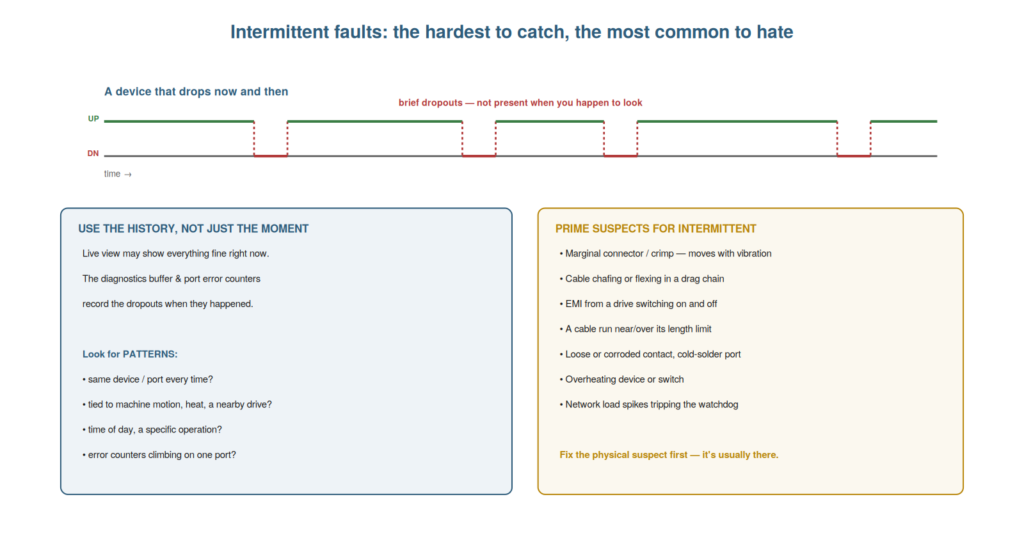
The intermittent fault — a device or network that drops in and out
unpredictably — is the most challenging and often the most hated
PROFINET problem, because the fault may not be present when you look for
it. Diagnosing intermittent faults requires a different, more patient
approach built on history and patterns, and understanding it equips you
for these frustrating problems. This chapter covers intermittent faults
and how to catch them.
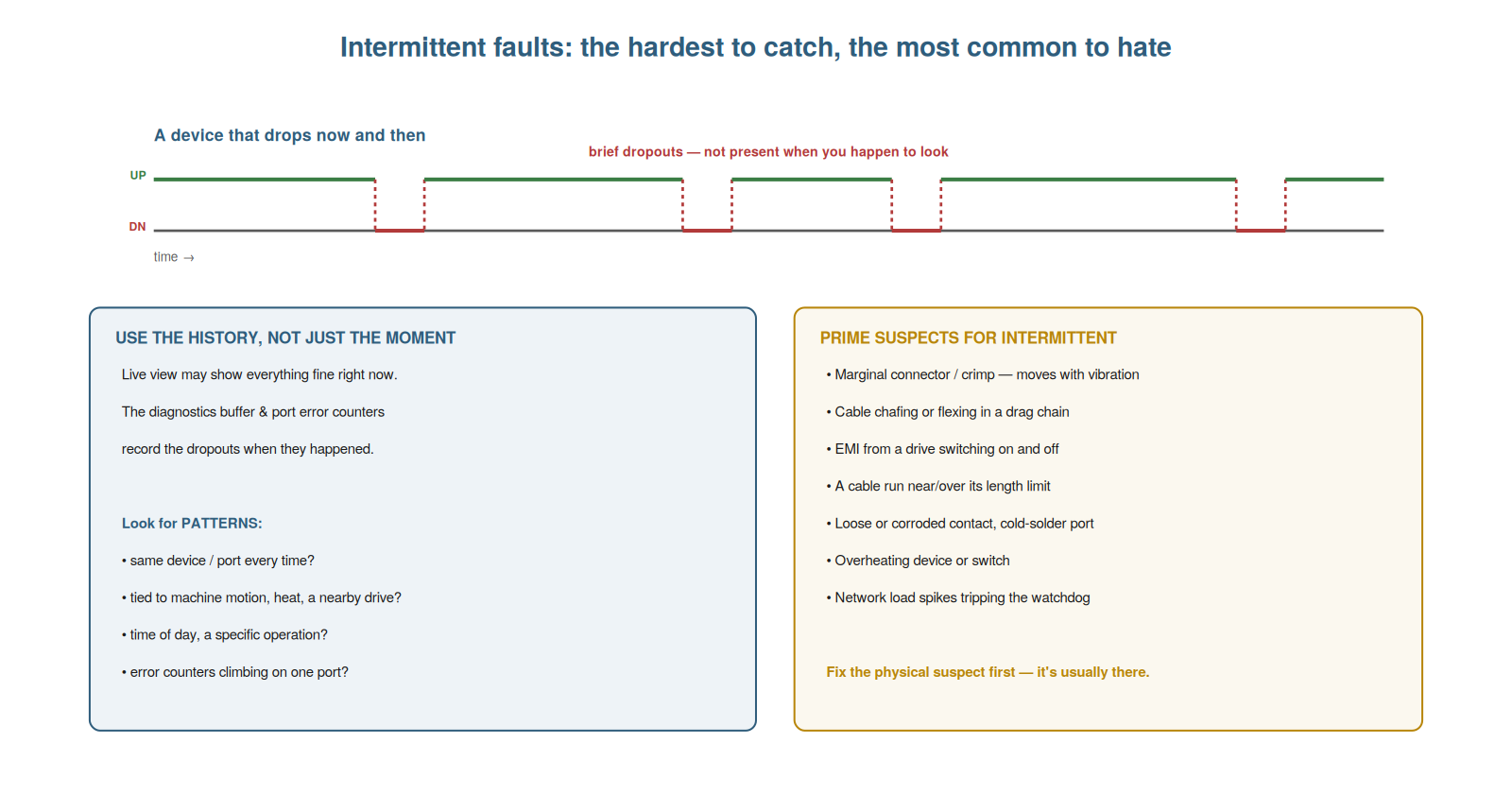
aren’t present when you look. Use the history (diagnostics buffer, port
error counters) rather than the live moment, look for patterns (same
port, tied to machine motion or heat), and suspect the physical:
marginal connectors, flexing cables, EMI, and load spikes.
Using history, not the moment
The key to diagnosing intermittent faults is using the recorded
history rather than the live moment, and understanding this shifts your
approach from catching the fault to reading its record. An intermittent
fault may not be present when you look — the device is fine at the
moment — so live observation alone can miss it entirely. But the
diagnostics buffer and port error counters record what happened over
time: the buffer logs each dropout with a timestamp, and the error
counters accumulate the errors from each intermittent problem. So rather
than trying to catch the fault live, you read its history: the buffer
shows when the device dropped and returned, and the counters show which
ports accumulated errors. This history reveals the intermittent fault
even when it is not currently present, and the pattern of occurrences
begins to point to the cause. So using history, not the live moment, is
the foundation of intermittent-fault diagnosis. Understanding this —
reading the recorded history rather than trying to catch the fault live
— shifts your approach effectively. It reinforces that intermittent
faults are diagnosed through the recorded history (buffer, error
counters) rather than the live moment, which captures the fault even
when it is not currently present. Understanding to use history, not the
moment — reading the diagnostics buffer and port error counters that
record intermittent dropouts over time rather than trying to catch the
fault live — is the foundation of diagnosing intermittent faults, so
that instead of the frustrating and often futile attempt to observe a
fault that is not currently present, you read its recorded history,
which captures the dropouts and errors when they occurred and begins to
reveal the pattern that points to the cause, turning the elusive
intermittent fault into something you can investigate through its
record.
Finding the pattern
The decisive step in diagnosing an intermittent fault is finding the
pattern in its occurrences, and understanding how to look for patterns
turns the history into a diagnosis. The recorded occurrences of an
intermittent fault usually have a pattern, and finding it points to the
cause. Look for patterns in several dimensions: is it always the same
device or port (pointing to that specific link or hardware)? Is it tied
to a machine action — movement, a drive starting, heating up (pointing
to a physical or noise cause triggered by that action)? Is it tied to a
time of day or a specific operation (suggesting a related condition)?
Are the error counters climbing on one particular port (localizing a
degrading link)? So you interrogate the history for these patterns: same
place, same trigger, same timing, climbing errors. The pattern that
emerges points to the cause — a fault always on one port tied to machine
motion strongly suggests a cable flexing there. Understanding how to
find the pattern — interrogating the history across place, trigger,
timing, and error accumulation — turns the record into a diagnosis. It
reinforces that finding the pattern in an intermittent fault’s
occurrences (same port, tied to an action, climbing errors) points to
the cause. Understanding how to find the pattern — examining the
recorded occurrences for consistency of place (same device or port),
trigger (tied to a machine action or condition), timing, and error
accumulation — turns the history of an intermittent fault into a
diagnosis, so that the pattern that emerges from the record (a
particular port always dropping when a nearby drive starts, or error
counts climbing on one link) points to the specific cause, which is how
the patient, history-and-pattern approach cracks the intermittent faults
that defy live observation and so often frustrate straightforward
troubleshooting.
The prime suspects
Because intermittent PROFINET faults are overwhelmingly physical,
knowing the prime suspects focuses your investigation, and understanding
them lets you check the likely causes directly. The usual causes of
intermittent faults are physical and marginal: a marginal connector or
crimp that moves with vibration (making and breaking contact), a cable
chafing or flexing in a drag chain (intermittently damaged), EMI from a
drive switching on and off (corrupting frames when active), a cable near
or over its length limit (marginal signal), a loose or corroded contact
or cold-solder joint, an overheating device or switch (failing when
hot), or network load spikes tripping the watchdog. So the prime
suspects are marginal physical conditions — connectors, flexing cables,
noise, heat, marginal length — plus load spikes. Knowing these lets you
check the likely causes directly: inspect and reseat connectors, examine
cables in drag chains, consider nearby noise sources, check for heat,
and consider load. And the guidance is to fix the physical suspect
first, since it is usually there. Understanding the prime suspects — the
marginal physical conditions behind most intermittent faults — focuses
your investigation on the likely causes. It reinforces that intermittent
faults are usually physical and marginal (connectors, flexing cables,
noise, heat, marginal length, load spikes), so you check these prime
suspects directly. Understanding the prime suspects for intermittent
faults — the marginal connectors, flexing or chafing cables,
intermittent EMI, marginal cable lengths, loose or corroded contacts,
overheating hardware, and load spikes — focuses your investigation on
the causes that are overwhelmingly responsible, so that once the pattern
has pointed you to a location or trigger, you check these likely
physical culprits directly, fixing the physical suspect first because
that is where intermittent PROFINET faults almost always live, which is
the efficient way to resolve these challenging come-and-go problems.
Provoking an intermittent fault safely
A technique that can help with intermittent faults is carefully
provoking the fault to catch it, and understanding how to do this safely
can turn an elusive fault into an observable one. If a pattern suggests
a trigger — the fault appears with machine movement, vibration, or a
particular action — you can sometimes provoke it deliberately to observe
it: gently flexing or wiggling a suspect cable or connector while
watching the link status (a marginal connection will show as the link
flickering when disturbed), or running the machine action that triggers
it while monitoring. When provoking the fault reproduces it — wiggling a
connector drops the link — you have caught and localized it. This must
be done safely: with the machine in a safe state, aware that provoking a
fault could disturb operation, and within your site’s rules. So
carefully provoking an intermittent fault, when a trigger is suspected,
can catch and localize it. Understanding how to provoke an intermittent
fault safely — gently disturbing a suspect connection or running a
trigger while observing — can turn an elusive fault observable.
Understanding how to provoke an intermittent fault safely — gently
flexing a suspect cable or connector while watching the link status, or
running a suspected trigger while monitoring, always with the machine in
a safe state and within your site’s rules — can turn an elusive
intermittent fault into an observable, localizable one, so that when a
pattern suggests a physical trigger, you can carefully reproduce the
fault (a wiggled connector dropping the link) to confirm and locate it,
which is a powerful technique for catching the marginal physical faults
that otherwise refuse to appear when you look, provided it is done
safely and responsibly.
Scenario: the fault that moved with the machine
A scenario shows the history-and-pattern approach cracking an
intermittent fault. A device dropped out intermittently, never present
when the technician looked, defying live diagnosis. He turned to the
history: the diagnostics buffer showed the dropouts, and reading their
pattern against what the machine was doing, he found they consistently
coincided with a particular machine movement — the device dropped
whenever a certain axis moved to its extreme. This pattern pointed to a
physical cause tied to the movement. He examined the cabling in the area
of that movement and found a cable that was stretched or flexed at the
axis extreme, intermittently breaking the connection. Securing and
rerouting the cable to avoid the strain resolved the fault. The history
revealed the pattern, and the pattern pointed to the movement-related
physical cause. This scenario shows the history-and-pattern approach
cracking an intermittent fault tied to machine movement. Understanding
to use the history and find the pattern let the technician tie the
dropouts to a machine movement and thence to a strained cable. It
reinforces that the history reveals intermittent dropouts and their
pattern (here tied to a movement), pointing to the physical cause. The
scenario reinforces the intermittent-fault method: the technician
cracked an elusive fault by reading the buffer history, finding the
dropouts coincided with a machine movement, and tracing that to a
strained cable, illustrating how the patient history-and-pattern
approach — rather than futile live observation — catches intermittent
faults by revealing the pattern that points to the physical cause, here
a cable strained by a specific machine movement.
Temperature and time-of-day patterns
A subtle class of intermittent-fault pattern involves temperature and
time of day, and understanding these helps you catch faults tied to
thermal or daily cycles. Some intermittent faults correlate with
temperature: a device or connection that fails when hot (after the
machine has run a while, or in a hot part of the day) and works when
cool, pointing to a thermal problem — a marginal component or connection
affected by heat expansion. Others correlate with time of day: a fault
that appears at a particular time, perhaps tied to a daily event (a
large machine starting elsewhere, a shift change, an environmental
change). Recognizing these patterns — by noting when the faults occur
against temperature and time — points to the thermal or daily-cycle
cause. So understanding temperature and time-of-day patterns helps you
catch faults tied to these cycles, which the buffer’s timestamps help
reveal. Understanding temperature and time-of-day patterns — faults tied
to heat or to daily events — helps you catch intermittent faults with
thermal or daily-cycle causes. Understanding temperature and time-of-day
patterns in intermittent faults — a fault that appears when hot and
clears when cool pointing to a thermal cause, or one tied to a
particular time pointing to a daily event — helps you catch faults tied
to these cycles, so that when reading the history of an intermittent
fault, you look for correlation with temperature (heat expansion
affecting a marginal connection) and time of day (a daily event’s
influence), using the buffer’s timestamps to reveal these patterns,
which catches the thermal and daily-cycle intermittent faults that a
purely spatial view would miss and points to their cause.
Patience and method with the hardest faults
To close, it helps to recognize that intermittent faults reward
patience and method above all, because embracing this attitude is what
carries you through the hardest PROFINET faults. Intermittent faults are
frustrating precisely because they resist the quick look — they are not
there when you check — and the temptation is to give up or guess. But
they yield to patience and method: reading the history, finding the
pattern, suspecting the physical, and carefully confirming. The
technician who approaches an intermittent fault with patience (accepting
it takes time and history) and method (the systematic
history-and-pattern approach) will crack faults that defeat the
impatient. So the right attitude to the hardest faults is patient
method: not quick guessing but the disciplined use of history and
pattern. Embracing this carries you through the intermittent faults that
are the sternest test of troubleshooting. Understanding that
intermittent faults reward patience and method — the disciplined use of
history and pattern — carries you through the hardest faults.
Understanding that intermittent faults reward patience and method above
all — the disciplined reading of history, finding of patterns, and
careful confirmation that cracks faults resisting the quick look — is
the attitude that carries you through the hardest PROFINET faults, so
that instead of giving up or guessing when a fault is not there as you
check, you embrace the patient, methodical approach that uses the
recorded history and emerging pattern to find the elusive cause, which
is what distinguishes the technician who resolves intermittent faults
from the one they defeat, and the right mindset for the sternest test of
troubleshooting.