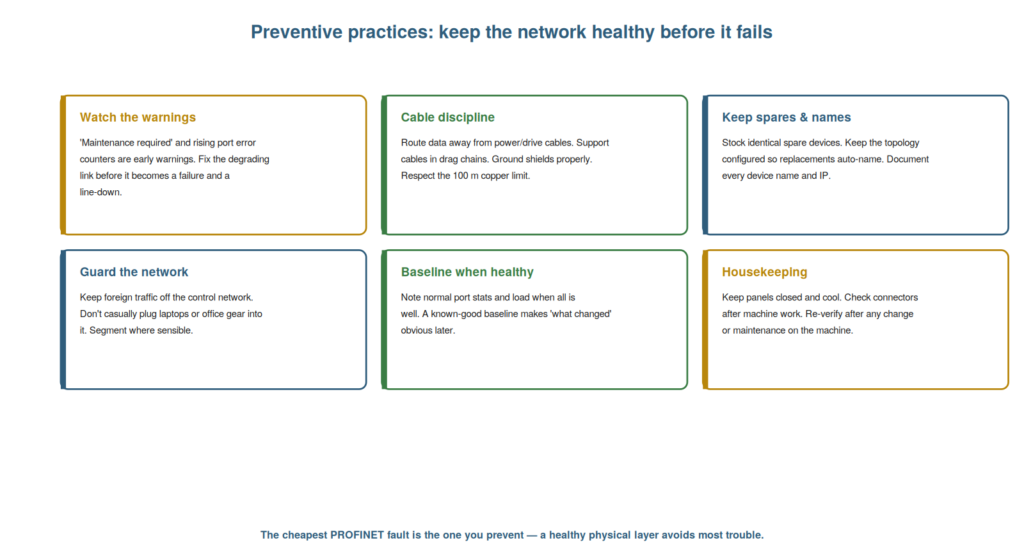
The best PROFINET fault is the one that never happens, and a set of
preventive practices — built around the network’s early warnings and a
healthy physical layer — can head off much trouble. Understanding these
practices lets you keep the network healthy and avoid many faults, which
is more valuable than diagnosing them after the fact. This chapter
covers preventive practices for the maintenance technician.
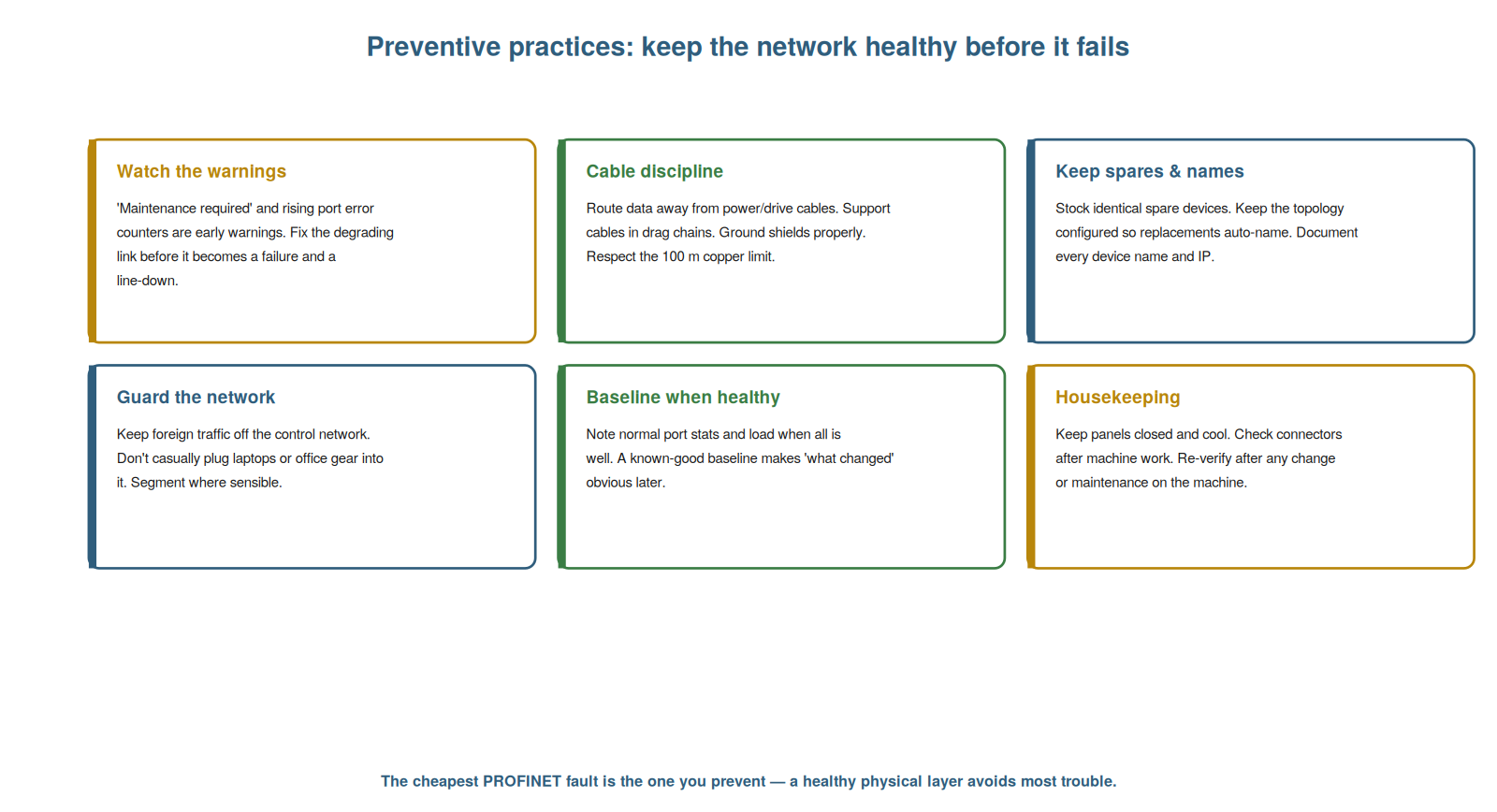
and rising errors, keep cable discipline, stock spares and keep device
names/topology documented, guard the network from foreign traffic,
baseline the network when healthy, and keep up housekeeping. The
cheapest fault is the one you prevent.
Heeding early warnings
The most valuable preventive practice is heeding the network’s early
warnings, and understanding it lets you fix degrading conditions before
they cause failures. PROFINET provides early warnings of degrading
conditions: ‘maintenance required’ indications and rising port error
counters signal a link or component that is degrading but has not yet
failed. Heeding these — investigating and fixing the degrading link at a
convenient time — prevents it from becoming an outright failure and a
line-down. This is the preventive use of the network’s own monitoring:
the warnings are opportunities to fix a problem before it stops the
machine. Ignoring them, by contrast, lets the degradation proceed to
failure, turning an avoidable maintenance task into a breakdown. So
heeding early warnings — acting on maintenance indications and rising
errors — is a powerful preventive practice. Understanding it lets you
fix degrading conditions before they fail. It reinforces that PROFINET’s
early warnings (maintenance indications, rising errors) signal degrading
conditions, and heeding them prevents failures by fixing the degradation
before it fails. Understanding the practice of heeding early warnings —
acting on the ‘maintenance required’ indications and rising port error
counters that signal a degrading link before it fails — lets you fix
degrading conditions preventively, so that you use the network’s own
monitoring to catch and repair problems before they cause failures and
stop the machine, which is a powerful preventive practice that turns
potential breakdowns into convenient, planned maintenance by acting on
the early warnings the network provides rather than waiting for the
failure.
Physical-layer discipline
Since most faults are physical, disciplined care of the physical
layer is a central preventive practice, and understanding what it
involves keeps the network’s most fault-prone part healthy.
Physical-layer discipline means routing data cables away from power and
drive cables (avoiding noise), supporting and protecting cables in drag
chains and where they flex (avoiding fatigue damage), grounding and
bonding shields properly (ensuring noise protection), respecting the 100
m copper segment limit (avoiding marginal signals), and using quality
connectors properly crimped and secured (avoiding connector faults).
Maintaining this discipline keeps the physical layer — where most faults
originate — healthy, preventing many faults before they occur.
Neglecting it, by contrast, invites the noise, fatigue, and connector
problems that cause the majority of faults. So physical-layer discipline
is a central preventive practice, directly addressing where faults most
arise. Understanding what it involves — routing, support, grounding,
limits, quality connectors — lets you keep the physical layer healthy.
It reinforces that physical-layer discipline (proper routing, support,
grounding, respecting limits, quality connectors) keeps the fault-prone
physical layer healthy, preventing many faults. Understanding
physical-layer discipline — routing cables away from noise sources,
supporting them where they flex, grounding shields properly, respecting
the segment limits, and using quality connectors well — is a central
preventive practice, so that you keep the physical layer, where the
majority of faults originate, in good health, preventing many faults
before they occur, which is the most direct preventive measure available
because it addresses the physical causes that account for most PROFINET
trouble, making disciplined physical-layer care one of the highest-value
habits in keeping a network reliable.
Spares, baselines, and guarding the network
Several further preventive practices — keeping spares, baselining the
healthy network, and guarding it from foreign traffic — round out a
preventive approach, and understanding them completes the picture.
Keeping spares means stocking identical replacement devices (so a
failure can be fixed quickly) and, with configured topology, enabling
near plug-and-play replacement. Baselining the healthy network means
noting the normal port statistics and load when all is well, so that
later a comparison makes ‘what changed’ obvious — a known-good reference
for diagnosis. Guarding the network means keeping foreign traffic off
the control network (not casually plugging in laptops or office
equipment, segmenting where sensible), protecting the network from the
overload and disruption that foreign traffic can cause. So these
practices — spares for quick recovery, baselines for reference, guarding
for protection — complement the early warnings and physical discipline.
Understanding them completes the preventive picture. It reinforces that
keeping spares, baselining the healthy network, and guarding it from
foreign traffic are further preventive practices that aid quick
recovery, provide a diagnostic reference, and protect the network.
Understanding the further preventive practices — keeping identical
spares for quick replacement, baselining the healthy network’s
statistics and load as a diagnostic reference, and guarding the network
from foreign traffic that could overload or disrupt it — completes a
rounded preventive approach, so that alongside heeding early warnings
and maintaining physical-layer discipline, you keep spares for fast
recovery, a baseline for spotting what changed, and a guarded network
protected from foreign disruption, which together form a preventive
practice that keeps the network healthy and heads off much of the
trouble that would otherwise require reactive troubleshooting.
Changing the network safely
A final preventive point concerns the safety of changes themselves,
and understanding the line between safe observation and network-altering
changes protects both the machine and your work. Reading and diagnosing
the network — the LEDs, the diagnostics buffer, the topology, the port
statistics, the device web pages, an accessible-devices scan — is safe:
these observe only and change nothing, so you can do them freely, just
as monitoring a program changes nothing. But changing the network —
assigning or changing a device name, changing an IP or subnet,
downloading changed configuration, adding or removing a device, changing
update times or topology, resetting a device, or updating firmware —
touches the running network and must be done deliberately. Before any
such change, back up the project (so you can roll back), know the
machine state, secure the machine and warn operators, and verify after.
So the discipline is to observe freely but change carefully, mirroring
the golden rule of all maintenance work: the diagnostics are safe, the
changes demand care. Understanding this line — safe observation versus
network-altering changes — protects the machine and your work. It
reinforces that reading and diagnosing the network is safe and free,
while changing names, IPs, configuration, or topology touches the
running network and demands the care of backup, awareness, securing, and
verification. Understanding the line between safe observation and
network-altering changes — that reading LEDs, buffers, topology, and
statistics changes nothing and may be done freely, while changing names,
addresses, configuration, or topology touches the running network and
must be done deliberately with backup, awareness, securing, and
verification — protects both the machine and your work, so that you
diagnose freely but change carefully, applying to the network the same
golden rule that governs all maintenance: observe all you like, but
treat every change to the running system with the deliberate care its
real consequences demand.
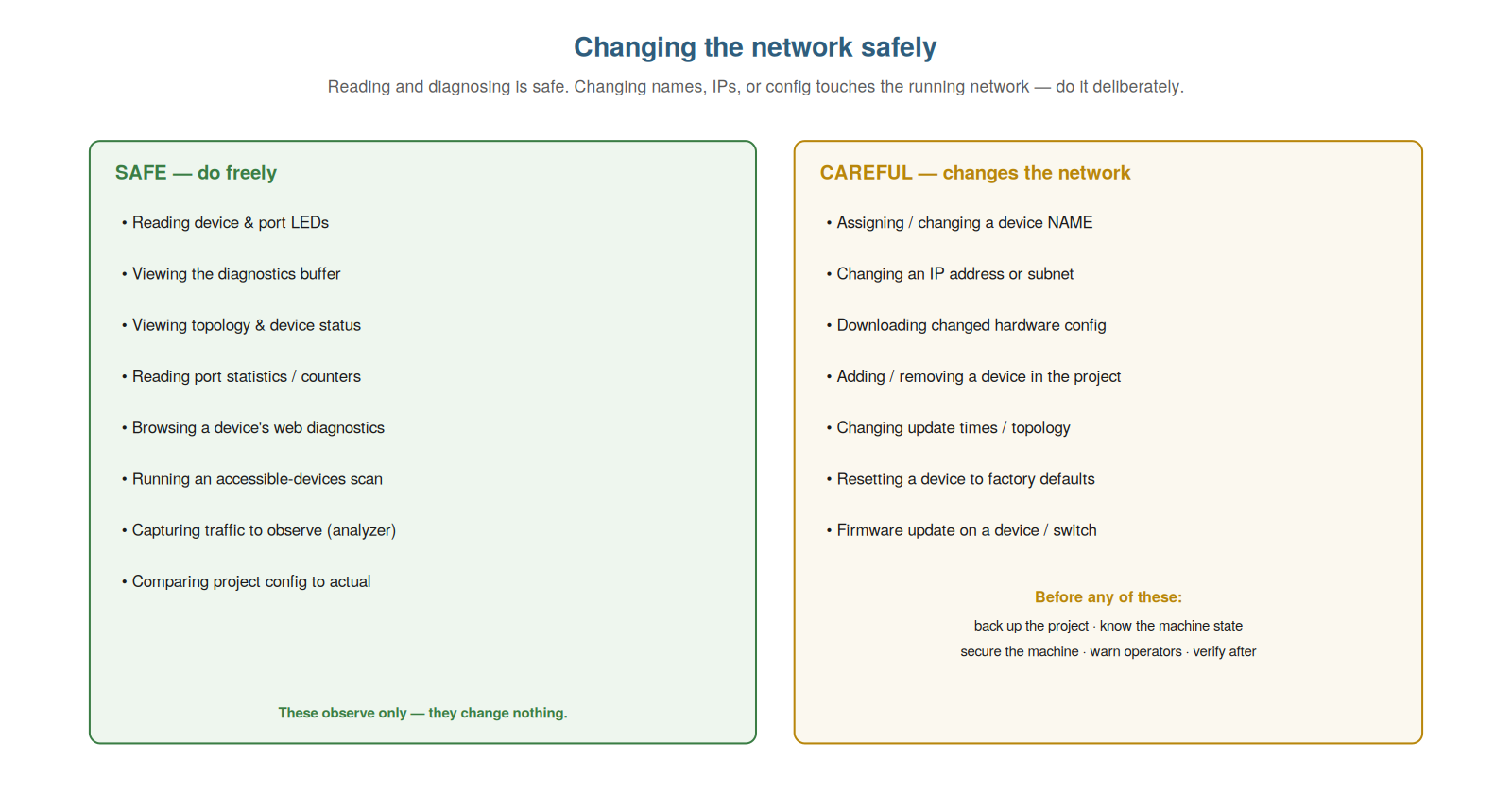
diagnostics buffer, topology, port statistics, and device web pages
changes nothing — do it freely. Assigning names, changing IPs or config,
or altering topology touches the running network — back up, know the
state, secure the machine, warn operators, and verify after.
Periodic health checks
A preventive practice that catches developing problems is the
periodic health check, and understanding it lets you find degrading
conditions on a schedule rather than waiting for failures. A periodic
health check means regularly reviewing the network’s health when nothing
is obviously wrong: reading the diagnostics buffer for any warnings or
intermittent events, checking the port error statistics for links
accumulating errors, noting any ‘maintenance required’ indications, and
comparing against your healthy baseline. Doing this on a schedule (not
just when a fault occurs) catches developing problems early — a link
slowly accumulating errors, an intermittent event recurring quietly —
before they become failures. So the periodic health check is proactive:
it finds the early signs of trouble on a schedule, allowing planned
fixes. This turns the network’s diagnostic information from purely
reactive (read when something breaks) into preventive (reviewed
regularly to catch problems early). Understanding the periodic health
check — regularly reviewing the network’s health to catch developing
problems — lets you find trouble early rather than waiting for failures.
Understanding the periodic health check — regularly reviewing the
diagnostics buffer, port error statistics, and maintenance indications
against your baseline, on a schedule rather than only when a fault
occurs — lets you find developing problems early, so that you catch the
links accumulating errors and the quietly recurring intermittent events
before they become failures, allowing planned fixes, which turns the
network’s rich diagnostic information into a preventive tool through the
simple discipline of reviewing it periodically rather than waiting for
something to break, making the periodic health check a valuable
proactive practice.
Scenario: the health check that prevented a
breakdown
A scenario shows a periodic health check preventing a breakdown.
During a scheduled health check, a technician reviewed the network’s
diagnostics though nothing was obviously wrong. He noticed in the buffer
some intermittent, self-clearing events for one device — brief dropouts
that had not yet caused a noticeable problem — and its port error count
was slowly climbing. Understanding these as early signs of a developing
physical fault, he investigated and found a connector starting to
loosen, which he re-secured. Had he not done the check, the connector
would likely have degraded to an outright failure and a line-down at an
inconvenient time. The periodic health check had caught the developing
fault early and prevented the breakdown. This scenario shows a periodic
health check catching a developing fault before it broke down.
Understanding the value of periodic health checks let the technician
catch the early signs (intermittent events, rising errors) and fix a
loosening connector before failure. It reinforces that periodic health
checks catch developing faults early through the quiet early signs,
preventing breakdowns. The scenario reinforces the value of periodic
health checks: the technician prevented a breakdown by catching a
loosening connector’s early signs — intermittent events and rising
errors — during a scheduled check, illustrating how regularly reviewing
the network’s diagnostics catches developing faults before they fail,
turning a would-be breakdown into a minor planned fix, which is the
preventive value of checking the network’s health proactively rather
than waiting for failures.
Training and shared knowledge
A preventive practice at the human level is training and sharing
knowledge, and understanding its value shows how a team’s competence
prevents and speeds the resolution of faults. A team where the
technicians understand PROFINET and know how to diagnose it will prevent
faults (through good practices) and resolve them faster (through
competence) than one where the network is a mystery to all but a few. So
investing in training — building the team’s understanding of PROFINET
and its troubleshooting — and sharing knowledge (the fault log,
documented resolutions, passing on experience) raises the whole team’s
capability, which both prevents faults and speeds their resolution. This
human factor complements the technical practices: the best documentation
and tools are most effective in the hands of a knowledgeable team. So
understanding the value of training and shared knowledge shows how team
competence is itself a preventive and resolving factor. Understanding
the value of training and shared knowledge — a competent team preventing
and resolving faults better — shows how the human factor complements the
technical practices. Understanding the value of training and shared
knowledge — that a team competent in PROFINET prevents faults through
good practice and resolves them faster through skill, and that sharing
knowledge (fault logs, documented resolutions, passed-on experience)
raises the whole team’s capability — shows how the human factor
complements the technical practices, so that investing in the team’s
understanding and sharing what is learned makes the documentation,
tools, and practices most effective, which is a preventive practice at
the human level that recognizes competence itself, spread across the
team, as a factor in both preventing faults and resolving them
quickly.
A culture of prevention
To close, it helps to see preventive practices as building a culture
of prevention, because a culture sustains the practices better than
isolated efforts. Individual preventive actions — a health check here,
heeding a warning there — help, but their full value comes when
prevention becomes a culture: a shared, habitual way of working where
heeding warnings, maintaining physical discipline, keeping documentation
current, and doing health checks are simply how things are done. In such
a culture, prevention is sustained and consistent, not dependent on one
person remembering. So building a culture of prevention — where the
preventive practices are shared habits — makes prevention durable and
effective across the team and over time. This is the deeper aim: not
just individual preventive acts but a way of working that keeps the
network healthy consistently. Understanding preventive practices as
building a culture of prevention — shared, sustained habits — makes
prevention durable. Understanding preventive practices as building a
culture of prevention — where heeding warnings, physical discipline,
current documentation, and health checks become shared, habitual ways of
working rather than isolated efforts — makes prevention durable and
consistent, so that the full value of the preventive practices comes
when they become a culture sustained across the team and over time, not
dependent on one person remembering, which is the deeper aim of
preventive maintenance: a way of working that consistently keeps the
network healthy through shared habits of prevention rather than sporadic
individual acts.