Push buttons are among the simplest—and most frequently used—devices in electrical control systems. They allow an operator to manually start, stop or control part of a machine by temporarily opening or closing a circuit.
Most industrial push buttons are momentary devices. This means the contacts change state only while the button is being pressed. Once released, the button returns to its normal position.
Two contact types appear most often: normally open and normally closed.
Normally Open Push Button
A normally open push button is abbreviated as NO.
When the button is not pressed, its electrical contact remains open, so current cannot flow through the circuit.
When the button is pressed, the contact closes and allows current to pass.
Normally open push buttons are commonly used as:
- Start buttons
- Reset buttons
- Jog controls
- Manual activation commands
A green START button is a familiar example.
Typical terminal numbers for a normally open push-button contact are:
- 1–2
- 3–4
The exact numbering depends on the manufacturer, so the markings on the contact block should always be checked.
Normally Closed Push Button
A normally closed push button is abbreviated as NC.
When the button is not pressed, its contact remains closed and current flows normally.
Pressing the button opens the contact and interrupts the circuit.
Normally closed push buttons are commonly used for:
- Stop commands
- Control-circuit interruption
- Contactor coil circuits
- Fault-reset arrangements
A red STOP button often uses a normally closed contact.
This arrangement is useful because a broken wire or loose connection can also interrupt the circuit and stop the machine. That provides a more fail-safe result than using a normally open stop command.
Typical NC terminal numbers may include:
- 3–4
- 11–12
- 21–22
Again, manufacturer markings take priority.
Start and Stop Circuit Example
In a basic motor-control circuit:
- The normally closed STOP button is wired in series with the contactor coil.
- The normally open START button is pressed.
- The contactor coil energizes.
- An auxiliary holding contact keeps the coil energized after the START button is released.
- Pressing STOP opens the control circuit.
- The contactor drops out and disconnects the motor.
The push button does not normally carry the motor’s full current. It controls the smaller current used by the contactor coil.
Push-Button Symbols
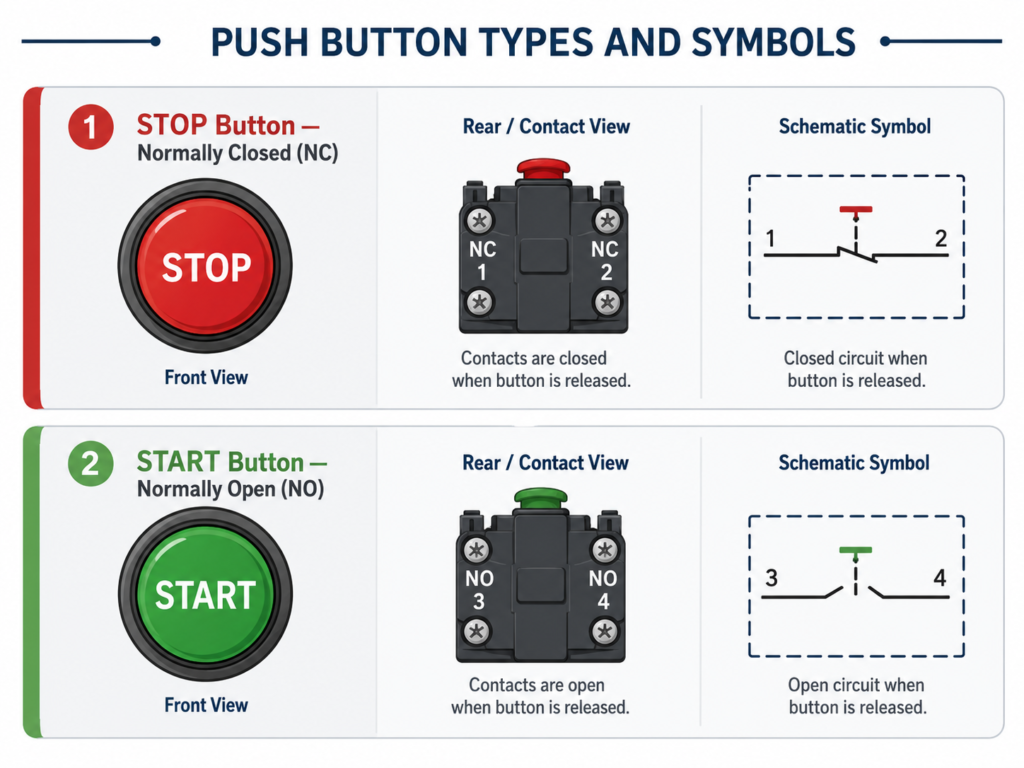
In schematic diagrams, push buttons are shown using contact symbols together with a mechanical operating mark.
The drawing represents the contact in its normal, unpressed position.
Therefore:
- A normally open symbol is drawn open.
- A normally closed symbol is drawn closed.
Push buttons may be identified by reference letters such as S, SB or another project-specific designation.
Final Thoughts
Normally open push buttons create a circuit when pressed, while normally closed buttons interrupt it.
NO contacts are commonly used for START commands. NC contacts are normally preferred for STOP commands.
Understanding the normal contact position, terminal numbering and schematic symbol makes control-circuit wiring much easier to follow and troubleshoot.