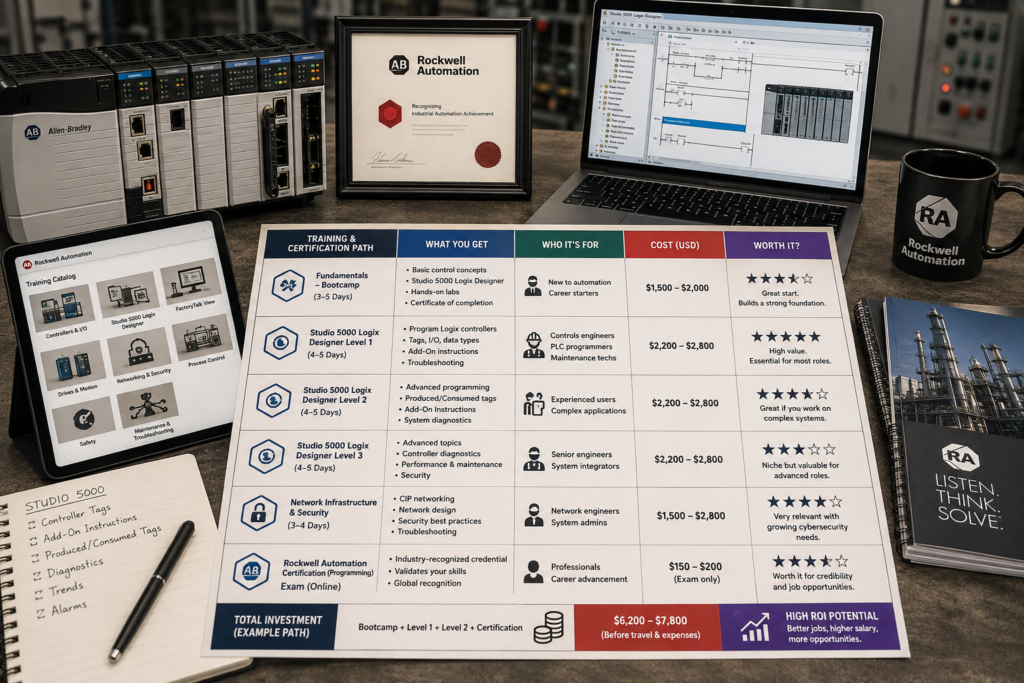
Official Rockwell Automation training is expensive.
A single Studio 5000 course can cost more than a used PLC training setup, while a complete programmer pathway may require several courses, travel and time away from work. That leads to an obvious question:
Does a Rockwell certificate actually help you get hired or promoted, or are you mostly paying for a logo?
The honest answer is that Rockwell training can be extremely valuable when your employer pays for it or your work already involves Allen-Bradley equipment. It is much harder to justify when a complete beginner is paying personally and expecting the certificate alone to produce a controls-engineering job.
The training is recognised. Real experience still carries more weight.
Training Certificate and Certification Are Not the Same
Rockwell offers ordinary training courses and structured certificate programmes.
Completing one course such as Studio 5000 Logix Designer Level 2: Basic Ladder Logic Programming proves that you attended that course.
The structured Logix, drives and motion certificate programmes require a defined training path followed by an assessment. After the candidate’s training record is approved and the final assessment is passed, Rockwell issues a Certificate of Achievement.
That distinction matters on your CV.
Write:
Studio 5000 Logix Designer Level 2 — Rockwell Automation
when you completed one course.
Use a title such as:
Accelerated Logix5000 Programmer Certificate Level 1
only after completing the corresponding programme and assessment.
The Main Rockwell Training Paths
| Path | Intended for | Best career fit |
|---|---|---|
| Logix Programmer | People developing PLC applications | PLC programmers and controls engineers |
| Logix Maintainer | People troubleshooting existing systems | Maintenance and automation technicians |
| Advanced Logix Programmer | Experienced Studio 5000 programmers | Senior programmers and integrators |
| PowerFlex Drives | Drive configuration and troubleshooting | Maintenance and commissioning |
| Kinetix Motion | Servo programming and maintenance | Motion-control specialists |
| Learning+ | Online and virtual learning | Flexible employer-funded development |
Choosing the correct path matters more than collecting the largest number of certificates.
Logix Programmer Path
The traditional programmer route includes several courses:
- CCP146: ControlLogix system fundamentals
- CCP151: Basic ladder-logic programming
- CCP143: Project development
- An approved elective
- Final assessment
Together, the first three courses already represent eight classroom days before the elective and assessment. The programme covers ControlLogix hardware, Studio 5000, ladder programming and complete project development.
Rockwell also offers an accelerated route.
The Accelerated Logix5000 Programmer Certificate Level 1, course CCP250, condenses the route into an intensive five-day course with the assessment included. It is intended for people who can learn the Logix5000 environment quickly and who already satisfy the stated prerequisite requirements.
An experienced technician moving into programming may benefit from CCP250.
A complete beginner may struggle because accelerated training moves quickly through hardware, terminology, Studio 5000 navigation and application development. Five days can introduce the platform. It cannot replace months of writing and testing programs.
Logix Maintainer Path
The maintainer path is better suited to technicians responsible for machines that are already operating.
The accelerated CCP300 Logix5000 Maintainer Certificate Level 1 course covers:
- ControlLogix hardware
- Studio 5000 navigation
- Uploading and downloading
- I/O and tag monitoring
- Ladder-logic interpretation
- Hardware troubleshooting
- EtherNet/IP faults
- Distributed I/O problems
- Electrical noise and field-device faults
The five-day course includes the certificate examination. Rockwell states that participants should already have wiring-diagram experience, recent Logix training and current working experience with Logix5000 systems.
That last point is important.
The maintainer certificate is not designed to turn someone with no industrial background into an independent controls technician in one week. It works best when the student already sees real ControlLogix or CompactLogix equipment at work and can immediately apply the training.
For a maintenance technician, this route may provide more value than the programmer certificate.
Your employer may care more about whether you can diagnose a failed I/O module, communication fault or missing field signal than whether you can design a complete machine program from zero.
Drives and Motion Certificates
Rockwell also provides separate certificate paths for PowerFlex drives and Kinetix motion systems.
The PowerFlex 750 route combines configuration and startup with maintenance and troubleshooting, plus additional elective training and an assessment.
The Kinetix 5700 paths are more extensive. The programmer route combines Studio 5000 fundamentals and project development with motion fundamentals and Kinetix programming. The maintainer route focuses more heavily on motion-system interpretation and troubleshooting.
These specialist paths make sense when your plant or customers actually use the relevant equipment.
A Kinetix certificate has limited immediate value when your workplace contains only basic VFD-driven conveyors. In a high-speed packaging, robotics or motion-control environment, it can be highly relevant.
How Much Does Rockwell Training Cost?
There is no single worldwide price. Courses are priced by country, delivery method and regional training organisation.
Official 2026 examples show substantial differences:
- In Poland, remote CCP151 ladder-logic training is listed at 2,437 PLN, while the accelerated CCP250 programmer certificate course is 5,556 PLN.
- In the Czech Republic, CCP250 is listed at approximately €1,602, while the accelerated maintainer programme is approximately €1,885.
- In Ireland, the remote CCP250 programmer programme is listed at approximately €2,651.
- In the UK, some full Logix courses exceed £2,000, with accelerated certificate programmes priced above that level.
Travel, accommodation and lost working time can increase the real cost considerably.
The traditional programmer path may require several individually priced courses. Depending on location, the total can easily reach several thousand euros before travel.
This is why official Rockwell training is commonly purchased by employers rather than individuals.
Do Employers Recognise It?
Yes—but normally as supporting evidence rather than a substitute for experience.
A current Amcor advanced controls-engineering vacancy lists Rockwell certifications covering Logix programming, PowerFlex drives and Kinetix motion as desirable. The same position also asks for at least five years of relevant manufacturing and automation experience.
That is a realistic picture of how certification is treated.
Employers may use it to confirm that:
- You received structured platform training.
- Your knowledge was assessed.
- You understand Rockwell terminology and workflows.
- You are serious about developing within the platform.
- You may need less introductory training.
It does not prove that you can independently commission a production line, diagnose an intermittent network fault or safely modify unfamiliar machinery.
A candidate with a certificate and no projects will usually lose to someone with several years of strong ControlLogix experience.
When two candidates have similar experience, the certificate can become a useful advantage.
When the Training Is Worth It
Your employer pays
In this case, it is normally worth taking.
You receive structured instruction, guided laboratory work and time away from normal breakdown pressure to focus on the platform. Rockwell’s certificate programmes are specifically built around practical exercises and formal assessment.
The main cost to you is time and effort.
You already work with Allen-Bradley systems
Self-funding may be reasonable when the training can lead directly to:
- A promotion
- Greater PLC access
- A maintenance-to-controls transition
- Commissioning responsibility
- A higher-paying Rockwell-focused position
Ask your manager whether completing the programme would materially change your responsibilities or pay before spending several thousand euros.
You want to work in a Rockwell-heavy market
Rockwell training has more value in North America and in companies standardised on Allen-Bradley equipment.
It may be less useful in a local market dominated by Siemens, Beckhoff or Mitsubishi unless you are targeting a specific employer or international commissioning work.
You are building a contracting speciality
Certification may increase credibility with clients using Rockwell systems, especially when combined with commissioning references.
Contractors are still hired primarily because they can deliver results independently. The certificate strengthens the evidence; it does not become the evidence.
When It Is Probably Not Worth It
Official training is difficult to justify when:
- You have never worked around industrial machinery.
- You have no access to Studio 5000 after the course.
- Local employers rarely use Rockwell equipment.
- You expect the certificate to guarantee employment.
- Paying for it would consume most of your savings.
- You have not yet learned basic PLC and electrical concepts.
A beginner may gain more from a lower-cost PLC course, electrical troubleshooting practice, simulation and a small documented project.
Once you have entered a Rockwell-based plant or integrator, the official maintainer or programmer path becomes much more valuable because every lesson connects to real equipment.
How to Get the Maximum Value
Before attending, learn the fundamentals:
- PLC scan cycle
- Digital I/O
- Tags and addressing
- Basic ladder logic
- Motor controls
- Electrical schematics
- IP addressing
During the course, record practical procedures rather than merely copying slides.
Afterward, apply the material through a real or simulated project:
- Create a controller project.
- Configure I/O.
- Build a motor routine.
- Add alarms and feedback.
- Simulate field failures.
- Practise uploading, downloading and going online.
- Document a troubleshooting process.
Without continued practice, an expensive five-day course can become a faint memory surprisingly quickly.
Final Verdict
Official Rockwell training is good training.
It is structured, platform-specific and recognised by employers using Allen-Bradley equipment. The programmer, maintainer, drives and motion paths also provide clearer evidence than a generic online course-completion certificate.
It is almost certainly worth taking when your employer pays.
It may be worth self-funding when you already have industrial experience, regularly use Rockwell equipment and can connect the certificate to a specific career opportunity.
For a complete beginner paying personally, the return is less certain. A certificate costing several thousand euros cannot compensate for having no electrical knowledge, no troubleshooting experience and no real projects.
The strongest combination is:
Official Rockwell training + regular Studio 5000 access + real machine experience + documented project results
The certificate may help you pass the initial CV scan.
What you have done with ControlLogix equipment is what normally gets you hired.
Allen-Bradley, ControlLogix, CompactLogix, Studio 5000, PowerFlex and Kinetix are trademarks of Rockwell Automation. This article is independently produced and is not affiliated with or endorsed by Rockwell Automation.