This closing chapter covers working safely and well — the safety awareness the control-circuit technician must have, the good practices that make troubleshooting effective, and a worked example drawing the book together — because skill without safety and good practice is incomplete. The 24 volt side is relatively safe, but it lives in a panel of lethal voltages, and working safely and methodically is part of being a good technician. This chapter closes the book with safe working, good practice, and the compass to carry forward.
Respecting the whole panel
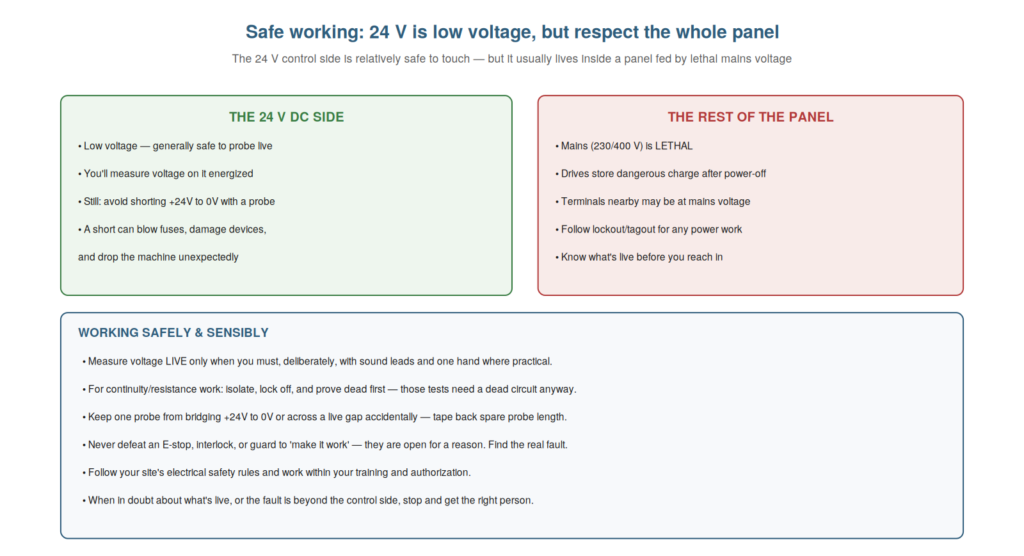
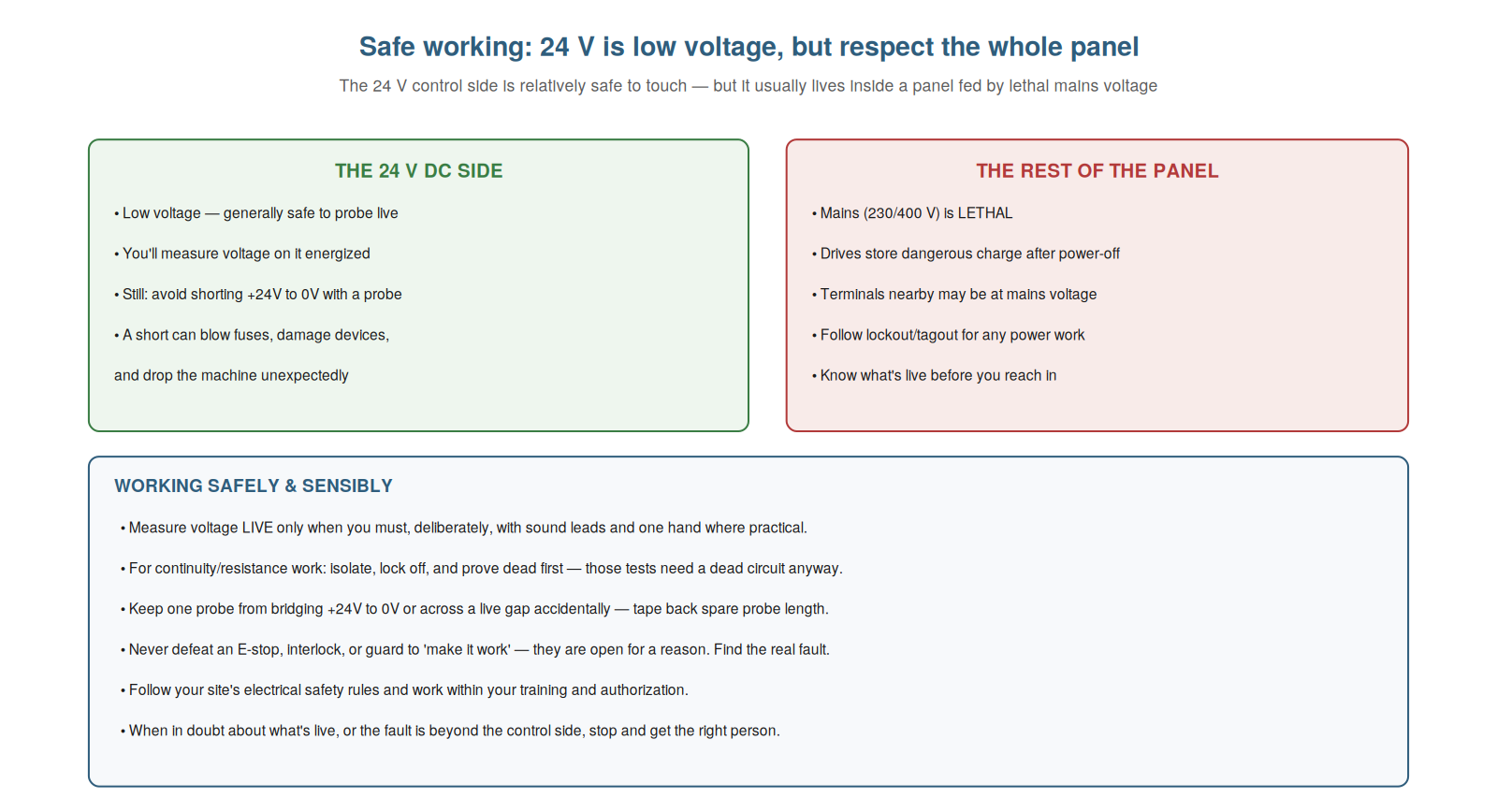
The essential safety understanding for control-circuit work is that the 24 volt side is relatively safe but the whole panel is not, and understanding this keeps you safe while working on the control circuit. The 24 volts DC control side is low voltage — generally safe to probe live, which is why you measure it energized — but it lives inside a panel that is also fed by lethal mains voltage (230 or 400 volts), and may contain drives that store dangerous charge even after power-off, and terminals at mains voltage close to the control wiring. So while the 24 volt side itself is relatively safe, reaching into the panel exposes you to the lethal parts around it. Respecting the whole panel means knowing what is live and dangerous before you reach in, keeping clear of the mains-voltage parts, following lockout/tagout for any work on the power side, and never assuming the whole panel is as safe as the 24 volt side. So the understanding is: safe control voltage, dangerous surroundings — respect the whole panel. Understanding to respect the whole panel — the safe 24 volt side within a panel of lethal voltages — keeps you safe while working on the control circuit. It reinforces that the 24 volt side is relatively safe but the panel contains lethal mains and stored charge, so you respect the whole panel and know what is live. Understanding to respect the whole panel — that the 24 volt DC control side is relatively safe to work on live but lives inside a panel fed by lethal mains voltage, with drives that store charge and terminals at dangerous voltages nearby — keeps you safe while troubleshooting the control circuit, so that you take advantage of the low-voltage side’s relative safety to measure it live while never forgetting the lethal parts around it, knowing what is live before you reach in, keeping clear of mains-voltage components, and following proper safety procedures for any power-side work, which is the essential safety awareness that lets you work confidently on the control circuit without being harmed by its dangerous surroundings.
Working safely and sensibly
Beyond respecting the panel, several specific safe-working practices apply, and understanding them keeps your control-circuit work safe and sound. Measure voltage live only when you must, deliberately, with sound leads and (where practical) one hand, to minimize risk. For continuity and resistance work, isolate, lock off, and prove dead first — those tests need a dead circuit anyway, so there is no reason to work live. Take care that a probe does not accidentally bridge +24V to 0V or across a live gap (which can blow fuses, damage devices, or drop the machine) — tape back spare probe length. Never defeat a safety device — an E-stop, interlock, or guard — to make the machine work; they are open for a reason, and the right action is to find the real fault. Follow your site’s electrical safety rules and work within your training and authorization. When in doubt about what is live, or when the fault is beyond the control side, stop and get the right person. So these practices — deliberate live measurement, isolation for dead tests, probe care, never defeating safety, following rules, knowing your limits — keep the work safe and sound. Understanding these safe-working practices keeps your control-circuit troubleshooting both safe and effective. Understanding the specific safe-working practices — measuring live only when necessary and deliberately, isolating and proving dead for continuity work, avoiding accidental probe bridging, never defeating safety devices, following site rules, and knowing when to stop and get help — keeps your control-circuit work safe and sound, so that you apply the concrete practices that protect you and the machine: deliberate live measurement, proper isolation for dead tests, careful probing, absolute respect for safety devices, adherence to the rules, and the good judgment to escalate when a fault or a voltage is beyond your scope, which together make your troubleshooting both safe and effective as a matter of consistent good practice.
A worked fault, end to end
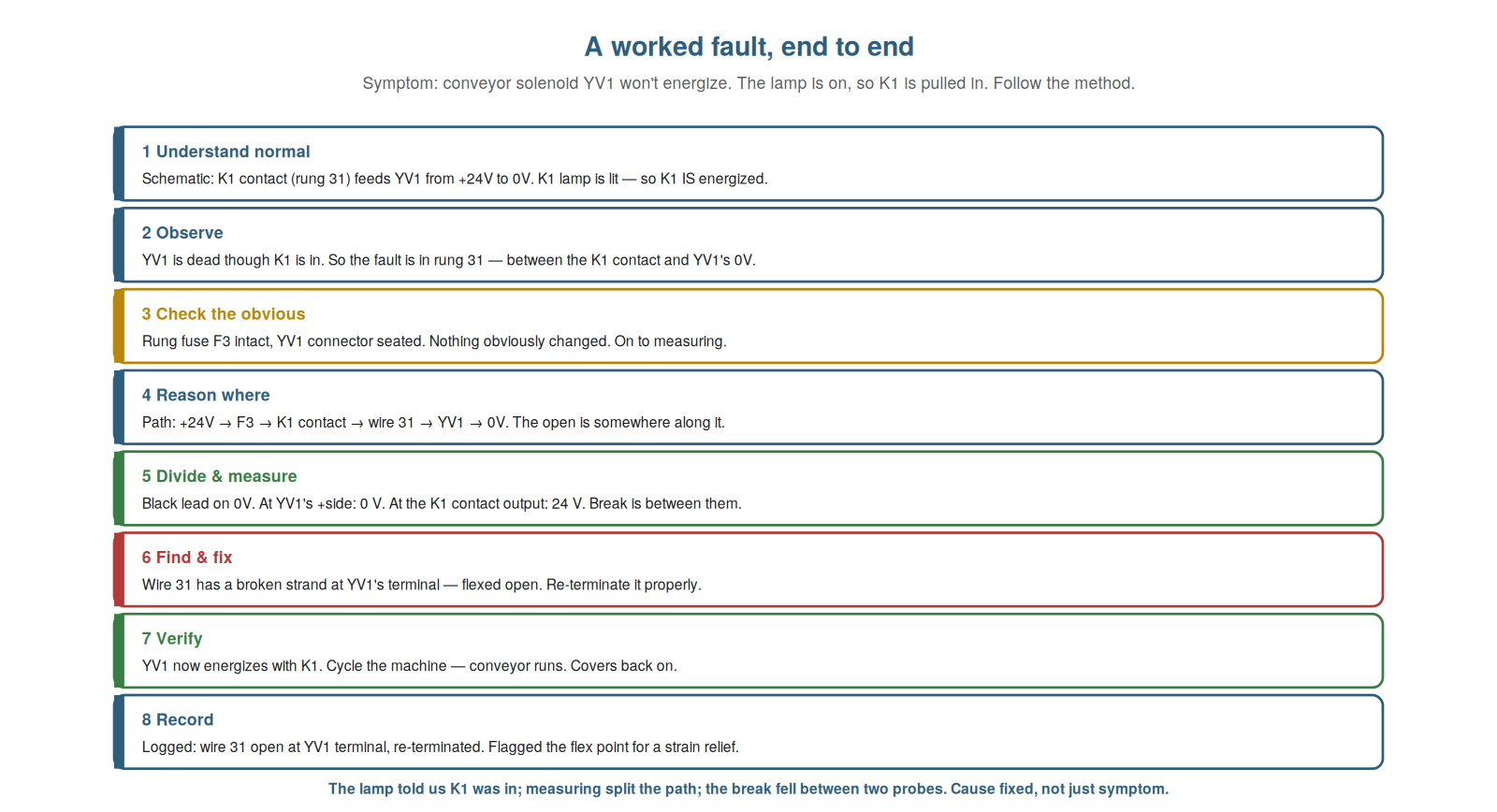
To draw the book together, a worked fault shows the whole method flowing from symptom to fix. Suppose a conveyor’s solenoid YV1 will not energize, though its lamp is on. Step one, understand normal: the schematic shows a K1 contact feeding YV1 from +24V to 0V, and the lit lamp means K1 is energized. Step two, observe: YV1 is dead though K1 is in, so the fault is in that rung, between the K1 contact and YV1’s 0V. Step three, check the obvious: the rung fuse is intact, YV1’s connector seated, nothing obviously changed. Step four, reason where: the path is +24V through the fuse, the K1 contact, wire 31, YV1, to 0V — the open is somewhere along it. Step five, divide and measure: black lead on 0V, at YV1’s positive side you read 0 volts, at the K1 contact output 24 volts — the break is between them. Step six, find and fix: wire 31 has a broken strand at YV1’s terminal, flexed open; you re-terminate it properly. Step seven, verify: YV1 now energizes with K1, the conveyor runs, covers back on. Step eight, record: logged the open at YV1’s terminal, flagged the flex point. The method flowed from symptom to fix. Understanding this worked fault shows the whole method in action, from understanding normal through dividing to fixing the cause and verifying. It reinforces that the method flows on a real fault: understand, observe, check obvious, reason, divide, fix cause, verify, record. Understanding a worked fault from end to end — the solenoid that would not energize, diagnosed by understanding normal, observing that K1 was in but YV1 dead, checking the obvious, reasoning the path, dividing with the meter to find the break between two probes, fixing the cracked wire properly, and verifying and recording — shows the whole method in action, so that you see the book’s systematic approach flow smoothly from symptom to fix on a real fault, the lamp telling you K1 was in, the measurement splitting the path, and the break falling between two probes, which demonstrates how the individual skills combine into the coherent method that resolves control-circuit faults, cause fixed rather than symptom patched.
The four habits to carry forward
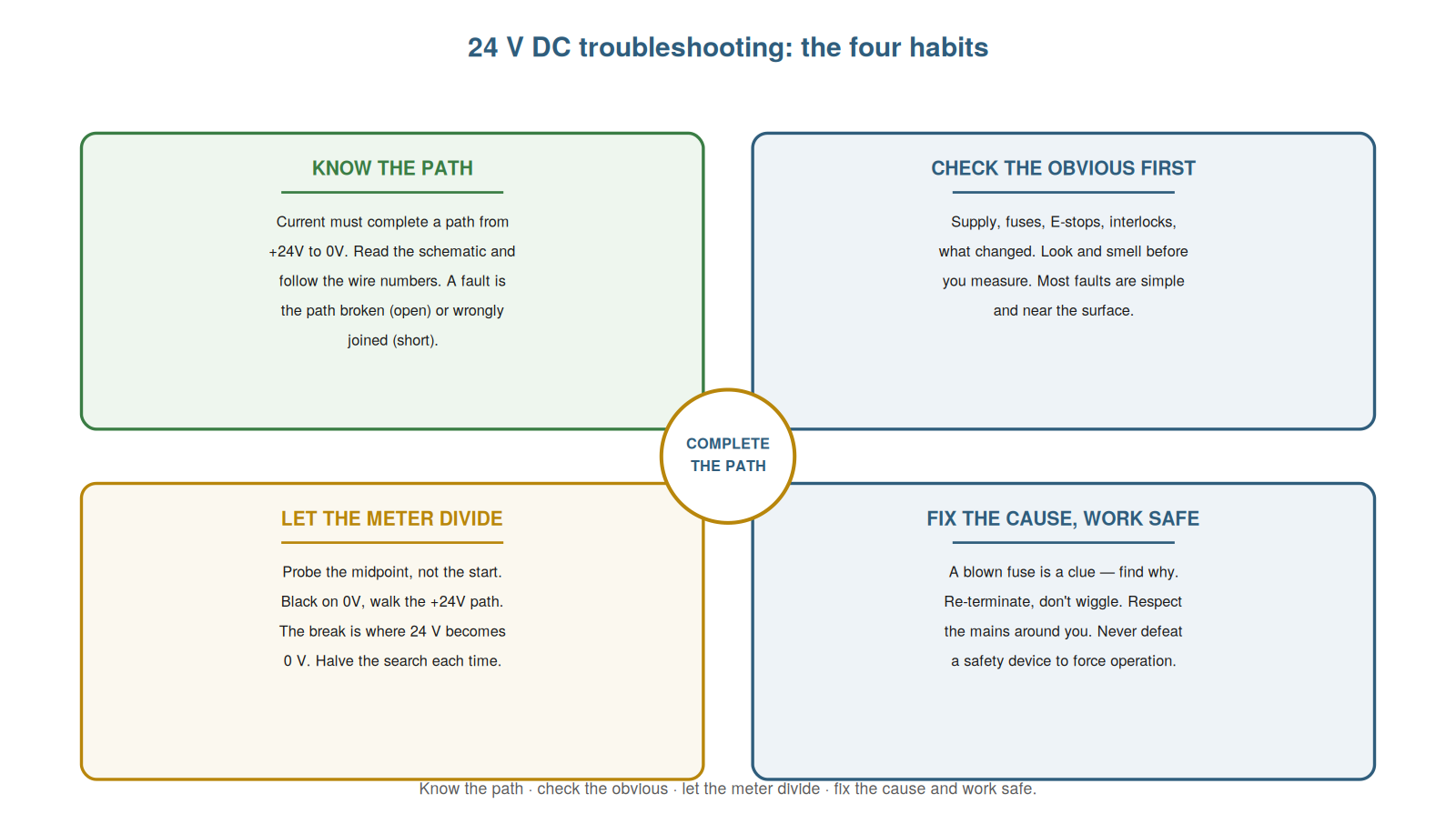
To close, the book’s compass distills into four habits to carry forward, and understanding them as your guiding practice equips you for confident control-circuit troubleshooting. Know the path: current must complete its journey from +24V to 0V, so read the schematic, follow the wire numbers, and see every fault as the path broken (open) or wrongly joined (short). Check the obvious first: the supply, fuses, safety devices, and recent changes — look and smell before you measure, because most faults are simple and near the surface. Let the meter divide: probe the midpoint, not the start; walk the +24V path from a 0V reference; find where 24 volts becomes 0 volts, halving the search each time. Fix the cause, and work safe: a blown fuse is a clue — find why; re-terminate rather than wiggle; respect the mains around you; never defeat a safety device. These four habits — know the path, check the obvious, let the meter divide, fix the cause and work safe — hold the whole book’s method in a form you can carry to every fault. Understanding them as your guiding practice equips you for confident, effective, safe control-circuit troubleshooting. The quiet low-voltage world behind the power becomes, with these habits, a circuit you can read, measure, and repair with assurance — and that competence, applied and grown through real work, makes you the technician who gets the machine running again. Understanding the four habits to carry forward — know the path, check the obvious first, let the meter divide, and fix the cause while working safe — equips you for confident control-circuit troubleshooting, so that you carry the book’s whole method as four guiding habits you apply to every fault, seeing the circuit as a path to complete, checking the obvious before measuring, letting the meter halve the search, and fixing causes safely, which together turn the 24 volt DC control circuit from an intimidating unknown into a system you can read, measure, and repair with the calm assurance of a capable maintenance technician.
Proving dead before you trust it
A specific safety practice worth understanding is proving dead — verifying a circuit is actually de-energized before working on it as if dead — because assuming dead without proving it is a dangerous mistake. When you isolate a circuit to work on it dead (for continuity testing, or any work that requires it de-energized), you must prove it is dead rather than assume it: use your meter (confirmed working on a known live source) to verify no voltage is present where you will work. This matters because isolation can fail or be incomplete — the wrong switch opened, a back-feed from another source, a mislabeled isolator — leaving the circuit live when you believe it dead. The discipline of proving dead (test the meter on a known live source, test the isolated circuit to confirm it reads zero, test the meter again on the known source to confirm it still works) catches these, so you never work on a circuit you wrongly believe is dead. So understanding to prove dead before trusting it — verifying de-energization rather than assuming it — is an essential safety practice, especially given the mains voltages in the panel. Understanding to prove dead before you trust it — verifying with a confirmed-working meter that an isolated circuit is actually de-energized rather than assuming it — is an essential safety practice, so that before working on a circuit as if dead you prove it dead (testing your meter on a known live source, confirming the isolated circuit reads zero, and re-confirming the meter still works), which catches the failed or incomplete isolation — the wrong switch, a back-feed, a mislabeled isolator — that could leave a circuit live when you believe it dead, a discipline especially important given the lethal mains voltages present elsewhere in the panel and one that protects you from the serious danger of working on a wrongly-assumed-dead circuit.
Scenario: knowing what was live
A scenario shows respecting the whole panel preventing a dangerous mistake. A technician needed to work on a control circuit inside a panel, and the 24-volt work itself was safe enough to do live. But being mindful that the panel also contained mains-voltage parts, he first identified what was live and dangerous around his work area — and noticed that a set of terminals right beside the control wiring he needed to reach were at 400 volts. Rather than reaching in carelessly (which could have brought his hand or a tool near the lethal terminals), he worked carefully, keeping clear of the mains terminals, and where he needed to work near them, isolated and proved dead first. Respecting the whole panel — knowing what was live before reaching in — kept him safe from the lethal parts surrounding the safe 24-volt side. This scenario shows respecting the whole panel keeping the technician safe from lethal parts. Understanding to respect the whole panel led the technician to identify the live mains terminals and work safely around them. It reinforces that respecting the whole panel — knowing what’s live before reaching in — protects you from the lethal parts around the safe 24-volt side. The scenario reinforces respecting the whole panel: the technician stayed safe by identifying the live mains terminals beside his 24-volt work before reaching in, and keeping clear of or isolating them, illustrating how the essential safety awareness — that the safe 24-volt side lives among lethal voltages — protects you by making you know what is live before you reach into the panel, rather than being lulled by the control side’s relative safety into carelessness around the dangerous parts.
Backing up the PLC program
A good practice worth understanding on PLC-based machines is keeping a backup of the PLC program, because it protects against losing the control logic and aids some diagnoses. On a machine whose control centers on a PLC, the program is the logic of the control circuit — and it exists only in the PLC (and, hopefully, a backup). Keeping a current backup of the program protects against its loss (a failed PLC, a corrupted program) that would otherwise be catastrophic, since the logic could not be restored. A backup also aids diagnosis: you can reference the program to understand the intended logic, and compare the running program to the known-good backup to see if it has changed. So keeping a PLC program backup — current, safe, and accessible — is an important good practice on PLC machines, protecting the control logic and supporting diagnosis. Understanding its value encourages maintaining the backup as part of good practice. So understanding to back up the PLC program — protecting the control logic and aiding diagnosis — is an important good practice on PLC-based machines. Understanding the good practice of backing up the PLC program — keeping a current, safe copy of the program that holds the control logic of a PLC-based machine — protects against the catastrophic loss of logic that a failed PLC or corrupted program would cause and aids diagnosis by providing a reference to the intended logic and a known-good version to compare against, so that you maintain the program backup as part of good practice on PLC machines, which safeguards the control logic that exists only in the PLC and supports troubleshooting by letting you reference and compare the program, an important practice for the many machines whose control depends on a PLC.
Your control-circuit journey
To close the book, it is fitting to reflect on the journey from here, because troubleshooting skill continues to grow with experience beyond what any book provides. This book has given you the map: the understanding of the 24-volt DC control circuit, the building blocks, the meter, the fault types and their methods, the systematic approach, and the compass of know the path, check the obvious first, let the meter divide, and fix the cause while working safe. But the map is the beginning; the journey continues as you apply it to real faults, building the experience that turns method into intuition. Each fault you resolve deepens your competence; each pattern you recognize sharpens your instinct; the fault log you keep and the knowledge you share compound your capability. So the journey from here is one of growing mastery through practice, with this book as the foundation and real experience as the teacher. The quiet low-voltage world behind the power becomes, through this journey, a circuit you read, measure, and repair with assurance — and that journey, from here, is yours to walk. Understanding the journey from here — growing mastery through applying the book’s foundation to real faults — frames the book as a beginning built upon by experience. Understanding your control-circuit troubleshooting journey from here — the growing mastery that comes from applying this book’s foundation of understanding, building blocks, meter skill, fault methods, systematic approach, and compass to real faults, building the experience that turns method into intuition — frames the book as a beginning rather than an end, so that you carry its map into the real work where each resolved fault deepens your competence, each recognized pattern sharpens your instinct, and the knowledge you log and share compounds your capability, the confident control-circuit troubleshooter being made not by the book alone but by its foundation built upon through the experience that is yours, from here, to gain.