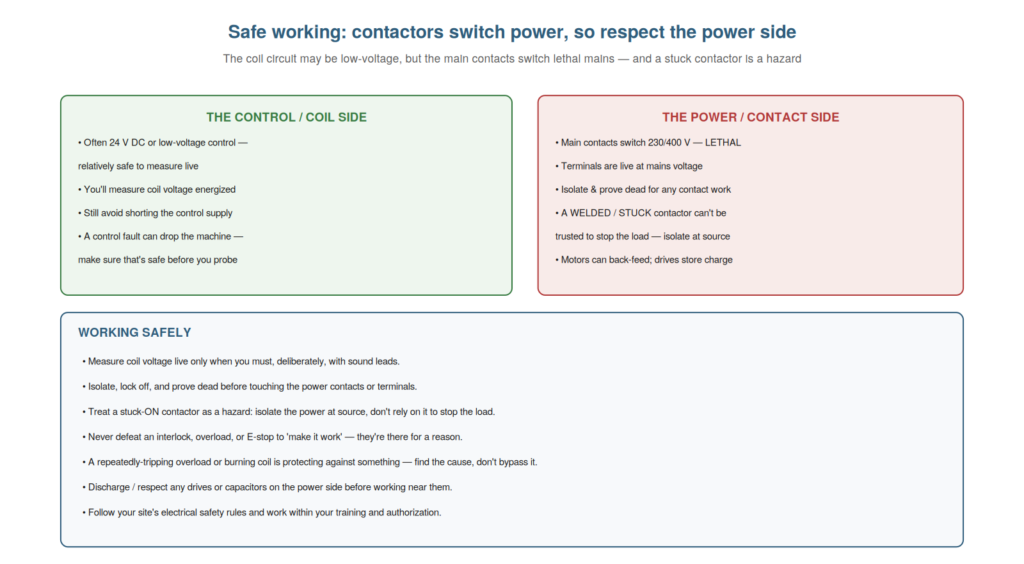
This closing chapter covers working safely and well — the safety awareness the contactor and relay technician must have, the good practices that make troubleshooting effective, a worked example drawing the book together, and the compass to carry forward — because skill without safety and good practice is incomplete. The coil side may be low-voltage, but the contacts switch lethal power, and a stuck contactor is a hazard, so working safely and methodically is part of being a good technician. This chapter closes the book.

Respecting the power side
The essential safety understanding is that a contactor’s coil side may be safe but its contacts switch lethal power, and understanding this keeps you safe while working. The control/coil side is often low-voltage (24 V DC or similar) and relatively safe to measure live — which is how you check coil voltage. But the main contacts switch the power circuit at mains voltage (230 or 400 V), which is lethal, and the contactor’s power terminals are live at these voltages. So while measuring the coil may be safe, working on or near the power contacts and terminals exposes you to lethal voltage. Respecting the power side means isolating and proving dead before touching the power contacts or terminals, knowing what is live before you reach in, and being aware that motors can back-feed and drives can store charge. So the understanding is: the coil side may be low-voltage, but the power side the contacts switch is lethal — respect it. Understanding this keeps you safe: you take advantage of the coil side’s relative safety for measurement while treating the power side with full caution. So understanding respecting the power side — safe coil, lethal contacts — keeps you safe while troubleshooting. Understanding to respect the power side — that a contactor’s coil side may be low-voltage and safe to measure live but its main contacts switch lethal mains voltage, with live power terminals, back-feeding motors, and charge-storing drives — keeps you safe while working, so that you use the coil side’s relative safety to measure coil voltage while isolating and proving dead before touching the power contacts or terminals and knowing what is live before reaching in, which is the essential safety awareness that lets you troubleshoot contactors and relays without being harmed by the lethal power their contacts switch.
The stuck contactor and safety devices
Two specific safety points deserve emphasis: the hazard of a stuck contactor and never defeating a safety device, and understanding them prevents dangerous mistakes. A stuck-on contactor (welded or held in) is a particular hazard because it means a load you cannot stop by the normal control — a motor running uncontrolled. So you must isolate the power at its source to stop and safely work on it, and never rely on the stuck contactor or the normal control to stop the load. And never defeating a safety device — an interlock, an overload, an E-stop — is essential: these are there for a reason (an interlock preventing a dangerous combination, an overload protecting the motor, an E-stop for emergencies), and defeating one to ‘make the machine work’ removes protection and can cause serious harm. If a safety device is preventing operation, you find and fix the real reason (or recognize it is correctly doing its job), never bypass it. Understanding these two points — isolate a stuck contactor at source, never defeat a safety device — prevents the dangerous mistakes most tempting under pressure. So understanding the stuck-contactor hazard and never defeating safety devices prevents dangerous mistakes. Understanding the stuck contactor and safety devices — the stuck-on contactor as a hazard requiring isolation at source (never relying on it or the normal control to stop the load) and the absolute rule never to defeat an interlock, overload, or E-stop to force operation — prevents dangerous mistakes, so that you treat an uncontrollable stuck contactor by isolating the power at its source and you never bypass a safety device that is preventing operation (finding the real reason or recognizing it is doing its job instead), which avoids the serious harm that removing protection or trusting a stuck device could cause and reflects the safety-first discipline essential to contactor and relay work.
A worked fault, end to end
To draw the book together, a worked fault shows the whole method flowing from symptom to fix. Suppose a motor starts but drops out the instant the operator releases the start button — it will not stay running. Step one, understand normal: it is a start/stop seal-in, so the contactor KM1 should hold itself in through its own aux contact after start is released. Step two, observe: it runs only while start is held, dropping out on release — so the seal-in is not holding. Step three, check the obvious: control voltage present, overload not tripped, stop circuit fine — and the coil clearly energizes with start (the motor starts). Step four, coil or contacts?: the coil does energize (the motor starts with start held), so the fault is the seal-in contact, not the coil. Step five, divide and measure: with start held (KM1 in), measure across the seal-in aux contact — it reads full voltage, so it is not closing. Step six, find and fix: the aux contact is worn and not making; replace the aux contact block (or the contactor). Now it seals in. Step seven, verify: press and release start — the motor keeps running; stop drops it out cleanly. Step eight, record: logged the worn seal-in aux contact, replaced. The method flowed from symptom to fix. Understanding this worked fault shows the whole method in action. Understanding a worked fault from end to end — the motor that would not stay running, diagnosed by understanding the seal-in, observing it dropped out on release, checking the obvious, recognizing the coil energized so the fault was the seal-in contact, measuring across the aux contact to find it not making, replacing it, and verifying and recording — shows the whole method in action, so that you see the book’s systematic approach and its pivotal ‘coil or contacts?’ question flow smoothly from symptom to fix on a real fault, the coil working so the diagnosis turned to the contact, which demonstrates how the individual skills combine into the coherent method that resolves contactor and relay faults, cause fixed rather than symptom patched.

The four habits to carry forward
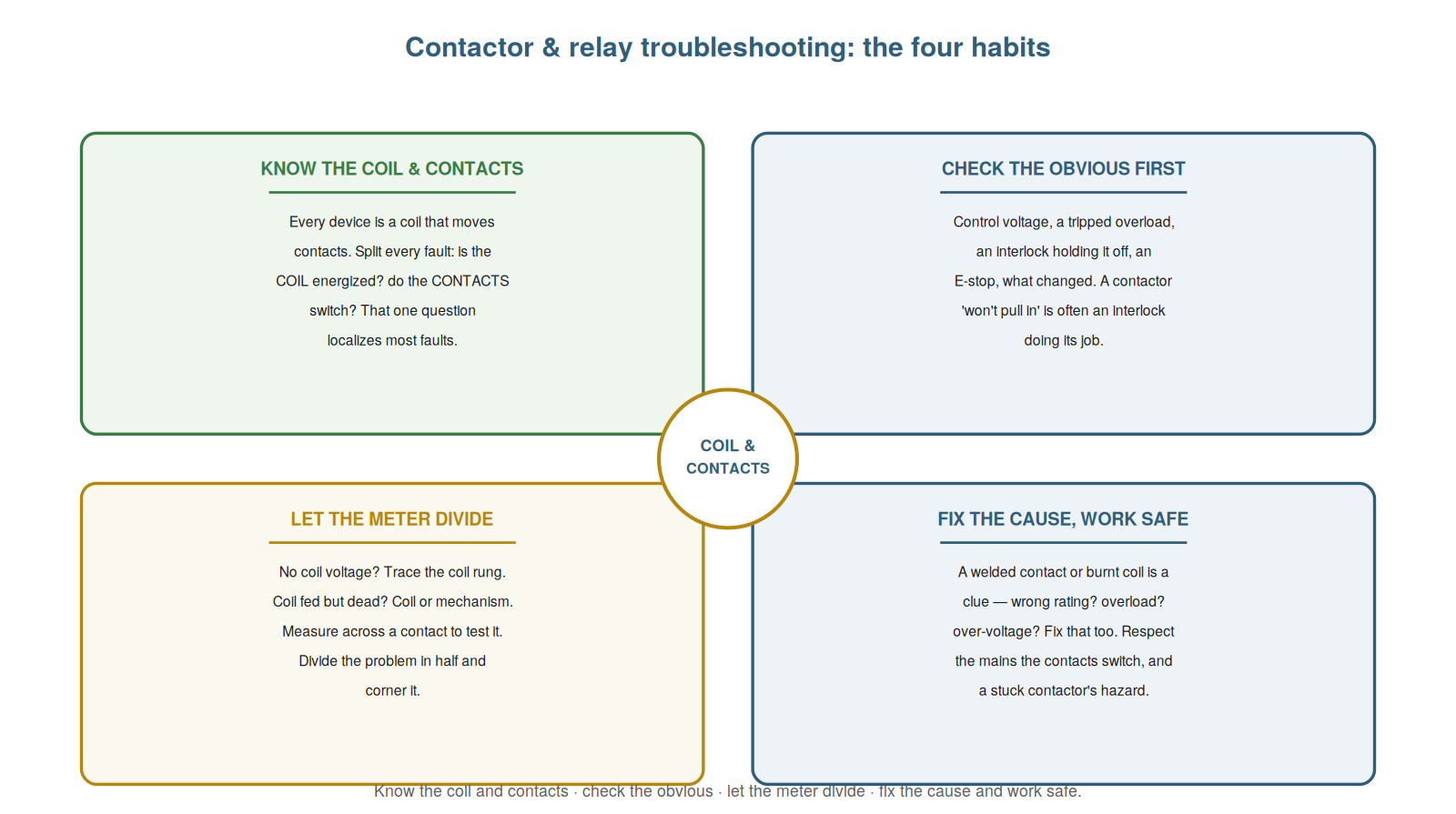
To close, the book’s compass distills into four habits to carry forward, and understanding them as your guiding practice equips you for confident contactor and relay troubleshooting. Know the coil and the contacts: every device is a coil that moves contacts, so split every fault — is the coil energized? do the contacts switch? — which localizes most faults at once. Check the obvious first: the control voltage, a tripped overload, an interlock holding it off, an E-stop, what changed — a contactor that ‘won’t pull in’ is often an interlock or overload doing its job. Let the meter divide: no coil voltage means trace the coil rung; coil fed but dead means the coil or mechanism; measure across a contact to test it; divide the problem in half and corner it. Fix the cause, and work safe: a welded contact or burnt coil is a clue — wrong rating? overload? over-voltage? — fix that too; respect the lethal power the contacts switch, and a stuck contactor’s hazard. These four habits hold the whole book’s method in a form you can carry to every fault. Understanding them as your guiding practice equips you for confident, effective, safe troubleshooting. The muscles of the control panel become, with these habits, devices you can read, measure, and repair with assurance — and that competence, applied and grown through real work, makes you the technician who keeps the plant running. Understanding the four habits to carry forward — know the coil and the contacts, check the obvious first, let the meter divide, and fix the cause while working safe — equips you for confident contactor and relay troubleshooting, so that you carry the book’s whole method as four guiding habits you apply to every fault, splitting each into coil and contacts, checking the obvious before measuring, letting the meter halve the search, and fixing causes safely, which together turn the contactors and relays of the control panel from intimidating unknowns into devices you can read, measure, and repair with the calm assurance of a capable maintenance technician.
Proving dead and the risk of back-feed
A specific safety practice worth understanding is proving dead and being alert to back-feed, because a contactor’s power side can be live even when you think it is isolated. When you isolate the power to work on a contactor’s contacts or terminals, you must prove it dead — verify with a meter (confirmed working on a known live source) that no voltage is present — rather than assume the isolation worked. And you must be alert to back-feed: a motor can be driven by its load (regenerating), or another source can feed into the circuit, making terminals live even when the normal supply is isolated. So isolation may not make everything dead: the wrong isolator, an incomplete isolation, or a back-feed can leave the power side live. Proving dead catches this. Understanding proving dead and back-feed keeps you safe on the power side: you verify de-energization and consider alternative sources before touching the contacts or terminals. So understanding proving dead and the risk of back-feed keeps you safe when working on a contactor’s power side. Understanding the practice of proving dead and the risk of back-feed — verifying with a confirmed-working meter that an isolated power side is actually dead, and being alert that a motor can back-feed or another source can make terminals live despite isolation — keeps you safe when working on a contactor’s power side, so that you prove de-energization rather than assume it and consider back-feed and alternative sources before touching the power contacts or terminals, which catches the failed isolation, wrong isolator, or back-feed that could leave the lethal power side live when you believe it dead, an essential safety practice given the mains voltages a contactor switches.
Scenario: proving dead before reaching in
A scenario shows proving dead preventing a dangerous mistake. A technician needed to work on a contactor’s power terminals and isolated the circuit at what he believed was the correct isolator. Before touching the terminals, following good practice, he proved dead: he tested his meter on a known live source (confirming it worked), tested the contactor’s power terminals (which read zero), and re-confirmed his meter on the live source. The terminals read dead, so it was safe. But had he not proved dead — had he assumed the isolation worked — he would have been at risk if the isolation had been incomplete or the wrong isolator opened. On another occasion, proving dead caught exactly that: the terminals read live despite the isolation, because a back-feed from another circuit kept them energized, which proving dead revealed before he touched them. Understanding to prove dead — not assume — protected him from the lethal power the contacts switch. This scenario shows proving dead preventing contact with unexpectedly live terminals. Understanding to prove dead rather than assume isolation protected the technician from a back-feed. It reinforces that proving dead catches failed isolation and back-feed before you touch the power side. The scenario reinforces safe working: understanding to prove dead — testing the meter, the terminals, and the meter again — rather than assuming isolation protected the technician, once catching a back-feed that left terminals live despite isolation, illustrating how proving dead catches the failed isolation, wrong isolator, or back-feed that could otherwise expose you to the lethal power a contactor’s contacts switch.
Planned replacement and maintenance records
A good practice worth understanding is planned replacement of contactors and relays based on their duty and records, because it prevents failures rather than merely reacting to them. Contactors and relays wear out with use — their contacts have a finite life in operations — so a heavily-cycled device will eventually fail. Rather than waiting for failure (which stops the machine unexpectedly), good practice on critical, heavily-used devices is planned replacement: replacing them before they fail, based on their expected life, their duty, and maintenance records of how long such devices last in the application. Maintenance records support this: logging failures and replacements builds a picture of how long devices last, informing when to replace proactively. Understanding this shifts you from purely reactive (fix when it fails) to partly preventive (replace before it fails) on the devices where an unexpected failure is costly. So planned replacement, informed by records, prevents unexpected failures of worn devices. Understanding planned replacement and maintenance records is a good practice that improves reliability. So understanding planned replacement and maintenance records prevents unexpected failures of worn devices. Understanding the good practice of planned replacement based on duty and records — replacing heavily-cycled critical contactors and relays before they wear out and fail, informed by their expected life and maintenance records of how long they last — prevents unexpected failures rather than merely reacting to them, so that on devices where an unexpected failure is costly you replace proactively before end-of-life, using logged failures and replacements to inform the timing, which shifts you from reactive fixing to preventive replacement and improves reliability by addressing the finite operational life of the contactors and relays that wear out with use.
Your contactor and relay journey
To close the book, it is fitting to reflect on the journey from here, because troubleshooting skill continues to grow with experience beyond what any book provides. This book has given you the map: the understanding of contactors and relays, the control circuits around them, the fault types and their methods, the systematic approach, and the compass of know the coil and the contacts, check the obvious first, let the meter divide, and fix the cause while working safe. But the map is the beginning; the journey continues as you apply it to real faults, building the experience that turns method into intuition. Each fault you resolve deepens your competence; each pattern you recognize sharpens your instinct; the records you keep and the knowledge you share compound your capability. So the journey from here is one of growing mastery through practice, with this book as the foundation and real experience as the teacher. The muscles of the control panel become, through this journey, devices you read, measure, and repair with assurance — and that journey, from here, is yours to walk. Understanding the journey from here — growing mastery through applying the book’s foundation to real faults — frames the book as a beginning built upon by experience. Understanding your contactor and relay troubleshooting journey from here — the growing mastery that comes from applying this book’s foundation of understanding, control circuits, fault methods, systematic approach, and compass to real faults, building the experience that turns method into intuition — frames the book as a beginning rather than an end, so that you carry its map into the real work where each resolved fault deepens your competence, each recognized pattern sharpens your instinct, and the records you keep and knowledge you share compound your capability, the confident troubleshooter being made not by the book alone but by its foundation built upon through the experience that is yours, from here, to gain.