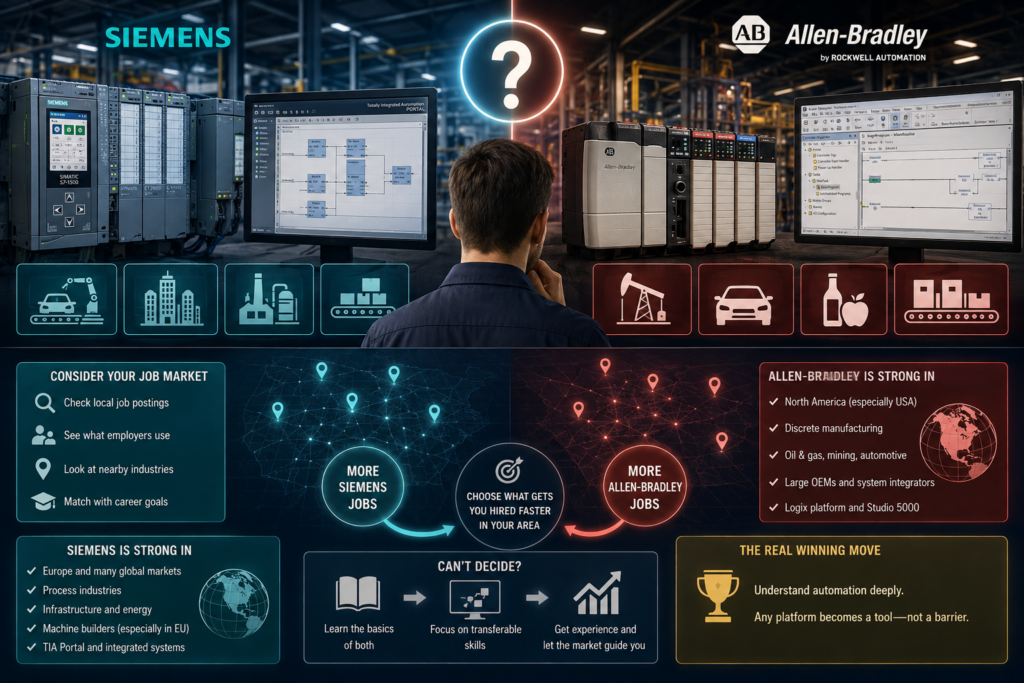
Siemens and Allen-Bradley are both excellent PLC platforms.
That does not mean they are equally useful for your first job.
The best platform to learn first is usually not the one with the nicest interface, the cheapest training hardware or the loudest supporters online.
It is the one used by employers within the market you can realistically enter.
A practical rule is:
Continental Europe
→ Siemens first

United States and much of Canada
→ Allen-Bradley first

Unsure or targeting international commissioning
→ Analyse local vacancies before choosing
That rule is useful, but it is not universal.
A US-owned factory in Europe may standardise on Allen-Bradley. A German machine builder installing equipment in the United States may use Siemens. A warehouse-automation company may expect both. A small local employer may use Mitsubishi, Beckhoff, Omron or CODESYS instead.
The correct question is therefore not:
Which PLC brand is better?
It is:
Which platform gives me the highest chance of getting relevant experience in the next one to two years?
The Quick Answer
| Your target market | Best first choice |
|---|---|
| Lithuania and the Baltic region | Siemens |
| Germany, Austria and much of continental Europe | Siemens |
| European machine building | Siemens |
| European factory maintenance | Usually Siemens |
| United States manufacturing | Usually Allen-Bradley |
| Canadian manufacturing | Often Allen-Bradley |
| UK and Ireland | Check locally; both appear regularly |
| International logistics and warehouse automation | Siemens, Allen-Bradley or both |
| Pharmaceutical and multinational plants | Check the exact employer |
| Current employer already uses one platform | Learn that platform first |
| No local industrial access | Learn the platform most common in 20–30 nearby vacancies |
| Want maximum long-term flexibility | Learn one deeply, then add the other |
For someone based in Lithuania and targeting European automation work, I would start with Siemens TIA Portal, S7-1200/S7-1500 and PROFINET.
I would not ignore Allen-Bradley. I would add it after becoming genuinely useful on Siemens.
Why Your Job Market Matters More Than Online Opinions
PLC programmers regularly argue about which platform is more logical.
You will hear claims such as:
- Siemens is more powerful.
- Allen-Bradley is easier to troubleshoot.
- TIA Portal is too complicated.
- Studio 5000 is too expensive.
- Ladder is clearer in Rockwell.
- Structured programming is better in Siemens.
Some of those opinions contain useful observations.
None of them matters as much as whether nearby employers use the platform.
Suppose you spend six months learning Studio 5000 because an American YouTube channel recommends it. You then search for junior automation work in Lithuania and discover that the vacancies around you repeatedly mention:
- Siemens TIA Portal
- STEP 7
- S7-1200 or S7-1500
- WinCC
- PROFINET
- PROFIBUS
Your Allen-Bradley knowledge is still valuable, but it may not help you enter the market as quickly.
Current Lithuanian vacancies illustrate this pattern. Recent automation positions have specifically requested or preferred Siemens TIA Portal, STEP 7, S7 controllers, WinCC and PROFINET. Examples include controls roles from Dematic, Swisslog, TPA and manufacturing employers. Some multinational commissioning positions also accept Allen-Bradley, but Siemens appears repeatedly across local and EMEA-facing roles.
The market is not static. You should repeat the analysis yourself when beginning your job search.
What Learning Siemens Actually Means
Learning Siemens does not mean memorising how to place one contact and one coil in TIA Portal.
For a modern machine-controls role, the useful Siemens stack commonly includes:
SIMATIC S7-1200 or S7-1500
+
STEP 7 in TIA Portal
+
WinCC
+
PROFINET
+
Distributed I/O
+
SINAMICS drive integration
Siemens positions TIA Portal as a unified engineering environment for SIMATIC controllers, HMI systems, networks and other automation components. STEP 7 is the PLC-programming portion, while WinCC provides panel, PC and plant visualisation options.
Core Siemens skills
A job-ready beginner should learn:
- Hardware configuration
- S7-1200 and S7-1500 CPU selection
- Local and remote I/O
- PLC tags
- Organisation blocks
- Functions and function blocks
- Data blocks
- Instance data
- Ladder Diagram
- Function Block Diagram
- Structured Control Language
- Online comparison
- Diagnostics
- Watch and force tables
- PROFINET device names
- IP configuration
- Basic WinCC screens and alarms
Siemens terminology you should recognise
| Siemens term | General meaning |
|---|---|
| OB | Organisation block or execution entry point |
| FC | Function without retained instance data |
| FB | Function block with associated instance data |
| DB | Data block |
| SCL | Siemens Structured Text implementation |
| LAD | Ladder Diagram |
| FBD | Function Block Diagram |
| Technology object | Configured motion or control object |
| PROFINET device name | Logical device identity used during network configuration |
| Optimised block access | Symbolic data organisation used on modern S7 systems |
You do not need to master every instruction before applying for junior work.
You should understand how a complete Siemens project is structured and how to diagnose why a physical output is not operating.
What Learning Allen-Bradley Actually Means
For modern Rockwell Automation work, the main stack commonly looks like:
CompactLogix or ControlLogix
+
Studio 5000 Logix Designer
+
FactoryTalk View
+
EtherNet/IP
+
PowerFlex drives
+
Distributed I/O
Studio 5000 Logix Designer supports current CompactLogix, ControlLogix and GuardLogix controller families. FactoryTalk View is commonly used for Rockwell HMI and supervisory visualisation projects.
Core Allen-Bradley skills
A useful beginner should learn:
- Controller and chassis configuration
- Local and remote I/O
- Controller-scoped and program-scoped tags
- Tasks
- Programs
- Routines
- Add-On Instructions
- User-defined data types
- Ladder Diagram
- Structured Text
- Function Block Diagram
- Online editing
- Upload and download
- Project comparison
- Produced and consumed tags
- EtherNet/IP device integration
- FactoryTalk View basics
Rockwell terminology you should recognise
| Rockwell term | General meaning |
|---|---|
| Task | Defines when programs execute |
| Program | Container for routines and program-scoped data |
| Routine | Executable Ladder, Structured Text or Function Block code |
| AOI | Reusable Add-On Instruction |
| UDT | User-defined data type |
| Controller tag | Globally available controller data |
| Program tag | Data scoped to one program |
| EtherNet/IP | Common Rockwell-oriented industrial Ethernet protocol |
| Produced/consumed tag | Controller-to-controller data exchange |
| Add-On Profile | Device integration profile used in Studio 5000 |
Current US postings continue to request strong Allen-Bradley and Studio 5000 experience for PLC programming, commissioning and manufacturing support. Siemens-specific US controls positions also exist, so Allen-Bradley dominance should be treated as a regional tendency rather than an absolute rule.
Siemens in the European Job Market
Siemens is normally the safer first choice across much of continental Europe.
That is especially true in:
- General machine building
- Factory automation
- Automotive suppliers
- Packaging
- Food processing
- Water and wastewater
- Material handling
- Building and infrastructure automation
- European system integration
Recent European vacancies include positions requiring Siemens TIA Portal, S7 and associated networks for commissioning, warehouse automation, automotive manufacturing, water treatment and pharmaceutical work.
Why Siemens is a practical EU starting point
Learning Siemens often aligns you with the complete European machine-controls environment:
S7 PLC
→ PROFINET remote I/O
→ WinCC HMI
→ SINAMICS drive
→ European machine builder
You are also likely to encounter older Siemens equipment:
- S7-300
- S7-400
- STEP 7 Classic
- PROFIBUS
- Older WinCC systems
Do not begin your learning with obsolete platforms, but recognise that factory maintenance work may require them.
A sensible order is:
S7-1200/S7-1500 and TIA Portal
→ PROFINET
→ WinCC
→ Older S7-300/400 concepts when required
Lithuania specifically
For someone in Lithuania, Siemens currently offers the clearest first-platform case.
A recent TPA PLC-programmer position listed Siemens TIA Portal, STEP 7 and WinCC as desirable experience. Dematic requested advanced TIA Portal experience for controls-software work, while Swisslog listed Siemens S7 or Beckhoff TwinCAT alongside European networks such as PROFINET and PROFIBUS. A manufacturing automation role also preferred Siemens, TIA Portal and STEP 7 experience.
Current job-board results also show a meaningful number of PLC and automation vacancies in Lithuania, although the search term “PLC” produces some irrelevant shopping-centre results and should not be treated as a precise statistical count.
The local conclusion is still straightforward:
Learn Siemens first unless a specific employer, factory or planned position gives you a better reason to learn something else.
Allen-Bradley in Europe
Allen-Bradley is less dominant across continental Europe, but it is far from irrelevant.
You may encounter it in:
- US-owned European factories
- Pharmaceutical plants
- Large multinational food and beverage companies
- Logistics and warehouse systems
- Automotive projects built around North American standards
- Equipment exported to the United States
- International system integrators
- Plants whose corporate engineering standard originates in North America
A recent EU contract vacancy, for example, sought an Allen-Bradley controls engineer for manufacturing and logistics projects across Europe and specifically required Studio 5000 experience.
This is why the advice should not be:
Europe
→ Never learn Allen-Bradley
It should be:
Europe
→ Siemens normally gives the broadest first opportunity
→ Allen-Bradley can become a profitable specialisation
A European engineer who knows both platforms may be particularly useful to:
- International machine builders
- Multinational manufacturers
- Commissioning companies
- Integrators supporting US customers
- Logistics companies operating across regions
Allen-Bradley in the North American Job Market
For someone intending to work in US manufacturing, Allen-Bradley is normally the safer first choice.
Current US job advertisements frequently request experience with:
- CompactLogix
- ControlLogix
- Studio 5000
- FactoryTalk View
- EtherNet/IP
- PowerFlex drives
One recent Allen-Bradley-focused PLC-programmer vacancy included PLC and HMI design, onsite commissioning, Ethernet/IP integration, PID, motion and industrial troubleshooting. Siemens experience was considered useful but secondary.
However, Siemens remains present in the US, especially in:
- Pharmaceutical manufacturing
- Process automation
- Automotive systems
- International machine building
- European-owned plants
- PCS 7 environments
- High-performance machinery
Current US listings include thousands of Siemens-related controls search results and dedicated Siemens PLC roles. Job-board counts are noisy and should not be interpreted as precise market-share measurements, but they show that Siemens knowledge is commercially useful in North America as well.
The UK and Ireland Are More Mixed
The UK and Ireland do not fit a clean Europe-versus-America rule.
You can find:
- Siemens-heavy machine-building roles
- Allen-Bradley-heavy pharmaceutical roles
- Food and beverage plants using either
- System integrators asking for both
- Legacy Mitsubishi and Omron systems
- Beckhoff and CODESYS-based machinery
Current UK vacancies include positions where either Siemens or Allen-Bradley is preferred, while Ireland has active Allen-Bradley vacancies as well as Siemens-focused engineering positions.
For those markets, analyse the actual industry and location.
Do not choose based on the country alone.
Industry Can Matter More Than Country
Two factories located five kilometres apart may use completely different platforms.
Automotive
Automotive automation may involve Siemens, Allen-Bradley or both, depending on:
- Vehicle manufacturer
- Plant ownership
- Machine builder
- Region
- Corporate standards
- Age of the line
Do not assume every European automotive plant is Siemens.
Food and beverage
Food-processing plants often contain a mixture of equipment purchased over many years.
You may encounter:
- Siemens on packaging lines
- Allen-Bradley on US-supplied equipment
- Schneider on utilities
- Omron on smaller machines
- Mitsubishi on Asian-built machinery
For factory maintenance, multi-platform troubleshooting can become more valuable than deep greenfield programming on one brand.
Pharmaceutical manufacturing
Pharmaceutical and life-science projects may use Siemens, Allen-Bradley, Beckhoff, DeltaV or other process-control platforms.
The employer’s validated systems and corporate standards matter more than national preference.
Warehouse and material handling
Global logistics companies frequently operate across regional standards.
Recent Lithuanian and European warehouse-automation vacancies mention Siemens, Allen-Bradley, Beckhoff, PROFINET and EtherNet/IP in different combinations.
Water and process industries
Siemens PLCs and WinCC are common in European process and infrastructure work, while Allen-Bradley and other DCS or PLC platforms also appear depending on the integrator and end customer.
A learner targeting process work should not focus solely on discrete Ladder logic. They should also develop:
- Analog scaling
- PID control
- Instrumentation
- Alarm management
- SCADA
- Redundancy concepts
- Modbus and OPC UA
How to Analyse Your Local Job Market Properly
Do not search for one vacancy and make a career decision from it.
Use a repeatable process.
Step 1: Define your realistic area
Choose locations where you could actually work.
For example:
Šiauliai
Kaunas
Vilnius
Klaipėda
Panevėžys
Remote or hybrid roles
EU positions with acceptable travel
Include relocation only when you are genuinely willing to relocate.
Step 2: Search several job titles
Use:
PLC programmer
Automation technician
Automation engineer
Controls engineer
Commissioning engineer
Electrical automation engineer
Control systems engineer
Maintenance automation technician
Job titles are inconsistent. A position titled “maintenance engineer” may contain more PLC work than one titled “automation engineer.”
Step 3: Search platform terms separately
Search for:
Siemens
TIA Portal
STEP 7
S7-1200
S7-1500
WinCC
PROFINET
Then:
Allen-Bradley
Rockwell
Studio 5000
RSLogix
CompactLogix
ControlLogix
FactoryTalk
EtherNet/IP
Employers may write “Rockwell” without mentioning Allen-Bradley.
Others may write “S7” without mentioning Siemens.
Step 4: Review at least 20–30 relevant vacancies
Create a simple spreadsheet:
| Company | Job title | Location | Siemens | Allen-Bradley | Other platform | Experience required |
|---|---|---|---|---|---|---|
| Company A | Automation technician | Kaunas | Yes | No | — | 2 years |
| Company B | Commissioning engineer | EU travel | Yes | Yes | Beckhoff | 1–5 years |
| Company C | PLC programmer | Vilnius | Yes | No | Schneider | 3 years |
Remove irrelevant listings.
Then total the results.
Step 5: Weight accessible jobs more heavily
A senior contract role requiring ten years of Studio 5000 experience should not strongly influence a beginner’s choice.
Use a basic scoring system:
Junior or trainee role:       3 points
Role accepting 1–2 years:     2 points
Senior role:                   1 point
Current employer platform:    5 points
Platform available through
a mentor or real hardware:     5 points
The exact numbers are not important.
The principle is:
A platform you can use on a real machine is worth more than a platform mentioned in distant senior vacancies.
Step 6: Repeat the search after several weeks
Job advertisements change.
One large recruitment campaign can temporarily distort the results.
Repeat the analysis before spending heavily on software, hardware or formal training.
The Current-Employer Rule
The most important exception to every regional recommendation is:
Learn the platform you can access safely at work.
Suppose you live in Germany, where Siemens is generally the obvious first choice, but your factory has:
- 40 CompactLogix controllers
- Several ControlLogix systems
- FactoryTalk View HMIs
- PowerFlex drives
- An experienced Rockwell engineer willing to mentor you
Learn Allen-Bradley first.
Real access gives you:
- Existing projects
- Electrical drawings
- Physical I/O
- Genuine diagnostics
- Experienced colleagues
- Production problems
- A chance to perform supervised work
That is far more valuable than practising Siemens exclusively in simulation because regional statistics say Siemens is common.
The same applies in North America. Someone working at a Siemens-standardised plant should learn Siemens first, even when Allen-Bradley dominates the broader local market.
Which Platform Is Easier for a Beginner?
Both can teach the essential principles:
- PLC scan cycle
- Boolean logic
- Timers and counters
- Data types
- Program structure
- State machines
- Analog processing
- Networks
- Diagnostics
- Safe online work
Why electricians often like Allen-Bradley
Rockwell Ladder logic is often considered visually direct for:
- Motor control
- Permissives
- Interlocks
- Online monitoring
- Maintenance troubleshooting
Tags and routines can feel approachable when beginning with discrete machine logic.
Why engineers often favour Siemens structure
Modern Siemens projects encourage the use of:
- Function blocks
- Instance data
- Structured data
- Symbolic access
- Integrated hardware configuration
- Unified PLC, HMI and drive engineering
This can initially feel more complicated, but it helps introduce scalable project organisation.
These are tendencies, not hard limitations.
Poorly structured programs can be created on either platform.
Excellent reusable architectures can also be created on either.
Training Access and Cost
Learning resources influence the choice, especially when you do not have employer access.
Siemens learning resources
Siemens provides extensive SCE educational material covering TIA Portal, PLC programming, HMI, networking, security, robotics and other automation subjects. Its current SCE library contains more than 100 documents, over 40 digital modules and more than 160 web-based trainings, with its TIA Portal learning materials updated in 2026.
The learning documents are a strong advantage for structured self-study.
Commercial engineering-software licensing is a separate matter. Do not assume that all TIA Portal software required for professional work is permanently free.
Rockwell learning resources
Studio 5000 is the relevant environment for CompactLogix and ControlLogix work, but full professional access commonly depends on commercial licensing.
Rockwell also provides Connected Components Workbench Standard Edition as a free download for its Micro Control System. CCW supports Micro800 programming and related component configuration.
Be careful with this distinction:
Connected Components Workbench
≠
Studio 5000 Logix Designer
Learning Micro800 in CCW can teach useful PLC fundamentals and introduce Rockwell-style equipment.
It does not make you automatically experienced with ControlLogix or Studio 5000.
Should You Learn Both at the Same Time?
Not at the beginning.
Trying to learn both simultaneously creates unnecessary confusion:
| Concept | Siemens | Rockwell |
|---|---|---|
| Reusable code | FB/FC | AOI/routines |
| Data storage | DB and instance DB | Tags and UDTs |
| Execution structure | OBs | Tasks, programs and routines |
| Main Ethernet ecosystem | PROFINET | EtherNet/IP |
| HMI platform | WinCC | FactoryTalk View |
| Engineering environment | TIA Portal | Studio 5000 |
The underlying control principles are similar, but the project organisation and terminology differ.
A better sequence is:
Learn one platform deeply
→ Build complete projects
→ Troubleshoot online
→ Learn the second platform by comparison
Once you understand good PLC programming, the second platform becomes much easier.
You stop relearning automation and begin translating concepts.
When Are You Ready to Add the Second Platform?
Add it when you can confidently perform these tasks on the first:
[ ] Configure PLC hardware
[ ] Add local and remote I/O
[ ] Write reusable motor and valve logic
[ ] Create a sequence using a state machine
[ ] Work with arrays and structured data
[ ] Build an HMI with alarms and diagnostics
[ ] Configure basic industrial communication
[ ] Upload and download safely
[ ] Compare online and offline programs
[ ] Diagnose missing permissives
[ ] Handle equipment timeouts
[ ] Document and test a change
At that point, the second platform could be learned through one comparison project.
For example, build the same conveyor system in both:
Siemens:
S7-1200 + TIA Portal + WinCC + PROFINET

Rockwell:
CompactLogix + Studio 5000 + FactoryTalk + EtherNet/IP
Compare:
- Program organisation
- Tag structures
- Reusable blocks
- HMI communication
- Drive integration
- Diagnostics
- Online editing
- Alarm handling
This gives you a useful interview story because you can explain conceptual differences instead of merely listing two software packages on your CV.
Recommended Route for a European Beginner
For someone in Lithuania or continental Europe:
Months 1–2: PLC fundamentals
Learn:
- Scan cycle
- Ladder logic
- Structured Text
- Data types
- Timers and counters
- Edge detection
- Interlocks
- State machines
Use Siemens terminology, but focus on general concepts.
Months 3–4: S7-1200 or S7-1500
Learn:
- TIA Portal project creation
- Hardware configuration
- OBs, FCs, FBs and DBs
- Local and remote I/O
- Online diagnostics
- Watch tables
- Project comparison
- PROFINET setup
Months 5–6: Complete Siemens system
Add:
- WinCC HMI
- Alarm handling
- VFD integration
- Analog signals
- Manual and automatic modes
- Communication-loss handling
- Proper documentation
Build two or three complete portfolio projects.
Months 7–9: Real-world exposure
Seek:
- Factory troubleshooting
- PLC backups
- I/O commissioning
- Drive replacement
- Small approved modifications
- Network diagnosis
- Machine commissioning
Months 10–12: Allen-Bradley introduction
Learn:
- Studio 5000 project organisation
- CompactLogix and ControlLogix concepts
- Tasks, programs and routines
- Tags, UDTs and AOIs
- EtherNet/IP
- FactoryTalk View concepts
Rebuild one Siemens project in Rockwell.
This route gives you a strong first specialisation without becoming locked into it.
Recommended Route for a North American Beginner
Reverse the order:
CompactLogix or ControlLogix
→ Studio 5000
→ FactoryTalk View
→ EtherNet/IP
→ PowerFlex
Then learn:
S7-1200/S7-1500
→ TIA Portal
→ WinCC
→ PROFINET
Siemens becomes particularly useful when targeting:
- European-owned factories
- Pharmaceutical projects
- International commissioning
- Automotive suppliers
- High-performance machinery
- Companies importing European equipment
Common Selection Mistakes
Choosing from online popularity
YouTube views do not equal local job demand.
A creator may focus on Allen-Bradley because their audience is American. Another may focus on Siemens because they work in Germany.
Neither creator knows your employment market.
Choosing the cheaper training PLC
Hardware price matters, but career access matters more.
A cheap PLC from an uncommon brand may be useful for fundamentals while doing little for your CV.
Listing both without knowing either
Writing this:
Siemens, Allen-Bradley, Mitsubishi, Omron,
Schneider, Beckhoff, CODESYS
does not impress a technical interviewer when your practical experience consists of one lamp program on each.
One platform demonstrated through complete projects is stronger.
Ignoring older systems
You should learn the current platform first, but maintenance positions may involve:
- S7-300
- S7-400
- PLC-5
- SLC 500
- RSLogix 500
- Older PanelView hardware
Legacy knowledge can become commercially valuable after your modern foundation is established.
Believing platform knowledge is the complete job
Employers also expect:
- Electrical drawing knowledge
- Sensors and actuators
- VFDs
- Machine safety
- Industrial networks
- HMI development
- Commissioning
- Troubleshooting
- Documentation
Knowing where to find an instruction in TIA Portal or Studio 5000 is only one part of the role.
Final Verdict
For most people in continental Europe:
Learn Siemens first.For most people targeting US manufacturing:
Learn Allen-Bradley first.For someone in Lithuania, the current vacancy sample strongly supports beginning with:
S7-1200/S7-1500
+
TIA Portal
+
WinCC
+
PROFINET
Then add Allen-Bradley when you can already design and troubleshoot complete Siemens applications.
Choose differently when:
- Your employer uses Allen-Bradley.
- A mentor can give you Rockwell experience.
- You are targeting a US-owned plant.
- Your planned role explicitly requires Studio 5000.
- You intend to relocate to North America.
- Local vacancy research contradicts the general regional pattern.
Do not spend months debating which brand is technically superior.
Search the jobs you can realistically obtain.
Count what employers request.
Choose one platform.
Learn it deeply enough to build, commission and troubleshoot a complete system.
Then learn the other one.
The first PLC platform helps you enter the market.
The second helps ensure that one company’s hardware standard does not control the rest of your career.