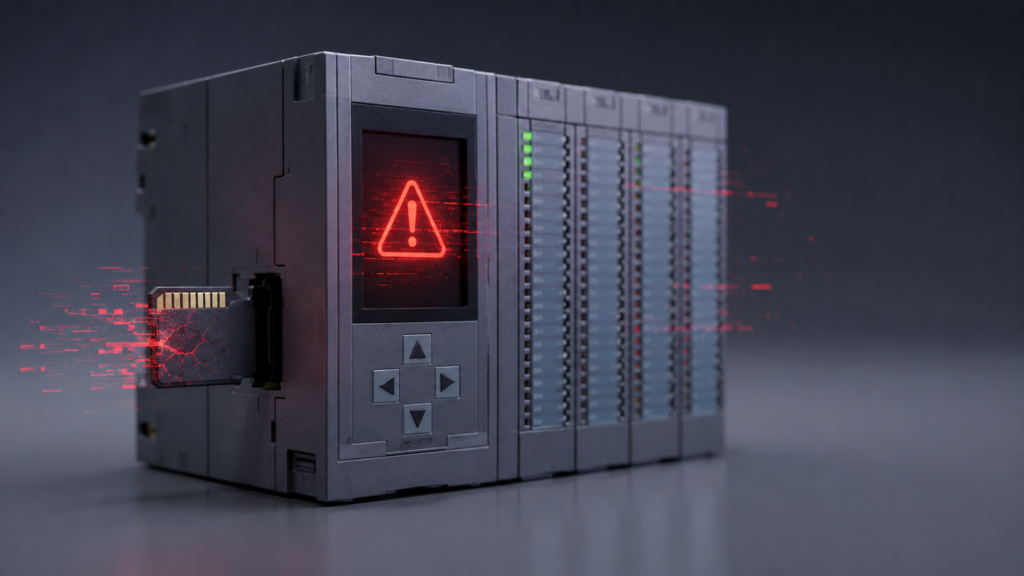
A particularly frustrating Siemens PLC fault occurs when a HART analog module appears healthy but quietly stops updating its values.
The CPU remains in RUN. No obvious hardware diagnostic appears. Communication with the PLC continues normally. Yet every input value from the affected module—HART variables and ordinary analog measurements—freezes at its last valid reading.
The problem may not appear immediately. In one reported case involving the S7-1500 AI HART module 6ES7531-7TF00-0AB0, the card worked normally for five to ten days before freezing. Only removing power from the module restored normal operation.
That is a troublesome failure mode because a frozen value can look believable. Unlike a wire-break alarm or obvious overrange fault, the PLC may continue using stale process data without realizing anything is wrong.
Typical Symptoms
The reported behaviour includes:
- All analog values from one module stop changing
- HART process variables freeze
- Standard 4–20 mA values freeze as well
- The S7-1500 CPU remains in RUN
- No useful module diagnostic is generated
- TIA Portal still shows the module as present
- Repowering or reseating the module restores operation
- The fault returns after several days
A similar issue was also reported with an ET 200SP HA or ET 200HA HART output module after a valve was placed out of service for calibration. When returned to operation, the HART feedback remained frozen until the card was removed and reinserted.
That does not prove both cases have the same root cause, but the symptoms are uncomfortably similar.
Start With the Module Configuration
Before assuming a firmware or hardware defect, review the hardware configuration in TIA Portal.
Check:
- Channel operating mode
- HART enabled or disabled per channel
- Measurement range
- HART variable assignments
- Diagnostic settings
- Update time
- Hardware interrupt settings
- Channel deactivation settings
- Parameter data records
- Module firmware compatibility
If the problem began after a project modification, compare the current hardware configuration with an older working backup.
Also confirm that the correct module version and firmware are selected in the project. A module can sometimes operate with a partially compatible configuration while still behaving unpredictably under specific conditions.
Check the Field Wiring and HART Loop
Although all channels freezing together points more strongly toward the module or its internal communication, the field circuits still deserve inspection.
Verify:
- Stable 24 V DC field supply
- Correct 4–20 mA loop wiring
- Adequate HART loop resistance
- Proper shielding and grounding
- No intermittent short circuits
- No excessive electrical noise
- Correct transmitter polarity
- No shared common or grounding problem
Measure the analog signal directly when the PLC value is frozen.
If the transmitter current continues changing while the module value remains fixed, the problem is clearly downstream of the transmitter.
A loop calibrator is useful here. Inject known values such as 4, 12 and 20 mA and compare them with the raw PLC input.
Check Module and CPU Firmware
Intermittent faults that appear only after several days can be caused by:
- Firmware defects
- Communication resource leaks
- Internal module state-machine problems
- Repeated HART requests
- Unexpected device responses
- Long-term buffer or timing issues
Check whether newer firmware exists for:
- The S7-1500 CPU
- The HART analog module
- The interface module, where remote I/O is used
- Connected HART field devices
Firmware should not be updated casually on a working production system. Record the existing versions, create a complete backup and verify compatibility before changing anything.
Can the Module Be Restarted From the PLC Program?
According to the reported discussion, Siemens support suggested changing HART parameters from the PLC program to trigger reinitialization of the HART function.
Unfortunately, the user reported that this did not solve the freezing problem.
Writing parameter data records may restart or reconfigure part of the HART communication, but it may not reset the complete analog module. If ordinary analog values are frozen alongside HART variables, the fault may exist deeper than the HART communication layer.
There does not appear to be a confirmed software instruction that fully power-cycles this module from the CPU program.
Detecting a Frozen Analog Module
Because the module may not generate a diagnostic alarm, the PLC program may need to detect stale values independently.
One method is to monitor a signal that should change regularly.
Possible approaches include:
- Monitor normal process variation
- Compare raw input changes over time
- Use a dedicated reference input
- Inject a small known test signal
- Compare redundant measurements
- Monitor HART communication counters or status
- Create a stale-value timer
For example, if a pressure transmitter normally varies during each machine cycle but remains bit-for-bit identical for several hours, the PLC could generate a warning.
However, a stable process can legitimately produce an unchanged reading. Stale-value detection must therefore consider the actual application rather than simply alarming whenever a number stops moving.
A more dependable option may be a spare channel connected to a small, controlled reference signal that changes periodically. If that channel freezes too, the PLC has stronger evidence that the entire module has stopped updating.
Automatic Power-Cycle Workaround
One forum participant suggested using a spare digital output and relay to interrupt the module’s L+ supply temporarily.
The proposed sequence is:
- Detect that the module values are frozen.
- Place affected signals into a controlled fallback state.
- Energize a relay that opens the module’s power supply.
- Keep power removed for several seconds.
- Restore module power.
- Wait for startup and signal stabilization.
- Resume normal processing after validating the inputs.
This is admittedly an ugly workaround, but it may restore operation where no firmware or parameter solution exists.
It must be designed very carefully.
Consider:
- What happens to outputs and control logic while the module is offline?
- Will the CPU report a configuration fault?
- Are stale values held or replaced with substitute values?
- Could a motor, valve or process continue operating unsafely?
- Is automatic module repowering allowed by the equipment design?
- Does the module share power with other equipment?
- How will repeated resets be recorded?
A relay-controlled power cycle should never hide a dangerous fault. At minimum, the event should generate an alarm and maintenance record.
Do Not Trust Frozen Values
The greatest risk is not that the module stops updating.
It is that the old values remain plausible.
A frozen tank level, pressure or valve-position signal may cause the PLC to continue operating based on a process condition that no longer exists.
The program should assign a quality status to important analog values. When the module is suspected of freezing, those values should be marked invalid rather than silently trusted.
Depending on the process, the safe response may be to:
- Stop automatic operation
- Hold the last valid value
- Switch to a redundant transmitter
- Move equipment to a safe state
- Require operator acknowledgement
- Generate a maintenance alarm
Final Thoughts
The random freezing reported with Siemens HART analog modules is difficult because the CPU may remain healthy and the module may provide no meaningful diagnostic.
Start by checking configuration, wiring, power quality and firmware. Record the exact conditions surrounding every occurrence and determine whether field current continues changing while the PLC value remains frozen.
If software reparameterization does not recover the card, a controlled external power cycle may be the only practical workaround—but it should be treated as fault recovery, not as a proper fix.
Most importantly, build stale-data detection into critical analog measurements. A clear communication error is inconvenient. A believable but frozen process value can be much more dangerous.