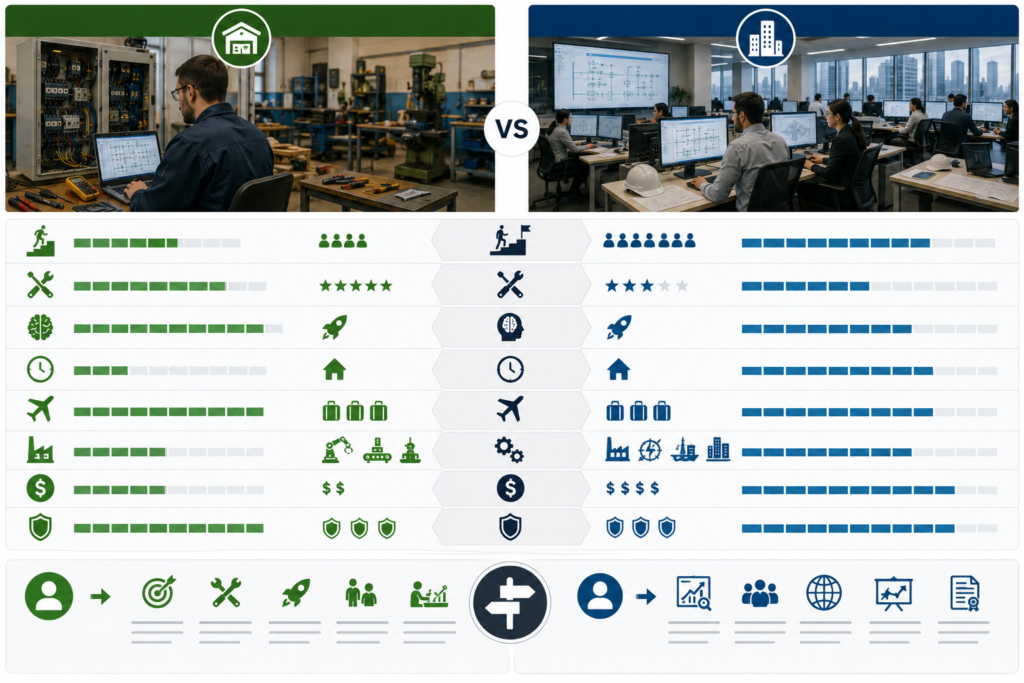
Two automation jobs can have almost identical titles while providing completely different careers.
A controls engineer at a small system integrator may design the panel, write the PLC program, build the HMI, commission the machine, train the customer, and answer the support call afterward.
At a large engineering company, the same engineer may spend months working on one section of a much larger project, following established standards and reporting through several technical and project-management layers.
Neither environment is automatically better. Small integrators often provide faster learning and greater responsibility. Large firms usually offer stronger systems, larger projects, and more predictable career structures.
The right choice depends on how you prefer to learn, work, and handle risk.
What Working at a Small Integrator Is Like
A small automation integrator may employ only a handful of engineers, electricians, and panel builders. Job boundaries are usually flexible.
You might begin the morning preparing an electrical bill of materials, spend the afternoon modifying PLC logic, and finish the day helping test a control panel.
You may be involved in:
- Quoting and technical sales
- Electrical design
- Component selection
- PLC and HMI programming
- Panel testing
- Site commissioning
- Customer training
- Remote support
- Documentation
- Emergency service visits
This variety can be extremely valuable early in your career. You see how projects move from an initial customer request to a working machine.
You also learn which design decisions create problems during wiring, commissioning, and long-term maintenance.
The disadvantage is that support may be limited. When a project goes badly, there may be no senior controls department, cybersecurity team, documentation specialist, or commissioning manager to take over.
You may be expected to solve problems independently before you feel ready.
What Working at a Large Engineering Firm Is Like
Large engineering companies normally divide projects into more specialised roles.
One engineer may design the control architecture. Another develops PLC software. A third creates the SCADA application. Separate teams may handle electrical design, functional safety, networking, testing, project management, and site commissioning.
This structure allows the company to deliver projects that would be impossible for a small integrator, such as complete factories, power plants, logistics centres, water-treatment systems, or multi-site SCADA networks.
The advantages often include:
- Formal training
- Experienced technical specialists
- Established design standards
- Better software and test resources
- Larger and more complex projects
- Clearer approval processes
- Defined promotion routes
- Stronger company benefits
The trade-off is narrower responsibility.
You may spend a year developing one subsystem without seeing how the entire installation was quoted, built, commissioned, or supported. Decisions can also move slowly because they require meetings, reviews, approvals, and coordination between departments.
Where Will You Learn Faster?
A small integrator often produces faster practical development.
You are exposed to customer problems, electrical hardware, software, commissioning, and commercial decisions at the same time. Mistakes become visible quickly because you may be the person who has to correct them on-site.
This can turn a motivated junior engineer into a capable generalist.
However, fast exposure is not the same as good training.
A small company with weak standards may teach bad habits: undocumented changes, copied programs, poor alarm design, unsafe testing, and software stored only on personal laptops.
A large firm may initially feel slower, but its review systems can teach valuable engineering discipline. You may learn proper specifications, version control, validation, cybersecurity, functional safety, and project documentation from experienced specialists.
The best learning environment is not determined by company size alone. It depends on who will review your work and whether the company has competent people willing to teach you.
Responsibility and Autonomy
Small integrators usually give engineers more freedom.
You may choose components, design the software structure, speak directly with the customer, and make decisions at the commissioning site.
That independence can be satisfying. It also means your mistakes have fewer barriers before reaching the customer.
At a large firm, responsibility is often shared. Design reviews, code standards, testing procedures, and approval gates reduce the chance that one person’s error reaches the final installation.
The process can feel bureaucratic, but it also protects inexperienced engineers and creates traceability.
Ask yourself whether you currently want independence or structured supervision. Early in a career, some limits can be useful.
Travel and Working Hours
Small integrators often have unpredictable travel.
A customer may call with a breakdown, a commissioning project may overrun, or the company may have nobody else available to visit the site. Engineers can become responsible for several unrelated projects at once.
Large engineering firms may involve more total travel, especially on international projects, but schedules and rotation policies are often more formal. Larger teams can sometimes distribute commissioning work between several engineers.
Do not assume that a large employer automatically provides better work-life balance. Major projects can involve months on-site, weekend shutdowns, and intense deadline pressure.
Ask every employer for specific numbers:
- Average annual travel percentage
- Typical trip duration
- Weekend and night work
- Overtime compensation
- On-call expectations
- Notice given before travel
- Time off after long commissioning periods
“Occasional travel” can mean almost anything.
Pay and Benefits
Large firms often provide stronger base salaries, pension contributions, health insurance, formal bonuses, paid training, and clearer expense policies.
Small integrators may have less structured benefits but can sometimes reward valuable employees more quickly. If you become the person who handles difficult PLC, robot, or commissioning work, you may gain negotiating power earlier.
The risk is that your responsibilities can increase much faster than your salary.
A small company may expect one engineer to perform several roles while paying for only one. A large company may pay competitively but limit salary progression to formal review cycles and job grades.
Compare the entire package, including overtime, travel pay, daily allowances, bonuses, training, company vehicle, and unpaid commuting or travel hours.
Promotion and Long-Term Options
A large firm usually offers a visible progression route:
- Junior engineer
- Engineer
- Senior engineer
- Lead engineer
- Technical specialist
- Project manager
- Engineering manager
It may also be easier to move internally into cybersecurity, data systems, safety, sales, or management.
A small integrator has fewer formal positions. You may gain senior-level responsibilities without receiving a senior title. Eventually, the only promotion available may be project manager, technical lead, or part-owner.
On the other hand, small integrator experience can prepare you to become an independent contractor or start your own integration business. You learn not only engineering but also quoting, customer management, purchasing, and project risk.
Questions to Ask Before Choosing
For a small integrator, ask:
- Who reviews my PLC and electrical designs?
- What happens when I cannot solve a commissioning problem?
- How are projects documented and backed up?
- How many projects will I handle simultaneously?
- Is overtime and travel time paid?
For a large firm, ask:
- How narrow will my role be?
- Will I participate in commissioning?
- How long does promotion normally take?
- Can I move between departments?
- How much time is spent in meetings and documentation?
The quality of your manager and team may matter more than the company’s size.
The Honest Verdict
Choose a small integrator when you want broad exposure, early responsibility, direct customer contact, and the possibility of becoming a strong automation generalist quickly.
Choose a large engineering firm when you value formal training, specialised mentors, large projects, established standards, and a clearer corporate career path.
A common strategy is to spend several years at a small integrator to gain broad practical experience, then move to a larger organisation for specialisation and stability.
The opposite route can also work. Large-company training can provide a strong technical foundation before you move to a smaller firm where you can take wider ownership.
Do not choose based only on company size or salary. Investigate the quality of the engineering standards, the people who will train you, the real travel expectations, and how much responsibility you will be given without support.