Relays are easy to understand physically, but reliable relay circuits still require careful attention to coil drive, contact stress, and transient energy. Ssrs have no moving contacts.
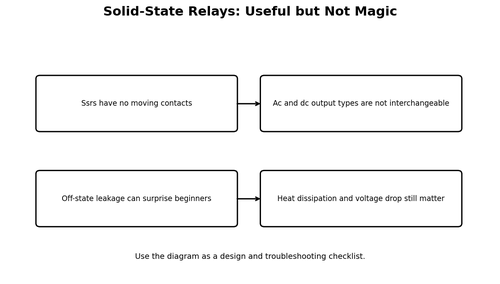
The main ideas are: Ssrs have no moving contacts. Ac and dc output types are not interchangeable. Off-state leakage can surprise beginners. Heat dissipation and voltage drop still matter.
Always separate the coil circuit from the contact circuit in your reasoning. A relay can click correctly while the contacts are wired incorrectly, and the load can be healthy while the coil never receives enough voltage to pull in. Treat those as separate diagnostic branches.
A useful troubleshooting habit is to divide the circuit into control, switch, and load. Prove each block separately before blaming the component in the middle.
Worked thinking: An AC triac-output SSR may not turn off a DC load because its output device relies on AC current crossing zero. The example is meant to demonstrate the method, not to replace the ratings and test conditions of the actual part you use.
Design view – SSRs have no moving contacts. Ask which component or connection establishes this behavior and which rating could be exceeded if the load changes. This turns a descriptive fact into a selection rule.
Troubleshooting view – AC and DC output types are not interchangeable. Imagine the reading if this condition were missing, too weak, too high, reversed, or intermittent. A useful test is one that separates those possibilities instead of merely producing another number.
Design view – off-state leakage can surprise beginners. Ask which component or connection establishes this behavior and which rating could be exceeded if the load changes. This turns a descriptive fact into a selection rule.
Troubleshooting view – heat dissipation and voltage drop still matter. Imagine the reading if this condition were missing, too weak, too high, reversed, or intermittent. A useful test is one that separates those possibilities instead of merely producing another number.
A switch should be evaluated in both steady state and transition state. ON-state voltage drop creates heat, OFF-state voltage stress can damage the device, and the brief transition between states can be the most stressful period during fast or repetitive switching.
Finish by verifying the real load. A driver that works with an LED may still fail with a relay, motor, solenoid, heater, or long cable because startup current, inductance, wiring resistance, and electrical noise change the conditions dramatically.
Worked Example
An AC triac-output SSR may not turn off a DC load because its output device relies on AC current crossing zero.
Hands-On Mini-Lab
- Measure coil resistance with power removed.
- Estimate coil current from rated voltage and resistance.
- Energize the coil from a suitable current-limited supply.
- Confirm NO and NC contacts with continuity mode.
- Add the intended coil driver and suppression before connecting the load.
Common Beginner Mistakes
- Leaving out flyback suppression on a DC coil.
- Using an AC contact rating as if it were an equal DC rating.
- Assuming an audible click proves the contacts are healthy.
- Driving a relay coil directly from a weak GPIO.
Fault-Finding Lens
- Verify the actual supply voltage at the load and switching device while the load is commanded ON.
- Measure the control quantity at the device itself: base current for a BJT, VGS for a MOSFET, or coil voltage for a relay.
- Check the load independently when possible so a failed load is not mistaken for a failed driver.
- Inspect protection parts, grounds, connectors, and wiring for open circuits, shorts, reversed polarity, or excessive voltage drop.
- After the repair, repeat the original operating condition and verify current, voltage drop, temperature, and turn-off behavior.
Check Your Understanding
- Explain solid-state relays: useful but not magic in your own words.
- Which voltage or current would you measure first to verify this stage?
- What is one failure mode that could make the switch run hot?
- What protection component or design margin is most relevant here?
- How would the circuit behave during controller startup or reset?
Key Points
- Ssrs have no moving contacts.
- Ac and dc output types are not interchangeable.
- Off-state leakage can surprise beginners.
- Heat dissipation and voltage drop still matter.