The fastest way to waste money on a no-start is to decide what failed before you define what the car is actually doing.
Why this matters
A symptom is an observation, not a diagnosis. “The battery is dead” is a diagnosis; “the dash goes dark and the starter clicks once” is a symptom.
Repeat the symptom the same way each time. Use the same key, pedal position, and accessory load so your observations are comparable.
First checks
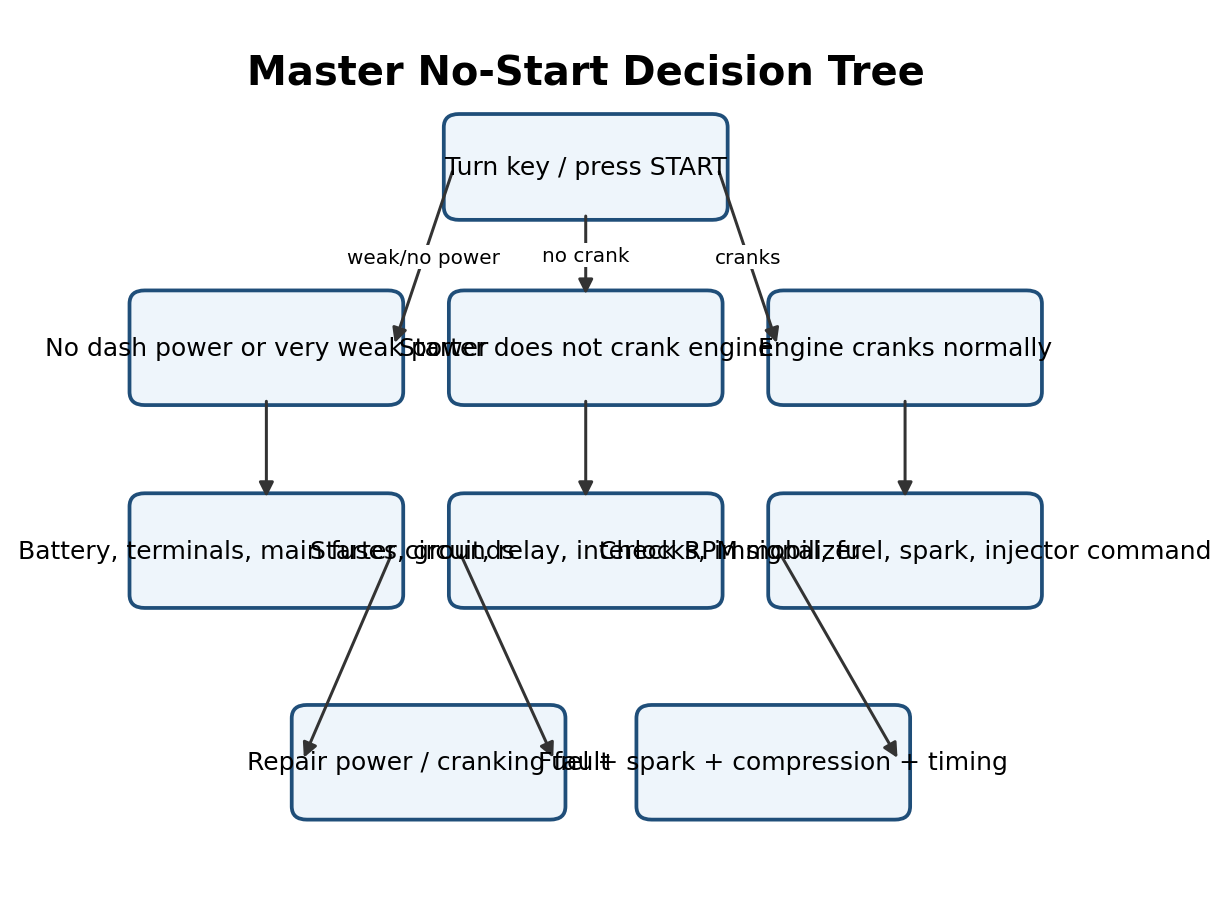
• Separate no-power, no-crank, slow-crank, crank-no-start, start-and-die, and intermittent faults.
• Write down what happens to the dash lights when START is requested.
• Notice whether the engine turns at normal speed and whether the sound changes from normal.
A practical test path
Begin with the easiest observation that can divide the problem into two paths. In a start with the symptom, not the part complaint, do not change several things at once. Record the initial condition, perform one test, and then decide what the result proves. If the test shows normal power, move downstream. If it shows a loss, stay with that part of the circuit until the source of the loss is found. Whenever possible, test the circuit while it is carrying its normal load rather than relying only on resistance or continuity checks with everything switched off.
For a cranking-system fault, the battery, cables, start request, interlocks, relay, solenoid, starter motor, engine mechanical freedom, and return ground form one chain. A missing result at any link prevents cranking. Measuring at strategic points is faster than removing parts.
Common mistakes to avoid • Replacing a battery because the starter clicks without checking cable connections and cranking voltage. • Calling every crank-no-start a fuel-pump failure.
Stop and get help when… • Stop if you smell fuel strongly, see smoke, have damaged battery cables, or the vehicle is in an unsafe location.
What to record
Write down whether the symptom was present during the test, the battery voltage or scan values you observed, and exactly what changed. For start with the symptom, not the part, include temperature, key used, whether the engine cranked, and any warning or security indicators that were different from normal. Good notes prevent repeated testing and make professional diagnosis faster if you need it.