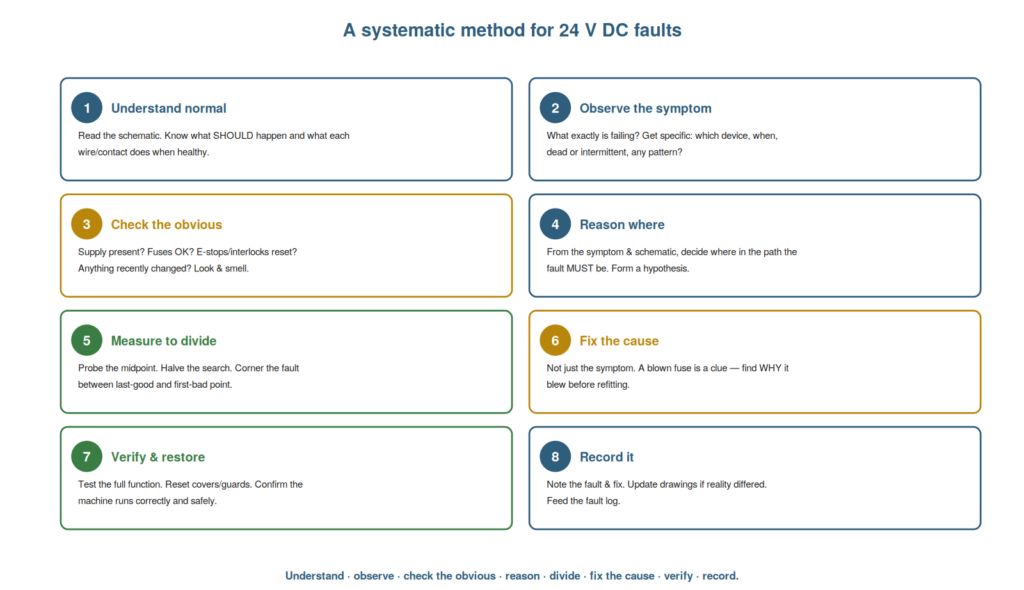
Drawing the book’s techniques together, this chapter lays out a systematic method for control-circuit troubleshooting — a repeatable sequence that carries you from symptom to fixed fault — because a method is what turns scattered techniques into reliable troubleshooting. The method embodies the book’s compass and works for any fault. Understanding it as a coherent whole equips you to approach any control-circuit problem with confidence. This chapter presents the systematic method step by step.
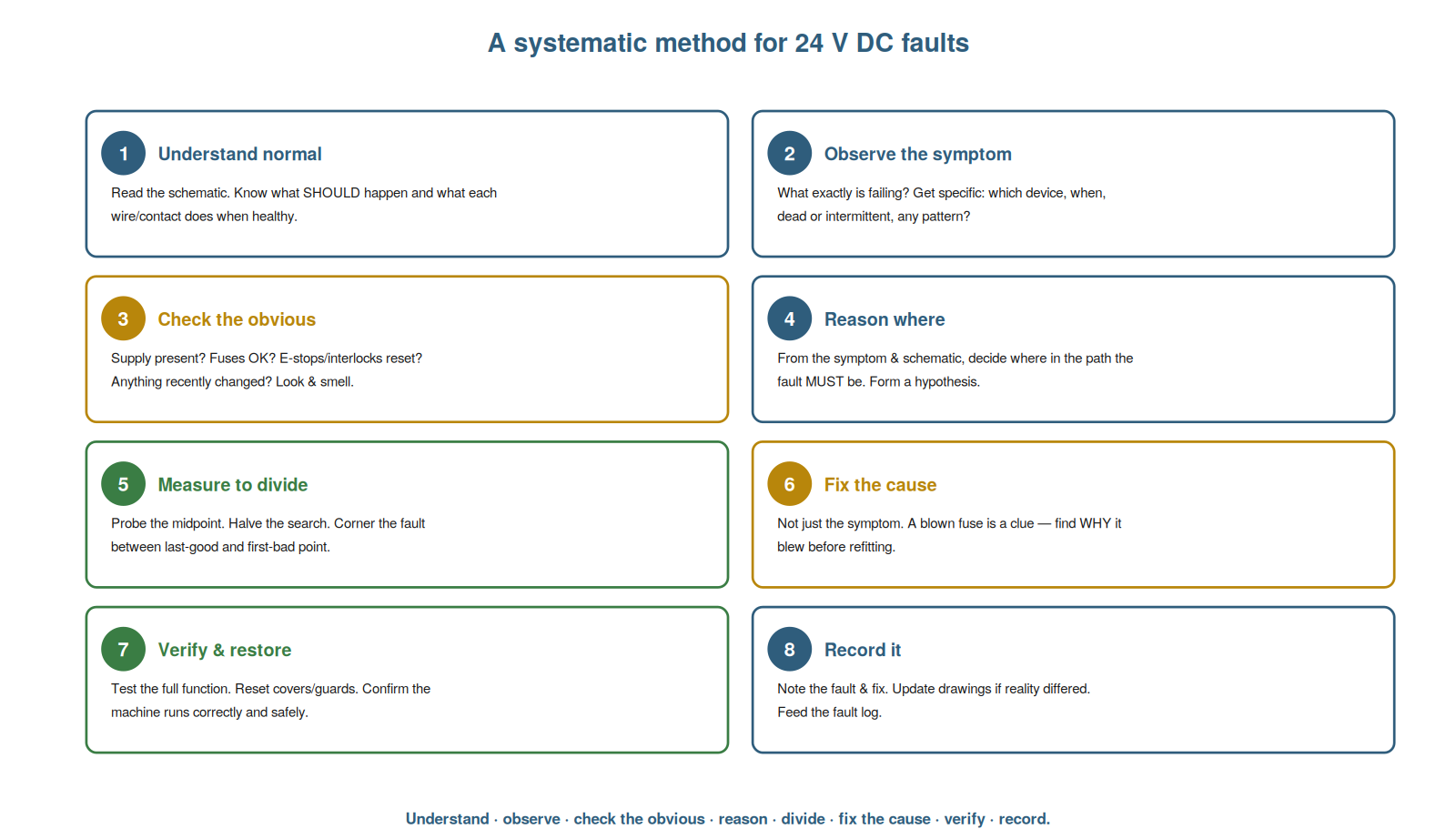
The eight steps
The systematic method has eight steps, and understanding them as a sequence gives you a reliable procedure for any fault. First, understand normal: read the schematic, know what should happen and what each element does when healthy. Second, observe the symptom: get specific about what is failing — which device, when, dead or intermittent, any pattern. Third, check the obvious: supply present, fuses intact, safety devices reset, anything recently changed — look and smell. Fourth, reason where: from the symptom and schematic, decide where in the path the fault must be, forming a hypothesis. Fifth, measure to divide: probe the midpoint, halve the search, corner the fault between last-good and first-bad. Sixth, fix the cause: not just the symptom — find why a fuse blew before refitting. Seventh, verify and restore: test the full function, reset covers and guards, confirm correct and safe operation. Eighth, record: note the fault and fix, update drawings, feed the fault log. So the eight steps — understand, observe, check the obvious, reason, divide, fix the cause, verify, record — form a complete method. Understanding them as a sequence gives you a reliable procedure applicable to any fault. Understanding the eight steps — understand normal, observe the symptom, check the obvious, reason where, measure to divide, fix the cause, verify and restore, and record — gives you a reliable procedure for any control-circuit fault, so that you have a complete, repeatable sequence carrying you from symptom to fixed fault, embodying the book’s techniques and compass in a systematic method that you can apply with confidence to any problem, which is what turns the individual skills the book has taught into dependable troubleshooting through a coherent step-by-step approach.
Check the obvious first
Among the steps, checking the obvious first deserves emphasis, and understanding why saves a great deal of time on faults that turn out to be simple. Before any detailed measurement or reasoning, a quick check of the obvious things resolves or clarifies a surprising number of faults: is the supply actually present (the whole circuit dead points here)? Are the fuses intact (a blown fuse is a common, obvious cause)? Are the safety devices reset (an E-stop pressed or a guard open is not a fault)? Did anything just change (a recent repair or modification often causes the fault)? Can you see or smell anything (a burnt component, a loose wire, water)? These obvious checks are fast and often decisive, catching the many faults that are simple and near the surface. Skipping them to launch into detailed diagnosis wastes time when the answer was obvious. So checking the obvious first — supply, fuses, safety, changes, look and smell — saves time by catching simple faults early. Understanding why to check the obvious first — that many faults are simple and caught by quick checks — saves time before detailed diagnosis. It reinforces that the obvious checks (supply, fuses, safety devices, recent changes, visible signs) are fast and catch many faults, so they come first. Understanding to check the obvious first — the supply, fuses, safety devices, recent changes, and visible or smell-able signs — saves a great deal of time, so that before launching into detailed measurement and reasoning, you make the quick obvious checks that resolve or clarify a surprising number of faults (a tripped supply, a blown fuse, a pressed E-stop, a recent change, a visible problem), catching the many faults that are simple and near the surface and avoiding the waste of detailed diagnosis when the answer was obvious all along, which is why checking the obvious first is a step worth its own emphasis in the systematic method.
Fix the cause, not the symptom
A principle woven through the method deserves its own emphasis: fix the cause, not just the symptom, and understanding it prevents faults from recurring. Many faults have a symptom that is easy to address and a cause that is the real problem: a blown fuse (symptom) caused by a short (cause); a device not working (symptom) because of a voltage-dropping corroded connection (cause); an intermittent signal (symptom) from a cracked wire (cause). Fixing only the symptom — replacing the fuse, ignoring the short — leaves the cause to strike again (the new fuse blows). Fixing the cause — finding and repairing the short — resolves the fault for good. So the principle is to look past the symptom to the underlying cause and fix that: ask why the fuse blew, why the connection corroded, why the wire cracked, and address the root. This prevents recurrence, which symptom-only fixes invite. Understanding to fix the cause, not the symptom — addressing the root to prevent recurrence — is a principle that distinguishes lasting repairs from temporary ones. It reinforces that fixing the cause (the short, the corrosion, the cracked wire) rather than just the symptom (the fuse, the weak device, the dropout) prevents the fault returning. Understanding to fix the cause, not just the symptom — looking past the easy-to-address symptom to the underlying cause and repairing that, asking why the fuse blew or the connection failed and addressing the root — prevents faults from recurring, so that you make lasting repairs rather than temporary ones, resolving the short behind the blown fuse and the corrosion behind the weak device rather than merely replacing the fuse or ignoring the cause, which is the principle that distinguishes durable troubleshooting from the repeated symptom-fixing that leaves the real fault to strike again, and a discipline worth holding throughout the systematic method.
Adapting the method to the fault
A refinement worth understanding is that the systematic method adapts to the fault — you emphasize different steps for different faults — because a rigid application wastes effort while a flexible one is efficient. The eight steps are a framework, but their emphasis shifts with the fault: for a dead circuit, the measure-to-divide step is central; for an intermittent, the observe-the-pattern and provoke steps dominate while straightforward dividing does not apply; for a fault right after a change, the check-what-changed part of checking the obvious often solves it immediately; for a blown fuse, fixing the cause (finding the short) is the crux. So you adapt the method: apply all the steps, but weight them according to what the fault calls for, spending your effort where it counts for that fault type. Understanding this adaptation keeps the method efficient rather than a rigid checklist applied uniformly. So understanding how to adapt the method to the fault — emphasizing the steps that matter for each fault type — keeps it efficient and flexible. Understanding how to adapt the method to the fault — weighting the eight steps according to what each fault type calls for, emphasizing dividing for a dead circuit, pattern-finding for an intermittent, checking changes for a post-change fault, and cause-finding for a blown fuse — keeps the method efficient and flexible, so that you apply the framework intelligently rather than as a rigid uniform checklist, spending your effort on the steps that matter most for the particular fault in front of you, which makes the systematic method a adaptable approach that fits each fault rather than a mechanical sequence applied identically regardless of the problem’s nature.
Scenario: the method under pressure
A scenario shows the systematic method proving its worth under the pressure of a line-down. A production line stopped, people were waiting, and the pressure to fix it fast was high — tempting the technician to start pulling things apart and guessing. Instead, he held to the method. He understood normal (read the schematic for the stopped section), observed the symptom specifically (which device was dead, and when), checked the obvious (supply and fuses good, but he noticed a guard had been worked on that morning), reasoned where (the fault was likely related to that morning’s work), and measured to divide, quickly cornering an open at a terminal that had been disturbed during the guard work and not retightened. He fixed the cause (retightened it properly), verified the line ran, and recorded it. The method, followed calmly under pressure, found the fault faster than panicked guessing would have. This scenario shows the systematic method proving faster than guessing under pressure. Understanding the method as a reliable sequence let the technician stay calm and find the fault efficiently despite the pressure. It reinforces that following the method calmly under pressure beats panicked guessing. The scenario reinforces the systematic method: under the pressure of a line-down, the technician found the fault faster by calmly following the method — understanding normal, observing, checking the obvious (catching the morning’s guard work), reasoning, and dividing — than panicked guessing would have, illustrating how the method is most valuable exactly when pressure tempts you to abandon it, delivering a reliable, efficient diagnosis when it matters most.
Documenting as you go
A practice that strengthens the method is documenting as you go — recording your findings during the diagnosis, not just at the end — because it keeps your reasoning clear and builds a useful record. As you work through a fault, noting what you find (this point reads 24 volts, this one 0; this fuse is good; this was changed yesterday) keeps track of your progress and reasoning, so you do not lose your place or repeat measurements, and it helps you see the emerging picture. It also builds the record you will formalize in the final ‘record’ step: the findings are already noted. For a complex or intermittent fault worked over time, this running record is especially valuable — it accumulates the observations that reveal a pattern or the fault. So documenting as you go supports the diagnosis in progress and feeds the final record. Understanding the value of documenting as you go — recording findings during the diagnosis — keeps your reasoning clear and builds the record. It reinforces that noting findings as you work keeps track of progress, reveals the picture, and feeds the final record. Understanding the value of documenting as you go — recording your findings during the diagnosis rather than only at the end — keeps your reasoning clear and builds a useful record, so that as you work through a fault you note what you find (which points read what, what is good, what changed), which keeps track of your progress and reasoning, helps the emerging picture take shape, and feeds the final record, a practice especially valuable for complex or intermittent faults worked over time where the accumulating observations are what reveal the pattern or the fault.
The method as what makes you reliable
To close, it is worth recognizing that the systematic method is what makes a troubleshooter reliable, because it is the difference between consistent success and hit-or-miss guessing. Individual techniques and knowledge matter, but it is the method — the disciplined sequence of understand, observe, check the obvious, reason, divide, fix the cause, verify, record — that ensures you apply them consistently and find the fault reliably, fault after fault, rather than sometimes getting lucky and sometimes floundering. A technician with the method is dependable; one without it is inconsistent. So the method is what makes you reliable, and internalizing it is what makes you a troubleshooter others can count on. Understanding the method as what makes you reliable — the disciplined sequence ensuring consistent success — is why internalizing it matters. Understanding the systematic method as what makes you reliable — the disciplined sequence that ensures you apply your techniques and knowledge consistently to find the fault reliably, fault after fault, rather than sometimes getting lucky and sometimes floundering — is why internalizing it matters, so that you recognize the method as the difference between the dependable troubleshooter and the inconsistent one, the framework that turns individual skills into reliable results and makes you a technician others can count on to find the fault, which is the deeper value of the systematic method beyond any single step.