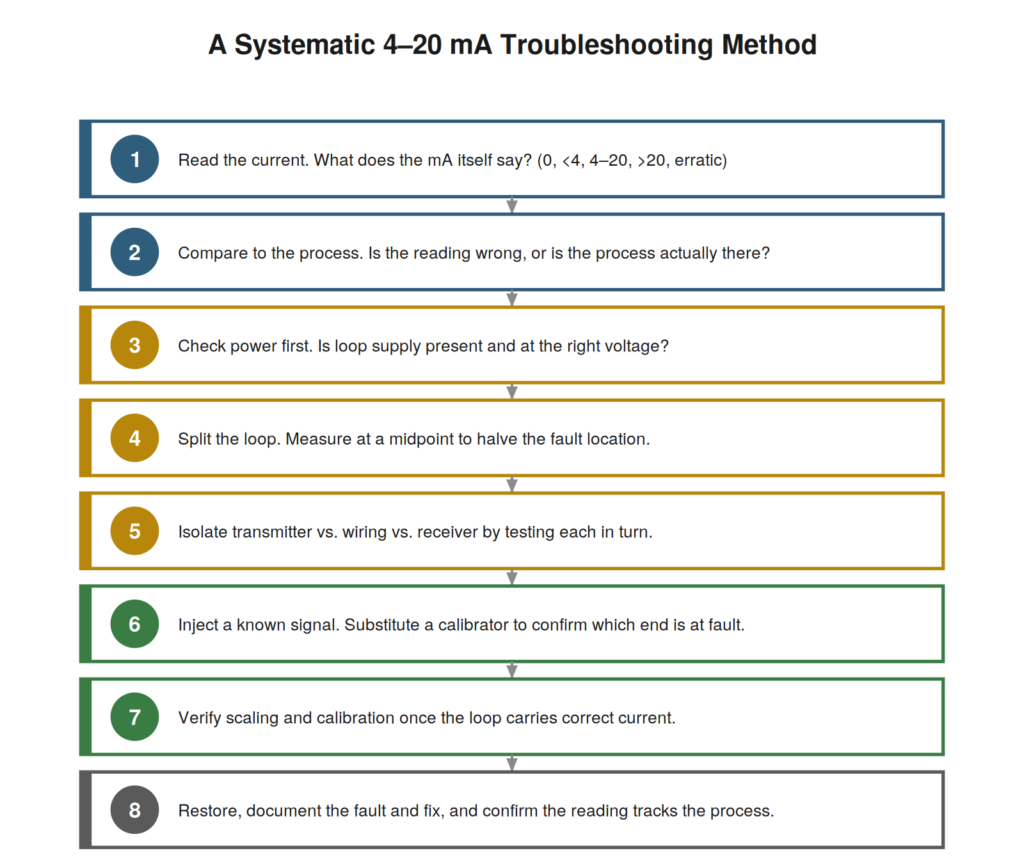
Reading the fault signature is the start; a systematic method carries you from there to the located fault. Rather than probing at random, a structured approach — reading the current, checking power, splitting the loop, isolating each part, and verifying — converges efficiently on the problem. This chapter lays out that method as a repeatable process.
Start with the current and the power
The method begins with reading the loop current and interpreting its signature, as the previous chapter described, to classify the fault. The next step is to compare the reading to the actual process: is the reading genuinely wrong, or is the process really at that value? A loop reading high may be correct because the process is high. Establishing that the reading is actually wrong — disagreeing with the true process condition — confirms there is a fault to find. Then, because so many loop faults come down to power, checking the power is a high-value early step: is the loop supply present and at the correct voltage? A loop with no power reads 0 mA, and a loop with inadequate voltage may fail at high current. Confirming the power is good early eliminates a common and easily checked cause before deeper investigation, which is why the method checks power near the start, right after establishing that a real fault exists.
Split the loop to localize
With a confirmed fault and power verified, the key localizing technique is to split the loop — measure at an intermediate point to determine which half of the loop contains the fault. Because the loop is a series circuit accessible at junction terminals, measuring the current at a midpoint tells you whether the correct current is present up to that point. If the correct current reaches the midpoint, the fault is beyond it, toward the receiver; if not, the fault is before it, toward the transmitter. This single measurement halves the region to search. Repeating the split on the identified half narrows the fault further. This split-half approach, detailed in the next chapter, is the most efficient way to localize a loop fault, because each measurement eliminates half the remaining loop, converging quickly on the faulty section rather than checking everything in sequence. Using the loop diagram to find the accessible midpoints makes this practical, and it is the heart of efficient loop troubleshooting.
Isolate, inject, and verify
Once the fault is localized to a section, the remaining steps isolate the specific faulty element and verify the fix. Isolating means testing the transmitter, the wiring, and the receiver in the faulty section individually — for instance, disconnecting the transmitter and substituting a known-good signal source to see whether the problem follows the transmitter or stays with the wiring. Injecting a known signal — using a loop calibrator to drive a precise current into part of the loop — is a powerful isolation technique, because it lets you test whether the receiver reads a known input correctly (isolating the receiver and scaling) or whether the wiring carries a known current faithfully (isolating the wiring), independent of the transmitter. Finally, once the fault is fixed, verifying means confirming the loop carries the correct current for the process and that the displayed value is right, checking the scaling as well as the current. This sequence — isolate the element, inject known signals to test each part, verify the complete loop — completes the method, taking you from a localized fault to a confirmed repair.
Why a method beats intuition
Experienced technicians sometimes troubleshoot by intuition, jumping to a likely cause, and for familiar faults this works. But a systematic method beats intuition for the hard cases and for consistency, which is why it is worth following even when intuition tempts you to shortcut. Intuition fails on unfamiliar faults, on intermittent problems, and when the obvious cause turns out not to be the problem — and then, without a method, you are left guessing. The systematic method — read the signature, verify it is real, check power, split to localize, isolate and inject, verify — works regardless of familiarity, because it methodically eliminates possibilities and converges on the fault rather than relying on a lucky guess. It is also more consistent: it finds the fault reliably rather than sometimes quickly (when intuition is right) and sometimes not at all (when it is wrong). The best approach combines both: let intuition suggest where to look, but fall back on the method when intuition does not quickly pay off, so that you get the speed of intuition when it works and the reliability of the method when it does not.
Scenario: when checking power first paid off
A scenario shows the value of checking power early. A loop was completely dead, reading 0 mA, and there were many possible causes — a broken wire anywhere in a long run, a failed transmitter, a blown fuse, a lost supply. Rather than starting a long trace of the wiring, the method’s early power check was applied: the loop supply was measured and found absent — a tripped supply or blown fuse had cut the power. The dead loop was simply unpowered. Restoring the power brought the loop back immediately, with no need to trace wiring or suspect the transmitter. Checking power first, as the method prescribes, found the cause in one quick measurement, whereas diving into a wiring trace would have wasted time before eventually discovering the power was off. This scenario illustrates why the systematic method checks power early: loss of power is a common cause of a dead loop and is quick to check, so verifying it before deeper investigation often finds the fault immediately or eliminates a common cause. The discipline of checking power first, even when tempted to start elsewhere, repeatedly pays off in exactly this way.
The method as a fallback and a framework
The systematic method serves two roles: a reliable fallback when quick approaches fail, and a framework that organizes the whole diagnosis. As a fallback, it guarantees progress: when intuition and the obvious checks do not find the fault, following the method — signature, verify, power, split, isolate, inject, verify — methodically converges on it, so you are never stuck without a next step. As a framework, it structures even intuition-led troubleshooting: the steps organize what to consider and in what order, so that however you approach a fault, the method ensures nothing essential is skipped. This dual role makes the method valuable to technicians at every level: beginners follow it step by step for reliable results, and experienced technicians use it as the underlying structure beneath their faster intuitive moves, falling back to strict adherence when a fault resists. Internalizing the method — so its steps become the natural framework of your troubleshooting — gives both the reliability of a systematic approach and the flexibility to move quickly when the fault is obvious, dropping into methodical mode when it is not. The method is not a rigid script but a dependable structure that underlies effective loop troubleshooting at any level of experience.
The method embodies the book
The systematic troubleshooting method embodies everything the book teaches, and seeing it this way ties the whole subject together. Each step draws on the fundamentals: reading the signature uses the understanding of live zero and diagnostic currents; verifying against the process uses scaling; checking power uses the circuit view; splitting the loop uses the series-circuit nature and the loop diagram; isolating and injecting use the measurement techniques and the transmitter types; verifying uses scaling and calibration. The method is the fundamentals applied in a systematic sequence to find a fault. So mastering the method is applying the whole book’s understanding in practice, and the method is where all the separate topics — the loop as a circuit, the wiring, the scaling, the measurement, the diagnostics — come together in the act of troubleshooting. Understanding the method deeply means understanding how all the fundamentals combine to diagnose a fault, which is the integrated competence the book aims to build. The method is not a separate technique layered on top but the culmination of the fundamentals, organized into a reliable process, and it is in executing the method that the loop technician’s full understanding is brought to bear on the practical goal of finding and fixing faults.
Adapting the method to the situation
While the method is a reliable sequence, applying it well means adapting it to the situation rather than rigidly following every step regardless. If the fault signature and context immediately identify the cause, you may jump ahead to confirm it rather than working through every intermediate step. If power is obviously fine (other loops on the same supply work), you may not need to check it. If the fault is clearly on one side, you may start splitting there. The method provides the full framework, but a skilled technician adapts it, using the steps that the situation calls for and skipping those clearly unnecessary, while keeping the method’s structure as a fallback if the shortcuts do not pan out. This adaptive application — using the method as a guide, adapting to the specifics, falling back to full rigor when needed — combines efficiency with reliability. Rigidly following every step always would be slow when shortcuts are warranted; ignoring the method entirely would be unreliable when the fault is not obvious. Adapting the method to the situation — shortcut when the situation allows, full method when it does not — applies it intelligently, which is how experienced technicians use it: as a flexible framework adapted to each fault, not a rigid checklist followed identically every time. The method guides; judgment adapts it to the case.
The method builds competence and confidence
Following the systematic method builds both competence and confidence over time, which is a benefit beyond finding any particular fault. Each time you work through the method, you practice the reasoning, reinforce the fundamentals, and see the method deliver a result, which builds your competence in loop troubleshooting and your confidence that you can find faults reliably. This growing confidence is itself valuable: it lets you approach loop problems calmly, knowing you have a method that works, rather than anxiously hoping to stumble on the answer. Over many diagnoses, the method becomes second nature, your competence deepens, and your confidence solidifies into the assured capability of an experienced troubleshooter. The method is thus not just a tool for individual faults but a path to developing troubleshooting competence and confidence, through repeated successful application. A technician who consistently uses the method grows steadily more capable and confident, while one who troubleshoots haphazardly may not develop the same reliable skill. Following the method builds the competence and confidence that make loop troubleshooting a strength rather than a struggle, and this developmental benefit — growing skill and assurance through consistent methodical practice — is a strong reason to adopt the method beyond its value on any single fault. The method makes you better at troubleshooting over time, not just successful at the fault before you.