Voltage, current, and resistance are the three basic ideas behind nearly every beginner circuit question.
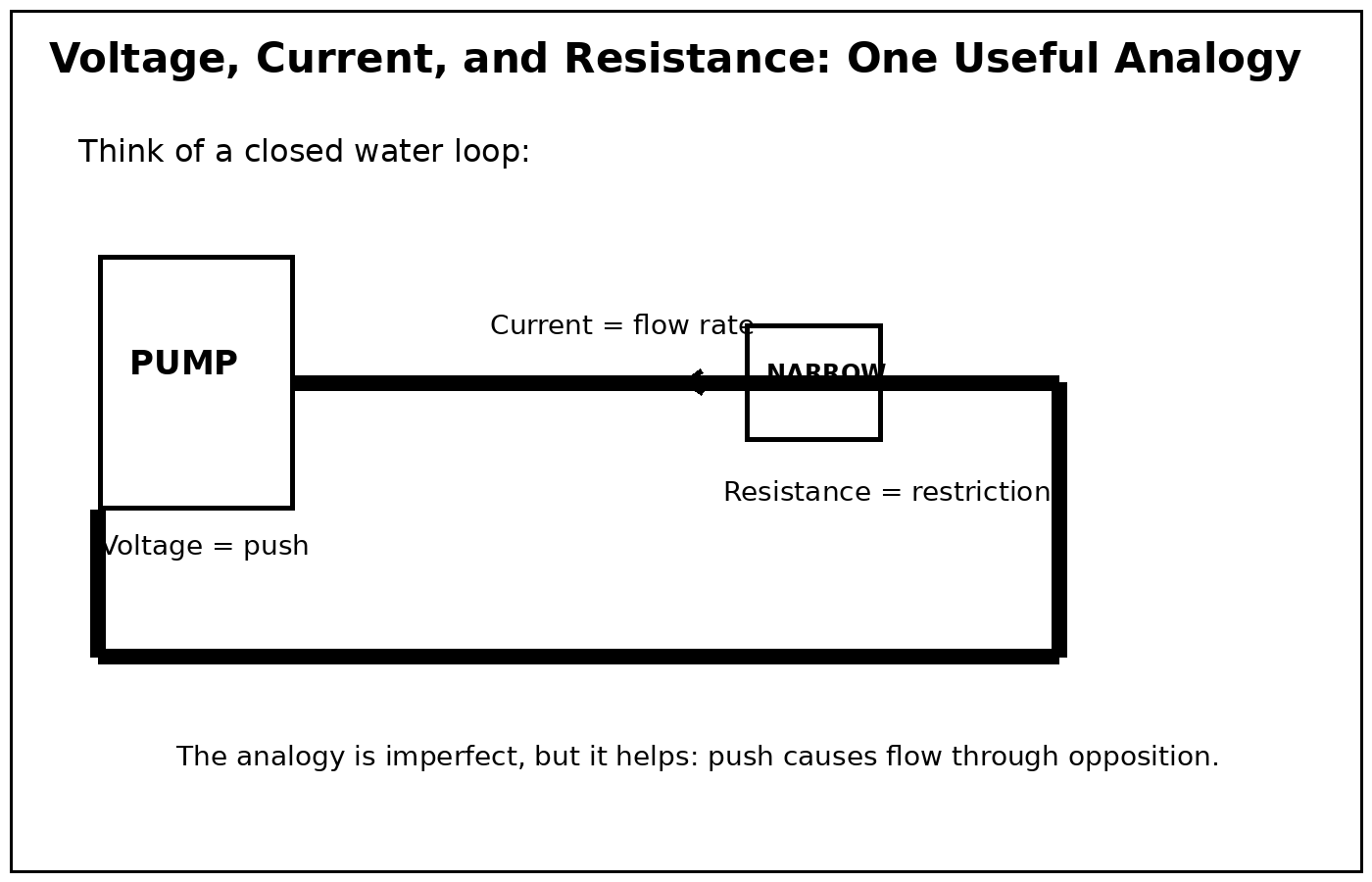
Figure: The Three Words That Unlock Most Circuits
The idea in plain English
Voltage is electrical push or potential difference between two points. That is why voltage measurements are always made between two points rather than at one point by itself.
Current is the rate at which charge flows through a path. Current is therefore best understood as a circuit-wide consequence of the source, the path, and the load acting together.
Resistance describes how strongly a material or component opposes current for a given voltage. That is why voltage measurements are always made between two points rather than at one point by itself.
What it looks like in real life
A higher supply voltage can drive more current through the same load.
A higher resistance can reduce current when the supply stays the same.
A simple way to reason it out
Start with the source. Ask what creates the electrical difference. Then trace the intended path through switches, conductors, protection, and the load. Finally, identify the return path. If you can point to those three things—source, complete path, load—you can usually explain the basic behavior without algebra.
Next, change one thing in your head. Imagine the switch opening, a connection becoming resistive, the load being replaced by a higher-power device, or the supply voltage changing. Predict what should happen before looking at a meter or a diagram. This habit is more valuable than memorizing isolated facts because it builds a working model you can reuse.
Common beginner traps
- The water analogy is useful only as a starting point; wires are not hollow pipes and voltage is not literally pressure.
Remember this
Voltage, current, and resistance are the three basic ideas behind nearly every beginner circuit question. If you can explain this chapter in your own words without using a formula, you understand the part that matters most.