Three-phase power is great when everything is balanced and healthy.
But when one phase disappears, voltage drops, phase sequence is wrong, or current becomes uneven, machines do not politely ask for help. Motors overheat. Contactors chatter. Drives trip. Control systems behave strangely. Sometimes production stops immediately. Sometimes, worse, the equipment keeps running under bad conditions until something fails.
That is where a three-phase monitoring relay earns its place in the panel.
It is a small electronic protection device that continuously checks the condition of a three-phase electrical network. If the measured values go outside the allowed limits, the relay changes its output state and can stop the load, trip a breaker, or send a fault signal to the control system.
Not glamorous. Very useful.
What Is a Three-Phase Monitoring Relay?
A three-phase monitoring relay is an electronic device used to monitor important electrical parameters in a three-phase supply system.
It checks whether the power network is healthy enough for connected equipment to operate safely. If something abnormal happens, the relay reacts through its output contact.
The output is often an SPDT contact, meaning it has a common terminal, normally closed contact, and normally open contact. This contact can be inserted into a control circuit, PLC input, contactor coil circuit, alarm circuit, or circuit breaker trip circuit.
In simple words:
The relay watches the supply.
If the supply is good, the machine can run.
If the supply becomes bad, the relay changes contact state.
Then the control system reacts.
Why Three-Phase Monitoring Is Important
Electrical equipment is designed to operate within certain limits. Motors, drives, heaters, compressors, pumps, control transformers, and other devices do not like abnormal voltage, missing phases, wrong phase order, or heavy imbalance.
A three-phase motor, for example, may be damaged if one phase is lost while it is running. This can cause increased current in the remaining phases and rapid overheating. Low voltage can also make a motor draw more current. Wrong phase sequence can make a motor rotate in the wrong direction, which may be dangerous for pumps, fans, conveyors, compressors, and mechanical systems.
And yes, wrong rotation is one of those faults that can look stupid after you find it — but it can still break expensive equipment.
A monitoring relay helps prevent these situations by detecting the problem early and stopping operation before serious damage occurs.
How Does a Three-Phase Monitoring Relay Work?
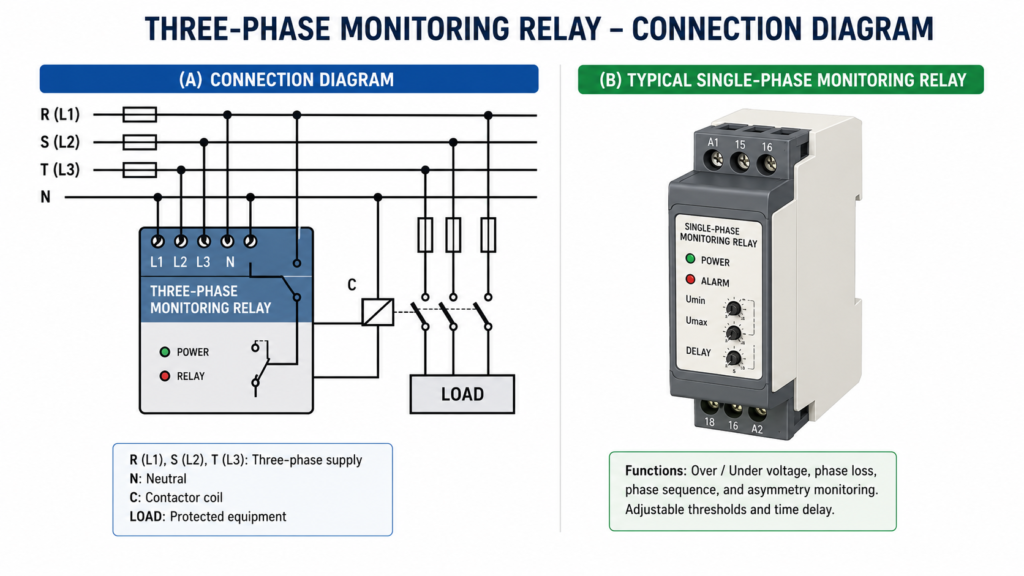
A three-phase monitoring relay is connected to the three-phase supply lines, usually marked as L1, L2, and L3, or R, S, and T. Some relays also use a neutral connection, depending on the monitored function and voltage system.
Inside the relay, electronic circuits measure the electrical quantities of the supply. These may include voltage, phase sequence, phase loss, imbalance, frequency, current, or other parameters depending on the relay type.
The relay compares the measured values with preset limits.
If the values are within the acceptable range, the relay output remains in its normal healthy state. If one or more values exceed the allowed limits, the relay trips or changes its output contact.
That output can then:
- De-energize a contactor
- Stop a motor
- Trip a circuit breaker through a shunt trip or trip coil
- Send a fault signal to a PLC
- Activate an alarm lamp or buzzer
- Prevent a machine from starting
The relay itself usually does not switch the main load current. It sends a control signal. The contactor, breaker, or controller performs the actual interruption.
Small relay. Big authority.
Network Monitoring vs Load Monitoring
A three-phase monitoring relay can be installed in different positions depending on what you want to protect.
Two common approaches are:
- Network monitoring
- Load monitoring
Network Monitoring
In network monitoring, the relay is connected on the supply side of the installation or distribution system.
This means it monitors the incoming three-phase power network before it feeds a larger section of equipment.
If a fault is detected, the relay can interrupt power to a whole machine group, production line, or department by opening a main contactor or tripping a circuit breaker.
This is useful when the goal is to protect several loads from bad incoming power.
For example, if the main supply loses one phase, there is no point allowing all machines in that area to continue trying to run. The monitoring relay can stop the whole section before motors and control equipment suffer.
Load Monitoring
In load monitoring, the relay is connected on the load side, near the equipment being protected.
This means it monitors the three-phase line feeding one specific load, such as a motor, pump, compressor, conveyor, or machine.
If a fault is detected, only that load is stopped.
This approach is useful when one machine needs dedicated protection without shutting down a larger area.
For example, a pump motor can have its own monitoring relay. If the relay detects phase loss, imbalance, or undervoltage on that motor circuit, it can stop only the pump while the rest of the plant continues operating.
So the difference is simple:
Network monitoring protects a larger supply section.
Load monitoring protects one specific load.
Both are useful. It depends on the application.
Common Parameters Monitored by Three-Phase Relays
Three-phase monitoring relays are available in many versions. Some monitor only one or two conditions. Others are multifunction relays that monitor several electrical parameters at once.
Common monitored conditions include:
- Phase failure
- Phase sequence
- Phase imbalance
- Overvoltage
- Undervoltage
- Overcurrent
- Undercurrent
- Frequency deviation
- Power factor
- Broken neutral wire
- Voltage asymmetry
- Phase-to-phase voltage problems
- Phase-to-neutral voltage problems
A basic relay may only detect phase loss and phase sequence. A more advanced relay may include adjustable voltage limits, delay settings, current monitoring, frequency monitoring, and fault memory.
More functions usually mean better protection — but also more settings to configure correctly.
And wrong settings can make a good relay very annoying.
Phase Failure Protection
Phase failure, also called phase loss, means one of the three phases is missing.
This is one of the most important faults to detect.
A phase can be lost because of:
- Blown fuse
- Failed breaker pole
- Loose terminal
- Damaged cable
- Bad contactor contact
- Supply network problem
- Broken conductor
For three-phase motors, phase loss can be dangerous. If the motor is already running, it may continue rotating on two phases for a short time, but current in the remaining phases can increase heavily. This creates heat and can damage the motor windings.
A three-phase monitoring relay detects the missing phase and opens its output contact, stopping the motor or preventing it from starting.
Good protection here saves motors. No question.
Phase Sequence Protection
Phase sequence means the order of the three phases.
For example, the supply may be L1-L2-L3 in the correct order. If two phases are swapped, the sequence changes. For many three-phase motors, this reverses the rotation direction.
Wrong rotation can be harmless in some cases, but in many machines it is a serious problem.
It can cause:
- Pumps running backward
- Fans blowing the wrong direction
- Compressors being damaged
- Conveyors moving the wrong way
- Mechanical systems crashing
- Incorrect machine operation
A phase sequence monitoring relay checks the order of the phases and prevents operation if the sequence is wrong.
This is especially useful after maintenance work, panel rewiring, generator connection, or temporary power supply changes.
Because sometimes someone swaps two phases and says, “It should be fine.”
It is not always fine.
Phase Imbalance Protection
In a healthy three-phase system, the voltages and currents should be reasonably balanced.
Phase imbalance means one phase differs too much from the others. Even a relatively small voltage imbalance can create a larger current imbalance in motors.
Causes of phase imbalance include:
- Uneven single-phase loads
- Poor supply quality
- Loose connections
- Damaged cables
- Transformer issues
- Motor winding problems
- Bad contactor contacts
- Distribution problems
A monitoring relay can detect when the imbalance exceeds the set limit. If it stays outside the allowed range for the set delay time, the relay trips.
This helps protect motors from overheating and prevents unstable machine operation.
Overvoltage Protection
Overvoltage means the supply voltage is higher than allowed.
Electrical equipment is designed for a certain voltage range. If voltage rises too high, components may overheat, insulation may be stressed, drives may trip, and control electronics may fail.
Possible causes include:
- Supply network problems
- Incorrect transformer tap settings
- Generator regulation faults
- Neutral problems
- Load switching effects
A three-phase voltage monitoring relay can disconnect or block operation if voltage exceeds the upper threshold.
This is especially useful for sensitive equipment and control systems.
Undervoltage Protection
Undervoltage means the supply voltage is too low.
Low voltage can be very damaging for motors. A motor under heavy load may draw more current to produce the required torque, which leads to overheating. Contactors may also chatter if control voltage drops too low.
Undervoltage can be caused by:
- Weak supply network
- Long cable runs
- Overloaded transformer
- Large motor starting nearby
- Loose terminals
- Faulty supply equipment
- Generator problems
A monitoring relay detects the low voltage condition and can stop the load or prevent starting until voltage returns to normal.
That is much better than letting a motor struggle like a tired horse.
Overcurrent and Undercurrent Monitoring
Some monitoring relays also measure current.
Overcurrent protection helps detect excessive load current. This can be caused by mechanical overload, jammed equipment, bearing failure, blocked pumps, or overloaded conveyors.
Undercurrent protection is useful when too little current indicates a problem.
For example:
- Pump running dry
- Broken belt
- Lost load
- Fan not moving air
- Conveyor disconnected
- Machine not doing work
This is a clever one. Not all faults create high current. Sometimes the problem is that the motor is running with no real load.
A current monitoring relay can detect both sides: too much current or too little current.
Frequency Monitoring
Some three-phase monitoring relays can monitor supply frequency.
Frequency problems are less common on a stable public grid but can matter in generator systems, islanded networks, marine systems, and special industrial power supplies.
Frequency deviation can affect motor speed, timing, heating, and equipment operation.
A frequency monitoring relay can detect when the supply frequency goes above or below the allowed range and trigger protective action.
Power Factor Monitoring
Power factor monitoring is used in some applications to evaluate the relationship between active and reactive power.
A poor or changing power factor can indicate abnormal load conditions, motor loading changes, or system inefficiency.
In general motor protection, power factor monitoring is less common than phase loss or voltage monitoring, but it can be useful in more advanced systems.
For example, a pump running dry may show a change in current and power factor. A monitoring relay may detect this and stop the pump before damage occurs.
Broken Neutral Wire Detection
In systems that use a neutral conductor, a broken neutral can create dangerous voltage shifts.
Single-phase loads connected between phase and neutral may receive incorrect voltage. Some devices may see undervoltage while others see overvoltage. Sensitive electronics can be damaged very quickly.
Some monitoring relays can detect neutral faults and disconnect the load.
This is especially useful for critical control systems, single-phase loads supplied from a three-phase network, and installations where neutral reliability is important.
Output Contact and Control Circuit Use
The output of a monitoring relay is commonly an SPDT contact.
This output can be wired in different ways depending on the control design.
Typical uses include:
- NC contact in series with contactor coil
- NO contact to PLC fault input
- Contact to alarm lamp
- Contact to buzzer
- Contact to trip coil of a circuit breaker
- Contact to machine enable circuit
A common setup is to use the normally closed contact in the control circuit. When the supply is healthy, the contact stays closed and the machine can run. When a fault is detected, the contact opens, breaking the control circuit and stopping the load.
Another contact may be used for indication, so the PLC or operator panel can show a fault such as “phase failure” or “voltage fault.”
This makes troubleshooting much easier than just having a machine stop with no explanation.
Time Delay Settings
Many three-phase monitoring relays include adjustable time delay settings.
This is important because not every short disturbance should stop the machine immediately. A brief voltage dip during motor starting or a short supply fluctuation may not require a trip.
A time delay helps avoid nuisance tripping.
Common delay functions include:
- Start-up delay
- Trip delay
- Reset delay
- Fault delay
A start-up delay can ignore temporary conditions when power is first applied. A trip delay allows the relay to wait before reacting to a fault. A reset delay prevents the machine from restarting immediately when the supply returns.
Correct delay settings are important.
Too short, and the relay trips all the time.
Too long, and the protection may react too late.
As usual, balance is the annoying but necessary part.
Adjustable Thresholds
Many monitoring relays allow the user to set voltage, current, imbalance, or frequency thresholds.
For example, an undervoltage relay may be set to trip if voltage drops below 85% or 90% of nominal voltage. An overvoltage setting may trip if voltage exceeds 110% or another selected limit. Phase imbalance may be set as a percentage difference between phases.
The exact values depend on the equipment being protected and the electrical design.
Good practice is to set thresholds based on:
- Equipment voltage tolerance
- Motor nameplate data
- Manufacturer recommendations
- Local electrical standards
- Process requirements
- Acceptable nuisance trip level
- Safety requirements
Do not set limits randomly just because the machine keeps tripping.
That is like covering a warning light with tape. Technically effective. Terrible idea.
Single-Phase Monitoring Relays
Single-phase monitoring relays are also used in automation and control panels.
They monitor one-phase voltage supply and are commonly used to protect:
- Control circuits
- PLC power supplies
- Sensitive electronics
- UPS-fed systems
- Small machines
- Heating controls
- Building automation devices
- Communication equipment
They may detect undervoltage, overvoltage, frequency deviation, or neutral problems depending on the model.
Even though three-phase monitoring gets more attention in motor applications, single-phase voltage monitoring is very useful for protecting control systems.
A PLC does not enjoy bad power either.
Applications of Three-Phase Monitoring Relays
Three-phase monitoring relays are used in many industrial and commercial systems.
Common applications include:
- Motor control panels
- Pump stations
- Compressors
- Fans and ventilation systems
- Conveyor systems
- Machine tools
- Packaging machines
- HVAC systems
- Production lines
- Generator supply monitoring
- Distribution panels
- Control panels
- Industrial departments
- Water and wastewater systems
- Refrigeration systems
- Critical equipment protection
They are especially useful where incorrect phase conditions can damage equipment or create unsafe operation.
For example, pumps and compressors are often protected with phase sequence and phase loss monitoring because wrong rotation or single-phasing can cause damage fast.
Three-Phase Monitoring Relay vs Thermal Overload Relay
A three-phase monitoring relay and a thermal overload relay are not the same thing.
A thermal overload relay mainly protects the motor from overload current over time. It reacts to motor heating caused by excessive current.
A three-phase monitoring relay checks the quality and condition of the electrical supply or load circuit.
Simple comparison:
| Feature | Three-Phase Monitoring Relay | Thermal Overload Relay |
|---|---|---|
| Main purpose | Monitors supply/load electrical conditions | Protects motor from overload current |
| Detects phase loss | Yes, often | Indirectly, depending on current effect |
| Detects phase sequence | Yes | No |
| Detects voltage limits | Yes | No |
| Detects current overload | Some models | Yes |
| Output type | Control contact | Control contact |
| Main use | Supply and network protection | Motor overload protection |
In many systems, both devices are used.
The monitoring relay checks whether the supply is acceptable.
The overload relay protects the motor from thermal overload.
Different jobs. Both important.
Benefits of Using Three-Phase Monitoring Relays
Three-phase monitoring relays provide several practical benefits.
They help protect equipment from bad power conditions, reduce downtime, prevent wrong motor rotation, detect missing phases, and provide clear fault information to the control system.
Main benefits include:
- Protection against phase loss
- Protection against wrong phase sequence
- Detection of voltage imbalance
- Overvoltage and undervoltage protection
- Reduced motor damage risk
- Better machine reliability
- Fault indication for PLC or operator panel
- Protection of critical equipment
- Prevention of nuisance machine behavior
- Support for preventive maintenance
They are small devices, but they can prevent expensive failures.
A relay that stops a motor before it burns is not causing downtime. It is preventing a worse one.
Limitations of Three-Phase Monitoring Relays
Three-phase monitoring relays are useful, but they are not a complete protection system by themselves.
They do not replace fuses, circuit breakers, overload relays, short-circuit protection, proper grounding, or correct machine design.
Possible limitations include:
- Must be set correctly
- Wrong thresholds can cause nuisance trips
- May not detect every mechanical fault
- Output contact usually only controls another device
- Does not replace short-circuit protection
- Requires correct wiring and phase connection
- Some models monitor voltage only, not current
- Advanced functions depend on relay type
The relay can only monitor what it is designed to monitor.
If you need current, power factor, frequency, and phase sequence protection, choose a relay that actually supports those functions.
Sounds obvious. Still worth saying.
Installation Tips
Correct installation is important for reliable monitoring.
Good installation practice includes:
- Connect phases in the correct order
- Check whether neutral is required
- Select the correct voltage range
- Set thresholds according to equipment requirements
- Set trip delay carefully
- Wire output contact into the correct control circuit
- Use the fault contact for PLC or alarm indication
- Test phase loss reaction during commissioning if safe
- Label the relay function in the panel
- Keep control wiring neat and documented
- Confirm whether the relay monitors network side or load side
Also, always check the relay diagram. Different models use different terminal numbers and function settings.
Do not assume every monitoring relay behaves the same.
That is how commissioning turns into detective work.
Final Thoughts
A three-phase monitoring relay protects machines by continuously checking the condition of the three-phase electrical supply or load circuit.
It can detect faults such as phase failure, wrong phase sequence, phase imbalance, overvoltage, undervoltage, overcurrent, undercurrent, frequency deviation, poor power factor, or broken neutral, depending on the relay type.
When a problem appears, the relay changes its output contact. That contact can stop a contactor, trip a breaker, send a PLC fault signal, or activate an alarm.
The main idea is simple: do not allow electrical equipment to run under dangerous supply conditions.
For motors, pumps, compressors, conveyors, production lines, and critical control systems, this kind of protection is cheap insurance. One small monitoring relay can prevent wrong rotation, overheating, unstable operation, and expensive downtime.
Three-phase power is strong, but it needs to be healthy.
A monitoring relay is the small watchdog making sure it is.