Approaching TIA Portal as a maintenance technician calls for a
particular mindset — different from a programmer’s — and understanding
it shapes how you work with the tool safely and effectively. The mindset
centers on three ideas: you read rather than write, you look before you
touch, and you respect that the tool can change real machines. Adopting
this mindset from the start makes your work both effective and safe, and
it underlies all the specific skills this book teaches.
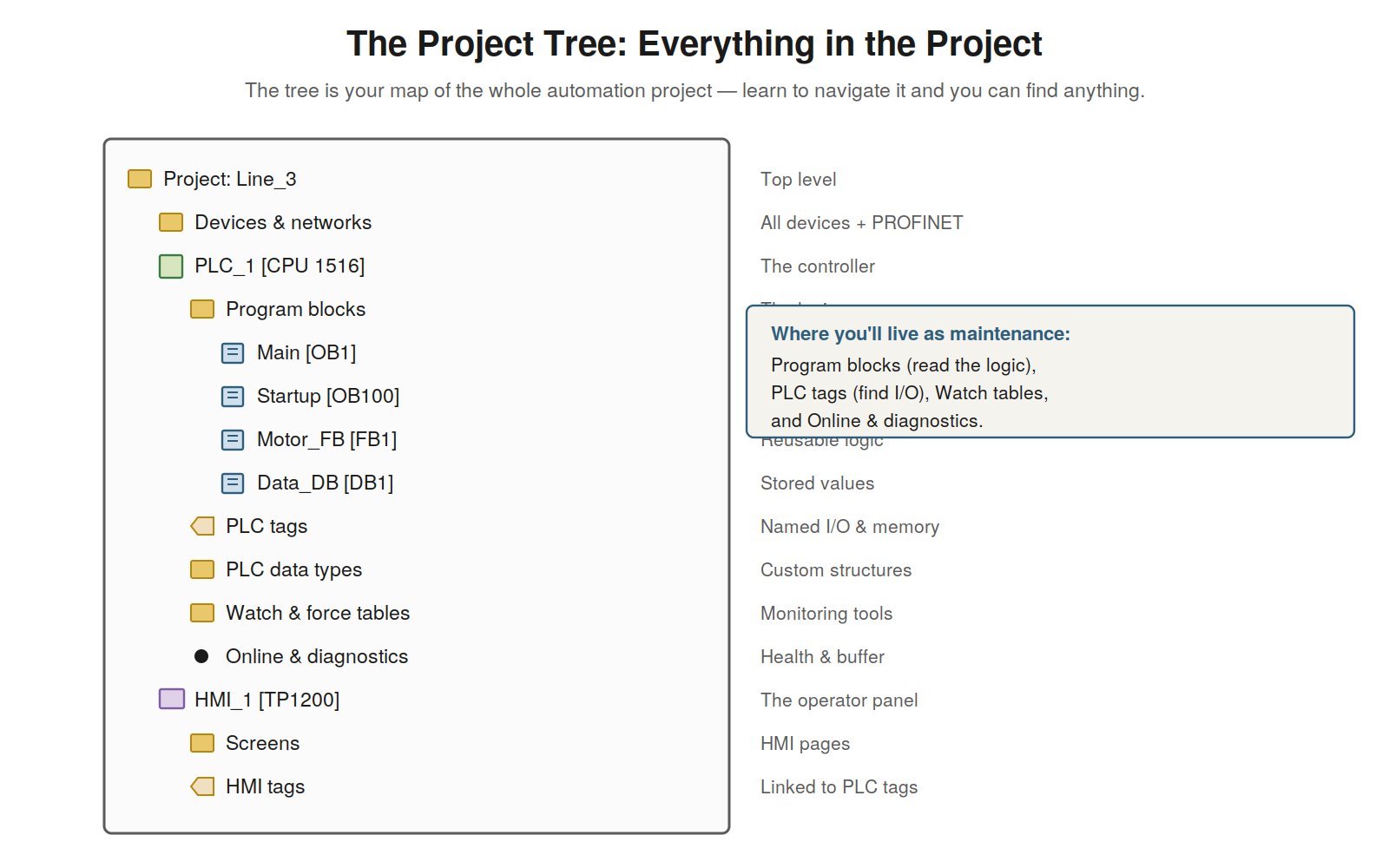
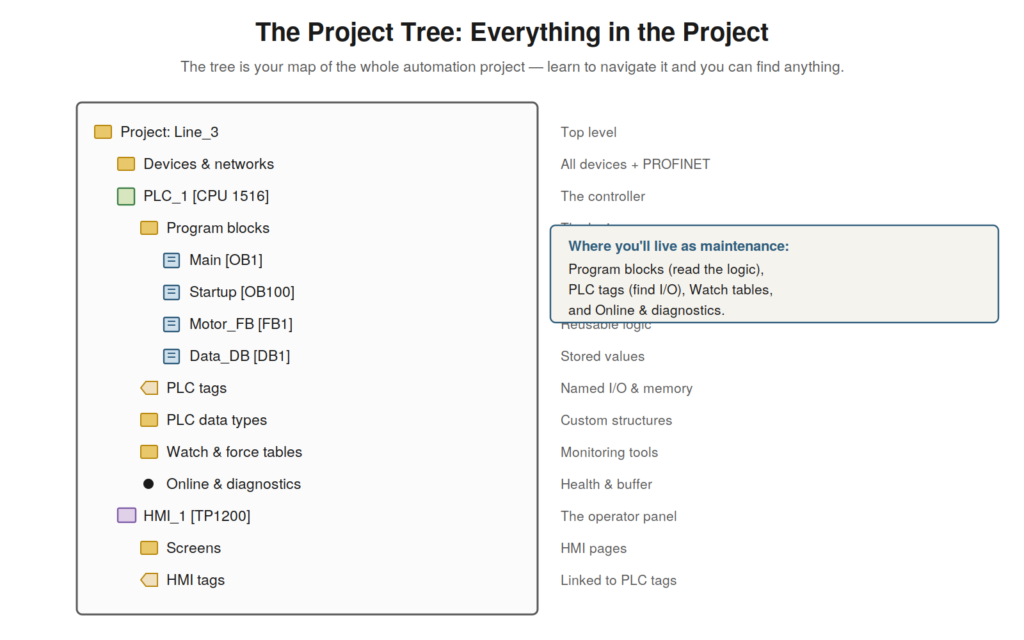
As maintenance, you’ll live mostly in Program blocks (read the logic),
PLC tags (find I/O), Watch & force tables (monitor), and Online
& diagnostics (health and the buffer).
You read rather than write
The core of the maintenance mindset is that you read rather than
write — your job is to understand existing programs, not create new
ones. This shapes how you approach a machine: you open its project to
read and understand what is there, not to change it. You navigate to the
logic to see how it works, you trace signals to understand the flow, you
monitor to see it run — all reading activities. When something is wrong,
you diagnose by reading the program and the diagnostics, finding the
cause, rather than by rewriting logic. This reading orientation is both
what maintenance actually requires and what keeps you safe, because
reading changes nothing. Understanding that you read rather than write
focuses your work on understanding existing programs — the actual
maintenance task — and orients you toward the reading and diagnostic
skills rather than programming. It reinforces that maintenance work is
fundamentally about reading and understanding existing programs to
diagnose problems, not about writing new logic, so that your approach to
any machine is to read and understand it, using TIA Portal’s monitoring
and diagnostic tools to see and comprehend what is there. Understanding
this reading orientation — the heart of the maintenance mindset — shapes
your whole approach: you come to understand and diagnose, reading the
existing program and its behavior, which is what maintenance requires
and what this book’s skills support.
Look before you touch
A crucial part of the maintenance mindset is to look before you touch
— to observe and understand before making any change — and this is both
good practice and a safety principle. Going online and monitoring a
machine changes nothing: you can watch the program run, see the values,
observe the behavior, all without affecting the machine at all. So you
should look freely, using this safe observation to understand the
situation fully before considering any change. Only after you understand
— what the machine is doing, why, and what is wrong — should you
consider whether a change is needed, and then make it deliberately.
Looking before touching means you never change something you do not
understand, and you exhaust the safe observation before any potentially
disruptive action. Understanding this principle — look (safely) before
you touch (which may affect the machine) — is central to the maintenance
mindset. It reinforces the safe, effective approach: observe and
understand fully first, using the risk-free monitoring, before
considering any change, so that you act from understanding rather than
guesswork, and you exhaust the safe options before any disruptive ones.
Understanding ‘look before you touch’ — the discipline of observing and
understanding, which is safe, before changing, which may not be — is a
foundation of safe, effective maintenance work in TIA Portal, ensuring
you understand before you act and use the safe observation fully before
any change that could affect the machine.
Respect that the tool changes real machines
The third element of the maintenance mindset is respecting that TIA
Portal can change real machines — that certain actions have physical
consequences — which underlies all safe use of the tool. While
monitoring is safe, other actions are not merely software operations:
downloading a changed program alters what the controller does, forcing
an input or output overrides the real I/O, and either can start, stop,
or disturb machinery. So these actions must be treated with the same
respect as working on live equipment, because that is effectively what
they are — changing a running machine through software. Respecting this
means treating downloads, forces, and online edits as physical acts
affecting real machinery, to be done deliberately, safely, with the
machine secured and people warned. Understanding this respect — that TIA
Portal’s changes are physical acts on real machines — underlies safe use
of the tool. It reinforces the crucial distinction between safe
monitoring (which changes nothing) and machine-changing actions (which
affect real equipment), and the respect the latter demand. Understanding
that TIA Portal can change real machines — and treating those changes
with appropriate respect and caution — completes the maintenance
mindset, ensuring that while you monitor freely, you change carefully,
treating downloads and forces as the physical acts they are, which is
essential to using the tool safely on real, running machinery that these
actions can physically affect.
THE GOLDEN RULEMonitor freely, change carefully. Going online and watching a machine |
Why the mindset prevents mistakes
It is worth understanding why the maintenance mindset specifically
prevents the mistakes that cause trouble, because appreciating this
reinforces the discipline. Most serious mistakes in maintenance work
come from acting without understanding, or from changing something
carelessly: downloading a wrong change, forcing an output without
realizing the consequences, editing logic you do not fully understand.
The maintenance mindset — read before you write, look before you touch,
respect that the tool changes machines — directly guards against exactly
these mistakes: it ensures you understand before acting (preventing
changes made in ignorance), observe safely first (preventing premature
action), and treat changes with care (preventing careless machine
changes). So the mindset is not just good attitude but specific
protection against the actual causes of maintenance mistakes.
Understanding why the mindset prevents mistakes — that it guards against
acting without understanding and changing carelessly, the real causes of
trouble — reinforces its discipline. It reinforces that the maintenance
mindset is protective, directly preventing the mistakes that cause
serious problems, by ensuring understanding before action and care with
changes. Understanding why the maintenance mindset prevents mistakes —
that it addresses the actual causes of maintenance trouble (ignorant
action, careless change) — gives you a concrete reason to maintain the
discipline, because the mindset is not mere caution but specific
protection against the mistakes that genuinely cause harm in maintenance
work, making the discipline of reading before writing, looking before
touching, and respecting the tool’s power a practical safeguard against
real and serious mistakes.
Scenario: the change that wasn’t needed
A scenario shows the maintenance mindset preventing a needless, risky
change. A machine was misbehaving, and a technician’s first instinct was
to change the program — to modify the logic to fix the symptom. But
following the maintenance mindset — look before you touch, understand
before changing — they first went online and monitored, observing what
was actually happening. Watching the live logic, they saw that the
program was working correctly; the problem was a sensor giving a wrong
signal (an input stuck due to a field problem), which the correct logic
was faithfully responding to. The fix was to the sensor, not the program
— no logic change was needed at all. Had they changed the program first,
they would have made an unnecessary, risky change and not fixed the real
problem. This scenario shows the maintenance mindset — look before you
touch — preventing a needless program change and leading to the real
cause. Understanding to observe and understand before changing led the
technician to the actual cause (a sensor) rather than a needless program
change. It reinforces that looking before touching prevents unnecessary,
risky changes by revealing the real cause first, which is often not what
a hasty change would have addressed. The scenario reinforces the
maintenance mindset’s value: by monitoring first, the technician found
the real cause (a faulty sensor) and avoided an unnecessary program
change, illustrating how looking before touching prevents needless,
risky changes and leads to the actual cause, which is exactly what the
discipline of understanding before acting is meant to achieve.
Confidence without recklessness
A nuance of the maintenance mindset worth developing is the balance
between confidence and caution — being confident enough to use the tool
effectively without being reckless — and understanding this balance
makes you effective and safe. Some technicians are so cautious they
hesitate to even go online, missing the powerful, safe diagnostic
capability that monitoring provides; others are so casual they change
things carelessly, risking harm. The right balance is confidence in the
safe activities (going online and monitoring freely, because they change
nothing) combined with caution in the changing activities (downloads,
forces, treated carefully). This balance — confident monitoring, careful
changing — lets you use TIA Portal to its full diagnostic potential
while staying safe. Developing it means being neither afraid of the safe
capabilities nor careless with the dangerous ones. Understanding the
balance of confidence without recklessness — confident in the safe
activities, careful with the changing ones — makes you both effective
and safe. Understanding confidence without recklessness — the balance of
using the safe capabilities freely while treating changes with care — is
a nuance that makes you a good maintenance technician, neither so timid
you miss the safe diagnostic power of monitoring nor so casual you risk
harm with careless changes, so that you develop the confidence to use
TIA Portal’s safe capabilities to their full potential combined with the
caution to treat its machine-changing capabilities with the respect they
demand, which is the mature balance the maintenance mindset aims at.
The mindset as your protection
Consolidating the maintenance mindset, it is fundamentally your
protection — protecting the machines, the process, people, and yourself
— and understanding it this way underscores its importance. The
mindset’s elements all protect: reading before writing protects against
changes made without understanding; looking before touching protects
against premature action and lets you exhaust safe options; respecting
that the tool changes machines protects against careless, harmful
changes. Together they protect the machine (from bad changes), the
process (from disruption), people (from the hazards of unexpected
machine action), and you (from the consequences of mistakes). So the
maintenance mindset is not a constraint but a protection, keeping your
work safe and sound. Adopting it fully means working in a way that
inherently guards against the things that go wrong. Understanding the
mindset as your protection — guarding the machine, process, people, and
yourself — underscores why it matters and motivates adopting it.
Understanding the maintenance mindset as your protection — guarding the
machine, the process, people, and yourself against the mistakes and
hazards of maintenance work — underscores its fundamental importance, so
that you see the discipline of reading before writing, looking before
touching, and respecting the tool’s power not as a constraint but as the
protection it is, keeping your work safe and sound by inherently
guarding against the things that go wrong, which is why the maintenance
mindset is worth adopting fully as the protective foundation of all your
work in TIA Portal.
Part II — Going Online and Monitoring
Monitoring a specific block or network
A practical refinement of monitoring is focusing on the specific
block or network relevant to your problem, and understanding how to
navigate to it makes monitoring efficient. A program can be large, with
many blocks and networks, so rather than scrolling through everything,
you navigate to the specific part relevant to your fault: the block
containing the logic for the output you are diagnosing, and the specific
network (rung) within it. You reach this via the tree (opening the
relevant block) or, powerfully, via cross-references (jumping straight
to where a tag is used). Once at the relevant network, you monitor it,
watching just the logic that matters for your problem. So effective
monitoring is focused: navigate to the relevant block and network, then
monitor there. Understanding how to focus monitoring on the specific
relevant logic — navigating via the tree or cross-references — makes it
efficient. It reinforces that monitoring is most effective when focused
on the specific block and network relevant to the problem, reached by
navigating there, rather than scrolling through the whole program.
Understanding how to monitor a specific block or network — navigating to
the relevant logic via the tree or cross-references, then monitoring
there — makes your monitoring efficient and targeted, focusing on the
logic that matters for your fault rather than the whole program, which
is the practical way to use monitoring in a real program of many blocks,
going straight to the relevant logic and watching it, especially by
using cross-references to jump to where the signal of interest is
used.
Scenario: following the green to the cause
A scenario shows live monitoring solving a classic fault. A machine’s
hydraulic pump would not start, and the technician went online to
monitor the pump’s start logic. Watching the live rung, they followed
the green (energized) path from the left and saw where it stopped: a
contact for ‘oil level OK’ was not green — the path was broken there.
This told them immediately that the oil-level condition was not
satisfied — the program was correctly refusing to start the pump because
the oil level signal said not-OK. Investigating that signal, they found
the oil level sensor faulty (reading low when the level was fine). The
fix was the sensor. Following the green straight to the broken condition
had led directly to the cause. This scenario shows the core monitoring
technique — following the green to the first false condition — solving a
start-failure fault. Understanding how to read the live logic and trace
to the breaking condition led the technician straight to the unsatisfied
oil-level condition and thence to the faulty sensor. It reinforces that
following the energized path to the first false condition is the
powerful diagnostic technique for ‘why won’t it start’, pointing
straight to the blocking condition. The scenario reinforces the value of
live monitoring: by following the green to the first non-energized
contact, the technician found the blocking condition (oil level not OK)
and its cause (a faulty sensor), illustrating the core maintenance skill
of tracing live logic to the condition preventing an output, which
resolves so many start-failure faults.
When monitoring shows nothing wrong
A situation that requires a nuanced response is when monitoring shows
nothing wrong — the logic looks correct — yet the machine misbehaves,
and understanding how to proceed handles this. Sometimes you monitor the
relevant logic and it all appears correct: the conditions are as
expected, the outputs match the logic, nothing is obviously broken. Yet
the machine is not behaving right. This points away from the program
logic and toward other causes: a sensor giving a wrong signal (the logic
correctly responds to bad input), a hardware problem (the output is
commanded correctly but does not physically act), a mechanical issue
(the control is right but something physical is stuck), or a problem in
logic you have not yet examined. So when monitoring shows correct logic
but wrong behavior, you widen the investigation: check the inputs (are
the sensors telling the truth?), the outputs (do they physically act?),
and the mechanical side. Understanding how to proceed when monitoring
shows nothing wrong — widening to inputs, outputs, hardware, and
mechanics — handles this nuanced situation. Understanding what to do
when monitoring shows nothing wrong — recognizing that correct logic
with wrong behavior points to sensors, hardware, or mechanics rather
than the program — handles a nuanced situation, so that a
correct-looking program does not leave you stuck but redirects you to
check whether the inputs are truthful, the outputs physically act, and
the mechanical parts function, which is where the problem lies when the
logic itself is monitoring as correct, widening the investigation
appropriately beyond the program logic that monitoring has shown to be
working.
Monitoring as the technician’s superpower
Consolidating the monitoring material, live monitoring is, more than
any other, the maintenance technician’s superpower in TIA Portal — the
capability that most transforms their ability to diagnose — and
understanding this emphasizes developing it well. Before monitoring,
diagnosing a control problem meant inferring what the program was doing
from outside; with monitoring, you see it directly, watching the logic
execute and the conditions change in real time. This direct sight of the
running logic is extraordinarily powerful: it turns diagnosis from
inference into observation, letting you see exactly what is happening
and why. And it is entirely safe, changing nothing, so you can use it
freely. This combination — powerful and safe — makes monitoring the
capability that most elevates the maintenance technician’s diagnostic
ability. So developing monitoring skill well repays the effort more than
almost anything else. Understanding monitoring as the technician’s
superpower — the safe, powerful capability that most transforms
diagnosis — emphasizes developing it well. Understanding live monitoring
as the maintenance technician’s superpower — the safe, powerful
capability that most transforms the ability to diagnose, turning
inference into direct observation of the running logic — emphasizes
developing it well, so that you recognize monitoring as the skill that
most elevates your diagnostic ability, letting you see exactly what the
program is doing and why, safely and freely, which is why it repays the
effort to develop your monitoring skill thoroughly, as it is the single
most valuable capability TIA Portal gives the maintenance technician for
understanding and diagnosing running machines.