A time delay relay is one of those small control panel components that makes machines behave in the right order.
Not everything in automation should happen instantly. Sometimes a motor needs to start a few seconds after a fan. Sometimes a warning lamp must stay on after a signal disappears. Sometimes a conveyor should stop only after the last product has passed. A normal relay can switch immediately, but a timer relay adds one important thing:
Time.
A time delay relay, often simply called a timer, is a device that changes its output contact state after a preset delay. It may delay the switching-on action, the switching-off action, or perform more advanced timing functions depending on the model.
Simple component. Very useful.
What Is a Time Delay Relay?
A time delay relay is an electrical control device that opens or closes contacts after a defined time delay.
In many industrial control circuits, the output is a changeover contact, often SPDT. That means the timer has a common terminal, a normally closed contact, and a normally open contact. When the timer operates, the contact state changes.
A standard relay changes state immediately when its coil is energized.
A time delay relay does not always do that.
Depending on the function, it may wait before switching on, wait before switching off, pulse for a set time, flash on and off, or perform another timing sequence.
In simple words:
A relay switches.
A timer relay switches with timing logic.
That timing function is what makes it valuable in automation circuits.
Why Are Timer Relays Used?
Timer relays are used when a control action must happen after a delay or remain active for a certain period.
Common uses include:
- Delayed motor starting
- Star-delta starter timing
- Fan run-on control
- Conveyor delay control
- Pump delay control
- Alarm delay
- Warning light delay
- Sequential machine operation
- Delayed shutdown
- Anti-short-cycle protection
- Automatic reset timing
- Signal stretching
- Flashing light control
For example, a machine may need a lubrication pump to run before the main motor starts. A timer can energize the main motor contactor only after the lubrication time has passed.
Or a fan may need to continue running after a heater is switched off. An OFF-delay timer can keep the fan circuit active for a few minutes.
Little timing details like that keep machines safer and smoother.
Basic Timer Relay Contacts
Many time delay relays have SPDT output contacts.
SPDT means single pole double throw.
This usually gives three contact terminals:
- Common contact
- Normally closed contact
- Normally open contact
Before the timer operates, the common contact is connected to the normally closed contact. After timing is complete, the common contact changes over to the normally open contact.
Some timers have more contacts, such as DPDT outputs. Others have transistor outputs or solid-state outputs. But the basic principle is the same: the timer receives an input signal and changes its output after a defined time function.
In control diagrams, timer contacts are often shown separately from the timer coil or supply terminals. That can look confusing at first, but it is just the same device split across the circuit drawing.
ON-Delay Timer
The ON-delay timer is probably the most common timer function.
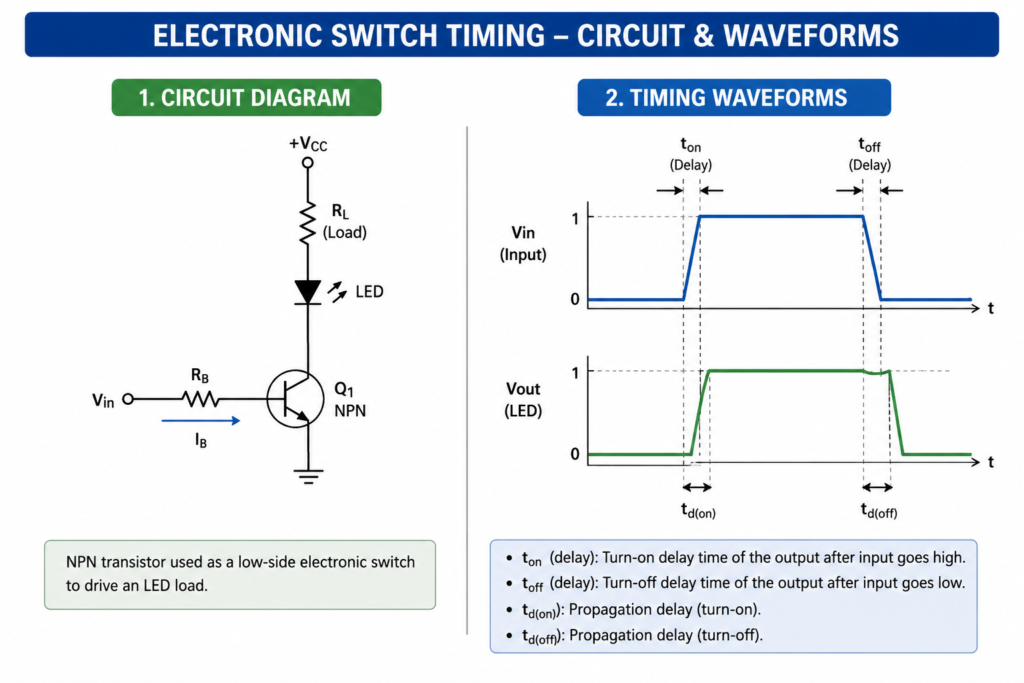
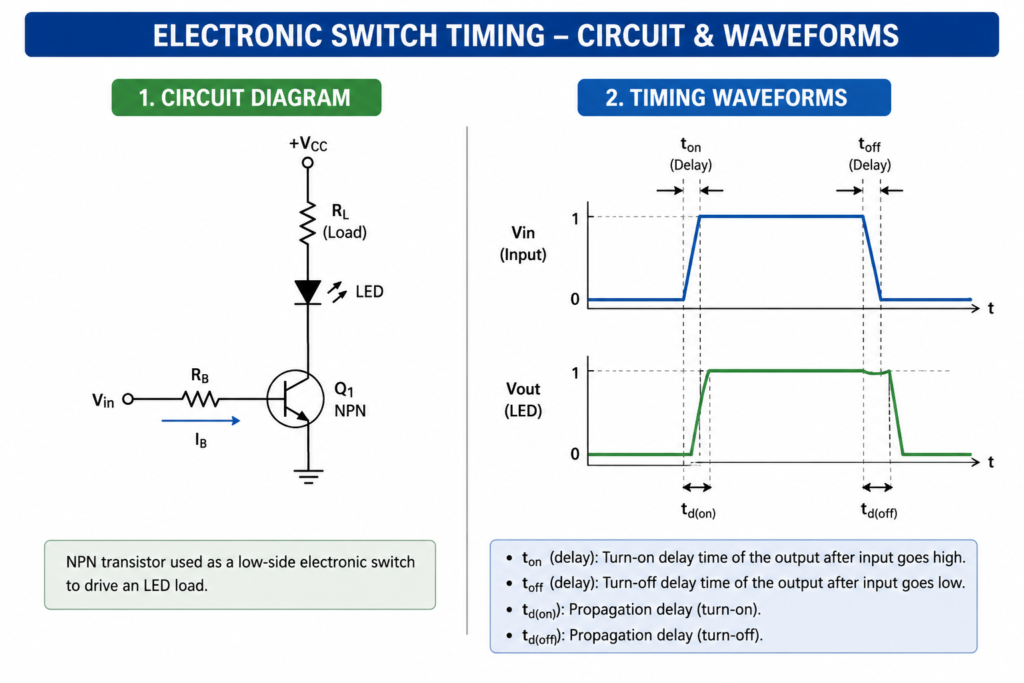
With an ON-delay timer, timing begins when supply voltage is applied to the timer input. During the timing period, the output contacts remain in their normal state. When the preset time expires, the output contacts change state.
The output remains active as long as the input voltage stays applied. When the input voltage is removed, the output returns to its normal state.
The sequence looks like this:
- Voltage is applied to the timer.
- Timing starts.
- Output remains unchanged during the delay.
- Preset time expires.
- Output contact changes state.
- Voltage is removed.
- Output resets immediately.
This is useful when something should happen only after a signal has been present for a certain time.
ON-Delay Timer Example
Imagine a conveyor system where a motor should start 5 seconds after a start command.
The operator presses start. The timer receives voltage. The timer waits 5 seconds. After the delay, the timer contact closes and energizes the motor contactor.
If the start signal disappears before the 5 seconds are complete, the timer resets and the motor does not start.
That is a typical ON-delay behavior.
This function is also useful when you want to ignore short accidental signals. If a sensor flickers for half a second but the timer is set to 3 seconds, the output never activates.
A cheap little way to avoid nuisance actions. Very handy.
OFF-Delay Timer
An OFF-delay timer works differently.
With an OFF-delay function, the output usually changes state immediately when the input signal is applied. When the input signal is removed, the timer starts counting. The output remains active during the delay period and only returns to normal after the preset time has expired.
The sequence looks like this:
- Voltage or control signal is applied.
- Output changes state immediately.
- Input signal is removed.
- Timing starts.
- Output remains active during the delay.
- Preset time expires.
- Output returns to normal.
This is useful when something must continue running for a while after the control signal disappears.
OFF-Delay Timer Example
A common example is a cooling fan.
When a machine heater turns off, the fan should continue running for 2 minutes to remove remaining heat. An OFF-delay timer allows the fan to keep running after the heater control signal is removed.
Another example is a warning light that should stay on briefly after a machine stops. The signal disappears, but the light remains active until the OFF-delay time finishes.
OFF-delay timers are often used for run-on functions, shutdown delays, and signal holding.
Electronic Timer Relays
Electronic timers are the most common modern timer relays.
They use electronic circuits, integrated timing chips, microcontrollers, or solid-state components to create the timing function. The output may be a small internal relay contact or a solid-state switching output.
Older or low-cost electronic timers may use an RC circuit, where capacitor charging is used as the timing reference. More advanced timers use digital timing circuits for better accuracy and repeatability.
Electronic timer relays are popular because they are compact, accurate, flexible, and available with many timing ranges.
Common timing ranges may include:
- 0.1–1 second
- 1–10 seconds
- 1–30 seconds
- 1–60 seconds
- 1–6 minutes
- 1–60 minutes
- Hours or days on some models
The exact range depends on the timer design.
How an Electronic ON-Delay Timer Works
In an electronic ON-delay timer, voltage is applied to the timer supply terminals. These terminals are often marked A1 and A2.
When voltage is applied, the internal timing circuit starts counting. During this period, the output contact stays in its initial state.
After the preset delay time expires, the internal relay switches. The normally open delayed contact closes, and the normally closed delayed contact opens.
When the supply voltage is removed, the timer resets and the output contacts return to their normal state.
This cycle can be repeated as many times as needed.
Input voltage on.
Wait.
Output switches.
Input voltage off.
Output resets.
Very straightforward.
Timer Adjustment Methods
Timer relays can be adjusted in several ways.
Common adjustment methods include:
- Front knob
- Recessed potentiometer
- DIP switches
- Thumbwheel switches
- Digital display
- Push buttons
- Software or communication interface on advanced models
A simple timer may have one knob for time setting. More advanced timers may have one selector for the time range and another knob for fine adjustment.
For example, one switch may select the range 1–10 seconds, and the knob sets the actual delay within that range.
Some timers support multiple functions in one unit, such as ON-delay, OFF-delay, pulse, interval, flasher, and star-delta timing. These are often called multifunction timers.
They are useful because one spare part can replace several timer types.
Timer Supply Voltage
Electronic timers are available for many supply voltages.
Common options include:
- 12 V DC
- 24 V DC
- 24 V AC
- 110 V AC
- 230 V AC
- Universal AC/DC supply ranges
Universal voltage timers are especially convenient because they can work with several different control voltages.
But still, do not assume.
Always check the label before wiring. Connecting a 24 V DC timer to 230 V AC is not a timing experiment. It is smoke generation.
Timer Output Rating
Timer relay outputs have electrical ratings.
A common relay output may be rated for several amps, sometimes around 5 A, 8 A, 10 A, or 12 A depending on the model.
But the real usable rating depends on the load type.
Switching a small PLC input is easy.
Switching a contactor coil is harder because it is an inductive load.
Switching a lamp, solenoid, or motor load can also stress contacts depending on current and inrush.
Important things to check include:
- Contact voltage rating
- Contact current rating
- AC or DC rating
- Resistive load rating
- Inductive load rating
- Minimum switching current
- Contact material
- Electrical life
For larger loads, the timer output should usually control a relay or contactor coil, not the main power load directly.
The timer decides.
The contactor does the heavy work.
Pneumatic Timer Relays
Pneumatic timers are mechanical-air timing devices often used together with contactors or control relays.
They are commonly mounted on the front or top of a contactor or relay. Their timing action is based on controlled air movement through a small orifice.
Inside a pneumatic timer, there may be a diaphragm, rubber bellows, small air cylinder, piston, spring, check valve, and adjustable air exhaust path.
The basic idea is simple: restrict air flow, and you create a delay.
No electronics needed.
That is why pneumatic timers still have a place in some industrial control systems, especially older panels or applications where their behavior is useful.
How a Pneumatic Timer Works
A pneumatic timer uses air flow restriction to control how quickly a mechanical part returns to position.
When the relay or contactor operates, it mechanically moves the pneumatic timer mechanism. Air enters or leaves a chamber through a check valve and adjustable orifice.
The adjustment knob changes the size of the air passage. A smaller opening slows the air movement and increases the time delay. A larger opening allows faster movement and reduces the delay.
At the end of the mechanical movement, the timer contacts change state.
In a very simple way:
Small air hole = slow movement.
Large air hole = fast movement.
That controlled movement creates the timing delay.
It is beautifully old-school.
Pneumatic ON-Delay and OFF-Delay
Pneumatic timers can be made for ON-delay or OFF-delay operation.
With a pneumatic ON-delay timer, the contact changes state after the relay or contactor has been energized for the set delay time.
With a pneumatic OFF-delay timer, the contact changes state immediately when the relay is energized, but returns to its normal state only after a delay when the relay is de-energized.
Some pneumatic timers can be changed between ON-delay and OFF-delay by a mechanical selector or by changing the mounting arrangement, depending on the design.
This makes them flexible in control circuits.
Advantages of Pneumatic Timers
Pneumatic timers have several practical advantages.
They are usually simple, rugged, and easy to adjust. They do not depend on complex electronics. They can be mounted directly to compatible contactors or relays. Some designs are also less affected by electrical noise than electronic timers.
Another interesting advantage is their behavior during power loss.
Because the timing energy can be stored mechanically or pneumatically, some OFF-delay pneumatic timers can still complete a delayed contact action after the electrical supply disappears. This can be useful in special fault indication circuits where a delayed alarm must activate using a separate backup supply.
That is a niche advantage, but a real one.
Common advantages include:
- Simple mechanical operation
- Easy adjustment with one knob
- No electronic timing circuit
- Good noise immunity
- Useful with contactor-mounted assemblies
- Some designs convertible between ON-delay and OFF-delay
- Can be useful in power-loss timing situations
Not flashy. But practical.
Limitations of Pneumatic Timers
Pneumatic timers also have limitations.
They are mechanical devices, so they can wear. Their timing accuracy is usually lower than modern electronic timers. Dirt, mechanical damage, air leakage, or worn seals can affect operation. Their available functions are also more limited.
Possible limitations include:
- Less timing accuracy than electronic timers
- Mechanical wear
- Limited timing functions
- Possible air leakage
- Sensitivity to dirt or mechanical damage
- Usually tied to compatible relays or contactors
- Larger physical size
- Slower adjustment precision
For modern compact control panels, electronic timers are usually more common. But pneumatic timers are still useful and can be very reliable in the right application.
Motorized or Electromechanical Timers
Motorized timers, also called electromechanical timers, use a small motor and gear mechanism to create a time delay.
The motor may be a synchronous motor or a clock-style motor. When energized, it rotates gears. These gears move a cam or mechanical mechanism that eventually changes the state of electrical contacts.
Some electromechanical timers have one time range. Others have multiple ranges selected by a small switch or gear mechanism.
A visible adjusting knob is often provided on the front. In some designs, the knob moves during timing, acting like a pointer so you can see the remaining time.
That moving pointer is actually quite satisfying to watch. Like a tiny industrial kitchen timer, but less friendly.
Advantages of Motorized Timers
Motorized timers can provide repeatable timing and visible mechanical operation.
They are useful in applications where mechanical timing indication is helpful or where older control systems were designed around them.
Advantages include:
- Clear mechanical timing action
- Visible moving pointer on some models
- Multiple timing ranges on some designs
- Instantaneous and delayed contacts available
- Suitable for repeated operations
- Familiar operation in older control systems
They are less common in modern compact panels than electronic timers, but they still exist and still do useful work.
Limitations of Motorized Timers
Because motorized timers contain moving parts, they are subject to mechanical wear.
They may also be larger, noisier, less flexible, and less accurate than electronic timers. The motor and gear system can fail over time, especially in dusty or vibrating environments.
Possible limitations include:
- Mechanical wear
- Larger size
- Motor failure
- Gear wear
- Limited timing functions
- Less flexibility than electronic multifunction timers
- Dependence on supply frequency for some synchronous designs
For new designs, electronic timers are often the easier choice. For older systems, motorized timers may still be found and should be understood.
Other Timer Functions
ON-delay and OFF-delay are the two most basic timer functions, but many other timing modes exist.
Common additional timer functions include:
- Pulse timer
- Interval timer
- Flasher timer
- Repeat cycle timer
- Star-delta timer
- Delay-on with pulse activation
- One-shot timer
- Two-time constant timer
- Asymmetric flasher with separate ON and OFF times
A flasher timer alternates the output on and off. This is useful for warning lights or signal lamps.
A pulse timer gives an output for a fixed time after receiving a trigger.
A two-time constant timer allows separate ON time and OFF time settings, often called T1 and T2.
A star-delta timer is used in motor starting circuits to change from star connection to delta connection after a preset delay.
Modern multifunction timers can include many of these modes in one unit.
Which is nice, until someone sets the wrong function and spends half an hour wondering why the output is doing something weird.
Timer Relays in PLC Systems
Modern PLCs have internal software timers.
So why use external timer relays?
Good question.
In many new systems, timing logic is handled inside the PLC. PLC timers are flexible, easy to change in software, and do not require extra panel components.
But hardware timer relays are still used for several reasons:
- Simple machines without PLCs
- Safety or backup timing functions
- Retrofitting old control panels
- Local timing independent of PLC logic
- Motor starter circuits
- Fan run-on control
- Pump control
- Alarm delay
- Star-delta starters
- Systems where electricians need simple hardware adjustment
Sometimes a physical knob on a timer is easier than opening PLC software, connecting a laptop, finding the timer block, changing a value, downloading, and hoping nobody changed the wrong project file.
There’s a place for both.
Choosing the Right Timer Relay
When selecting a timer relay, check the application carefully.
Important selection points include:
- Required timing function
- Timing range
- Supply voltage
- Output contact rating
- Number of contacts
- Mounting style
- Reset behavior
- Trigger input requirements
- Accuracy
- Repeatability
- Environmental conditions
- Need for LED indication
- Need for multifunction operation
- Mechanical or electronic preference
For example, an ON-delay electronic timer is a good choice for delayed motor starting. An OFF-delay timer is better for fan run-on. A flasher timer is useful for a warning lamp. A star-delta timer is designed specifically for motor starting transition.
Using the wrong timer function is a very easy mistake.
The timer may work perfectly and still do the wrong job.
Installation Tips
Timer relays are usually simple to install, but some details matter.
Good installation practice includes:
- Check supply voltage before wiring
- Confirm A1 and A2 supply terminals
- Use the correct contact terminals
- Check NO and NC contact function
- Match output rating to load
- Use a contactor or interposing relay for larger loads
- Label timing function and setting
- Protect settings from accidental changes
- Separate control wiring from noisy power cables
- Confirm operation after installation
- Test timing with a real control sequence
For OFF-delay electronic timers, check whether the timer needs a permanent supply and a separate trigger input. Many electronic OFF-delay timers require continuous power to time correctly after the control signal disappears.
That detail catches people.
With an ON-delay timer, power-on timing is simple. With OFF-delay, wiring can be slightly more specific.
Common Timer Relay Applications
Timer relays are used in many industrial and building control systems.
Typical applications include:
- Conveyor sequence delay
- Star-delta motor starting
- Pump start delay
- Fan run-on delay
- Heater cooldown control
- Alarm delay
- Warning light flashing
- Delayed contactor operation
- Automatic reset delay
- Door lock delay
- Compressor anti-short-cycle timing
- Packaging machine timing
- Process step delay
- Signal pulse generation
- Machine startup sequencing
Any time a machine needs a delay, a timer relay might be involved.
And once you start noticing them, they are everywhere.
Final Thoughts
A time delay relay is a control device that changes its output after a preset time.
The two most common functions are ON-delay and OFF-delay. An ON-delay timer waits after receiving power before switching its output. An OFF-delay timer switches immediately but waits before returning to normal after the signal disappears.
Timer relays can be electronic, pneumatic, or motorized.
Electronic timers are compact, accurate, flexible, and widely used in modern control panels. Pneumatic timers use controlled air movement and are often mounted with contactors or relays. Motorized timers use a small motor and gear mechanism to operate contacts after a delay.
Each type has its own strengths.
The important thing is to choose the right timing function, correct voltage, proper contact rating, and suitable time range. Then wire it carefully and test the real sequence.
Because in automation, timing is not just a detail.
Sometimes it is the difference between a machine running smoothly and a machine doing everything in the wrong order.