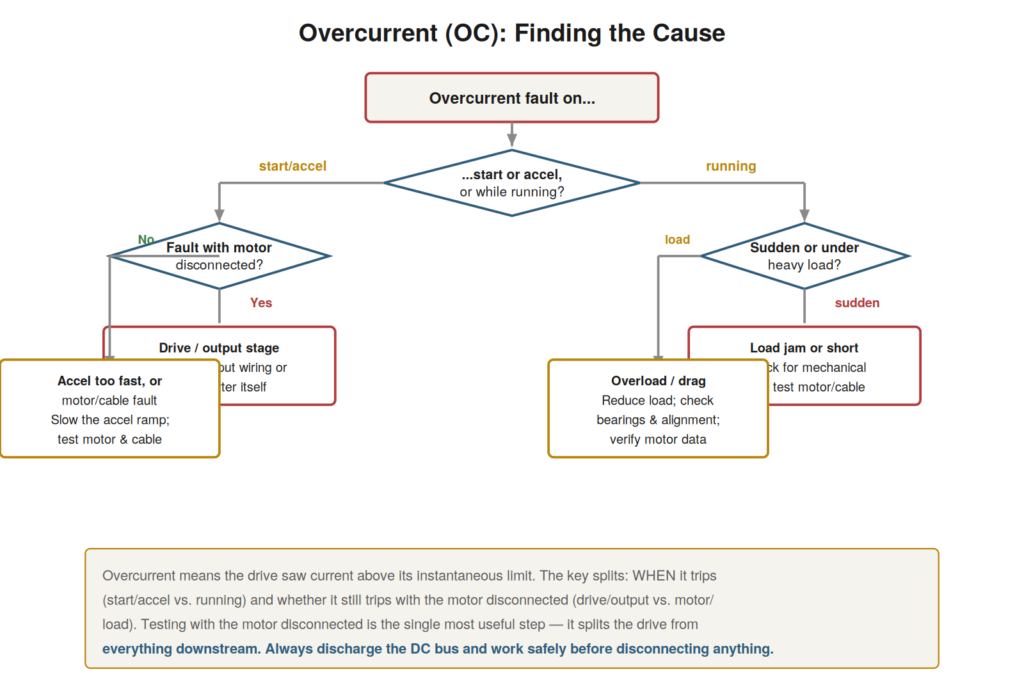
Overcurrent is one of the most common drive faults, and it has a
structured diagnosis that follows from when it occurs and whether it
persists with the motor disconnected. An overcurrent fault means the
drive detected current above its instantaneous limit — a condition it
must trip on quickly to protect its output stage. Because overcurrent
can arise from the drive, the output wiring, the motor, or the load, a
systematic approach to localizing it is essential, and this chapter
provides one.
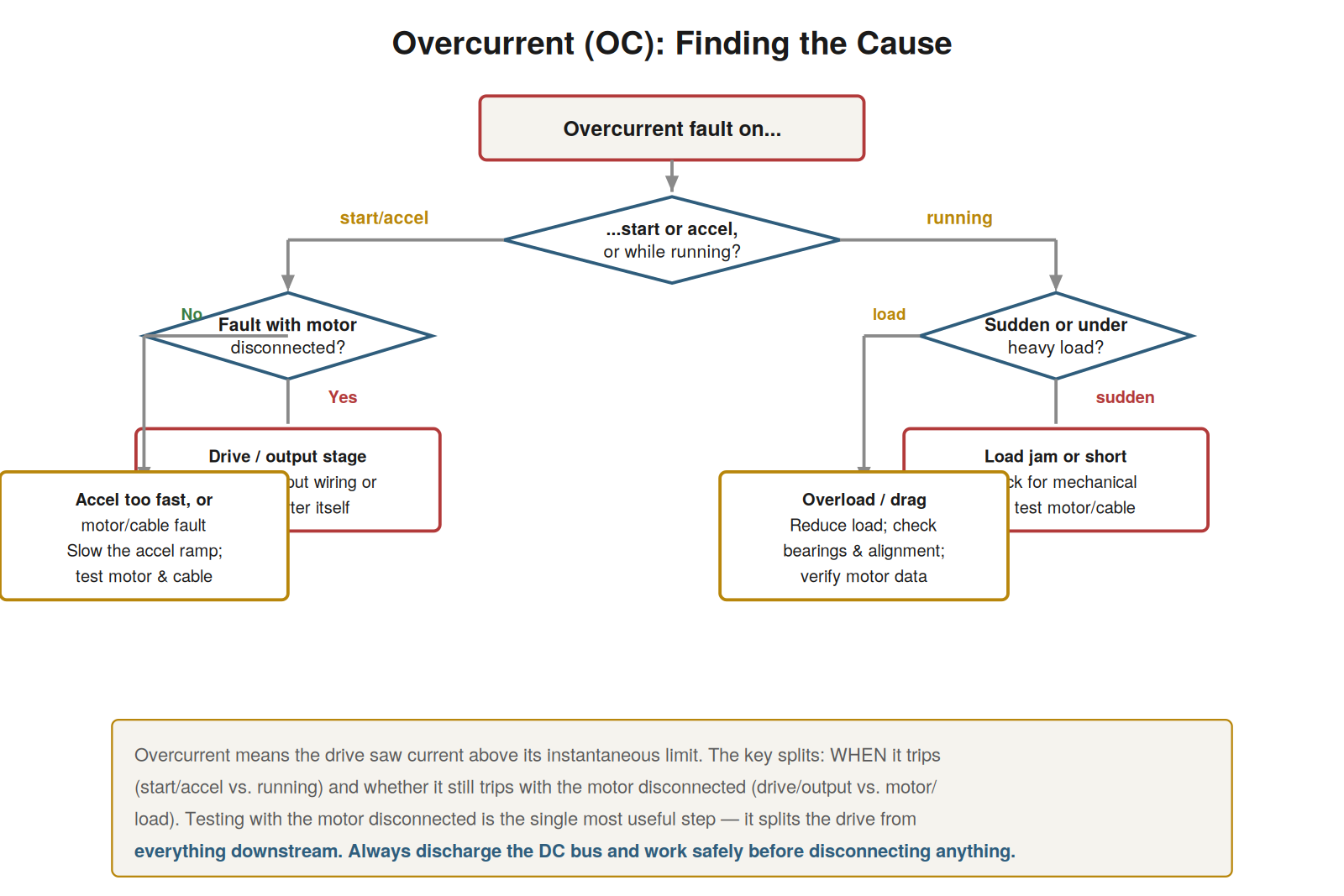
trips (start/accel versus running) and whether it still trips with the
motor disconnected (drive/output versus motor/load). Testing with the
motor disconnected is the single most useful step. Always discharge the
DC bus and work safely.
What overcurrent means
An overcurrent fault means the drive detected a current exceeding its
instantaneous limit — a rapid, large overcurrent that the drive must
interrupt immediately to protect its inverter, which cannot tolerate
excessive current even briefly. This is distinct from an overload (a
sustained moderate overcurrent, covered separately): overcurrent is a
fast, large current spike that trips the drive quickly. The current
could come from several sources: a short circuit at the output (in the
cable or motor, or the inverter itself), the drive forcing too rapid an
acceleration (drawing high current), a mechanical jam or short in the
load, or a motor or cable fault. In each case, the current momentarily
exceeds the drive’s limit, and the drive trips to protect itself.
Understanding what overcurrent means — a fast, large overcurrent
exceeding the instantaneous limit, tripped quickly to protect the
inverter — frames the diagnosis. It clarifies that overcurrent is about
a current spike, not sustained overloading, and that the diagnosis seeks
the source of the spike — a short, a too-fast acceleration, a jam, or a
fault. Understanding the nature of overcurrent directs the diagnosis
toward these sources of excessive instantaneous current, distinguishing
it from the overload fault and focusing on what could cause the rapid
current spike that trips the drive’s fast overcurrent protection.
When does it trip?
The first key question in diagnosing overcurrent is when it trips —
at start or during acceleration, or while running steadily — because
this points to different causes. Overcurrent at start or during
acceleration often points to too-fast an acceleration ramp (the drive
forcing rapid acceleration draws high current), or to a fault that draws
high current immediately (a short in the output or motor). Overcurrent
while running steadily points to a change during operation — a sudden
mechanical jam or short causing a current spike, or a load increase. So
the timing of the overcurrent — at accel versus running — distinguishes
acceleration-related causes (too-fast ramp) from running causes (jam,
short, load change). Understanding this first split — when the
overcurrent trips — directs the diagnosis: an accel-time overcurrent
suggests checking the acceleration ramp (and for output faults), while a
running overcurrent suggests looking for a jam, short, or load change
during operation. It reinforces establishing when the fault occurs as an
early diagnostic step, because the timing points toward the likely
causes, distinguishing the common acceleration-ramp cause (easily fixed
by slowing the ramp) from running faults, and focusing the diagnosis on
the causes relevant to when the overcurrent actually occurs, which the
drive’s fault conditions or observation of when it trips reveals.
The disconnected-motor test
The single most useful step in diagnosing overcurrent is testing with
the motor disconnected, because it cleanly separates drive and
output-wiring faults from motor and load faults. With the drive safely
isolated and the DC bus discharged, disconnecting the motor cable from
the drive output and then testing (running the drive with no motor,
where the drive permits, or checking the output) separates the drive
from everything downstream: if the drive still faults on overcurrent
with the output disconnected, the problem is in the drive itself (its
output stage). If the overcurrent occurs only with the motor connected,
the problem is downstream — in the output cable, the motor, or the load.
This test is powerful because it addresses the central question — is the
fault in the drive or in what it feeds — with a single step. Following
it, if the fault is downstream, further tests (insulation testing the
motor and cable, checking the load) localize it further. Understanding
the disconnected-motor test — separating the drive from the motor,
cable, and load — as the key overcurrent diagnostic directs the
diagnosis efficiently. It reinforces this test as the most valuable
step: it determines whether the overcurrent originates in the drive or
downstream, which focuses all further diagnosis on the correct side,
making the disconnected-motor test — done safely, respecting the DC bus
— the pivotal step in localizing an overcurrent fault to the drive or to
the motor, cable, or load it feeds.
Overcurrent versus overload
It is important to distinguish overcurrent from overload clearly,
because they are different faults with different causes and diagnoses,
though both involve excess current. Overcurrent is a fast, large
overcurrent — an instantaneous current spike exceeding the drive’s
instantaneous limit — that the drive trips on quickly to protect its
inverter. Overload is a sustained moderate overcurrent — the motor
drawing above its rating for a period — that the drive’s overload
protection trips on after a time to protect the motor from overheating.
So overcurrent is about a fast spike (protecting the inverter), while
overload is about sustained excess current (protecting the motor). Their
causes differ accordingly: overcurrent comes from shorts, too-fast
acceleration, or sudden jams (causing current spikes), while overload
comes from sustained heavy load, wrong motor data, or mechanical drag
(causing sustained excess current). Understanding this distinction —
overcurrent (fast spike, inverter protection) versus overload
(sustained, motor protection) — is essential to diagnosing each
correctly. It reinforces reading which fault the drive reports and
diagnosing it appropriately: overcurrent by looking for spike causes
(shorts, fast accel, jams), overload by looking for sustained-current
causes (load, motor data, drag). Confusing the two leads to the wrong
diagnosis, so understanding that overcurrent and overload are distinct
faults — despite both involving excess current — with different natures,
causes, and diagnoses, is important to addressing each correctly,
directing the diagnosis to the fast-spike causes for overcurrent and the
sustained-current causes for overload.
Scenario: disconnected motor splits the fault
A scenario shows the disconnected-motor test in action. A drive
tripped on overcurrent immediately on starting, and it was unclear
whether the drive, the motor, or the cable was at fault. Applying the
disconnected-motor test, the technician safely isolated the drive,
waited for and verified the DC bus discharge, disconnected the motor
cable from the drive output, and then tested. The drive, with its output
disconnected, no longer tripped on overcurrent — it started and ran
normally with no motor connected. This showed the drive itself was fine,
and the overcurrent occurred only with the motor and cable connected, so
the fault was downstream. Insulation-testing the motor and cable (now
disconnected from the drive) revealed a short in the motor cable, which
had caused the overcurrent whenever the drive tried to drive it.
Replacing the damaged cable resolved the fault. This scenario shows the
disconnected-motor test splitting the fault cleanly: the drive was fine
disconnected, localizing the fault downstream, where the cable short was
found. Understanding that disconnecting the motor separates the drive
from the downstream circuit explains this: the test showed the drive
healthy and the fault downstream, directing the diagnosis to the motor
and cable, where the short was. It reinforces the disconnected-motor
test as the key overcurrent diagnostic, cleanly separating the drive
from the motor, cable, and load, so the fault is localized to the
correct side — here downstream, revealing the cable short — which is why
this test is the most valuable step in overcurrent diagnosis.
Slowing the accel ramp as a first move
For overcurrent occurring during acceleration, slowing the
acceleration ramp is often a good first move, and understanding why
makes it an efficient early step. Overcurrent on acceleration is very
commonly caused by too-fast an acceleration ramp forcing high current, a
parameter issue easily addressed by extending the ramp. Because this is
such a common cause and the fix is simple (a parameter change, no
hardware work), trying a slower acceleration ramp early — when
overcurrent occurs specifically on acceleration — is efficient: if it
resolves the fault, the cause was the ramp, quickly fixed; if it does
not, the cause is elsewhere (a fault or short), and the diagnosis
continues. So for acceleration overcurrent, extending the ramp is a
quick, common-cause-addressing first move. Understanding why — too-fast
acceleration is a common overcurrent cause, easily fixed by slowing the
ramp — makes this an efficient early step. It reinforces that for
overcurrent on acceleration specifically, checking and extending the
acceleration ramp is a sensible first move, addressing the common cause
quickly before deeper investigation. Understanding that acceleration
overcurrent is often simply a too-fast ramp — a common, easily-fixed
parameter cause — reinforces trying a slower ramp early for acceleration
overcurrent, an efficient step that resolves the common case quickly
and, if unsuccessful, directs the diagnosis to other causes, making it a
practical first move that reflects the common cause of acceleration-time
overcurrent faults.
Overcurrent diagnosis in summary
Bringing the overcurrent diagnosis together consolidates the approach
to this common fault. Overcurrent means a fast, large overcurrent
tripping the drive to protect its inverter, and the diagnosis proceeds
by two key questions: when does it trip (at accel, pointing to a
too-fast ramp or fault; while running, pointing to a jam, short, or load
change), and does it persist with the motor disconnected (yes, pointing
to the drive; no, pointing downstream to the motor, cable, or load). The
disconnected-motor test is the pivotal step, cleanly splitting the drive
from the downstream circuit. For acceleration overcurrent, trying a
slower ramp addresses the common cause quickly. When downstream,
insulation-testing the motor and cable (disconnected from the drive) and
checking the load localizes the fault. So the overcurrent diagnosis is
structured: the timing and the disconnected-motor test localize the
fault, and the specific tests confirm it. Recognizing this structure
consolidates the overcurrent approach: use the timing and the
disconnected-motor test to localize, then confirm. It reinforces the
systematic overcurrent diagnosis — when it trips, whether it persists
disconnected, then targeted tests — as the reliable approach to this
common fault. Understanding the overcurrent diagnosis in summary — the
key questions and the pivotal disconnected-motor test — consolidates a
structured approach to overcurrent, one of the most common drive faults,
so that it is diagnosed reliably by localizing the fault (timing,
disconnected-motor test) and confirming it (targeted tests), rather than
by guesswork, making overcurrent a manageable fault approached
systematically.