Drives, like motors, benefit greatly from preventive maintenance, and
much of what causes drive failures — cooling problems, connection
problems, and aging components — can be caught or prevented by
maintenance. This closing chapter covers preventive maintenance for
drives and then works through case studies that show the troubleshooting
method resolving real drive faults, tying together the book’s approach
from fault code to solution.
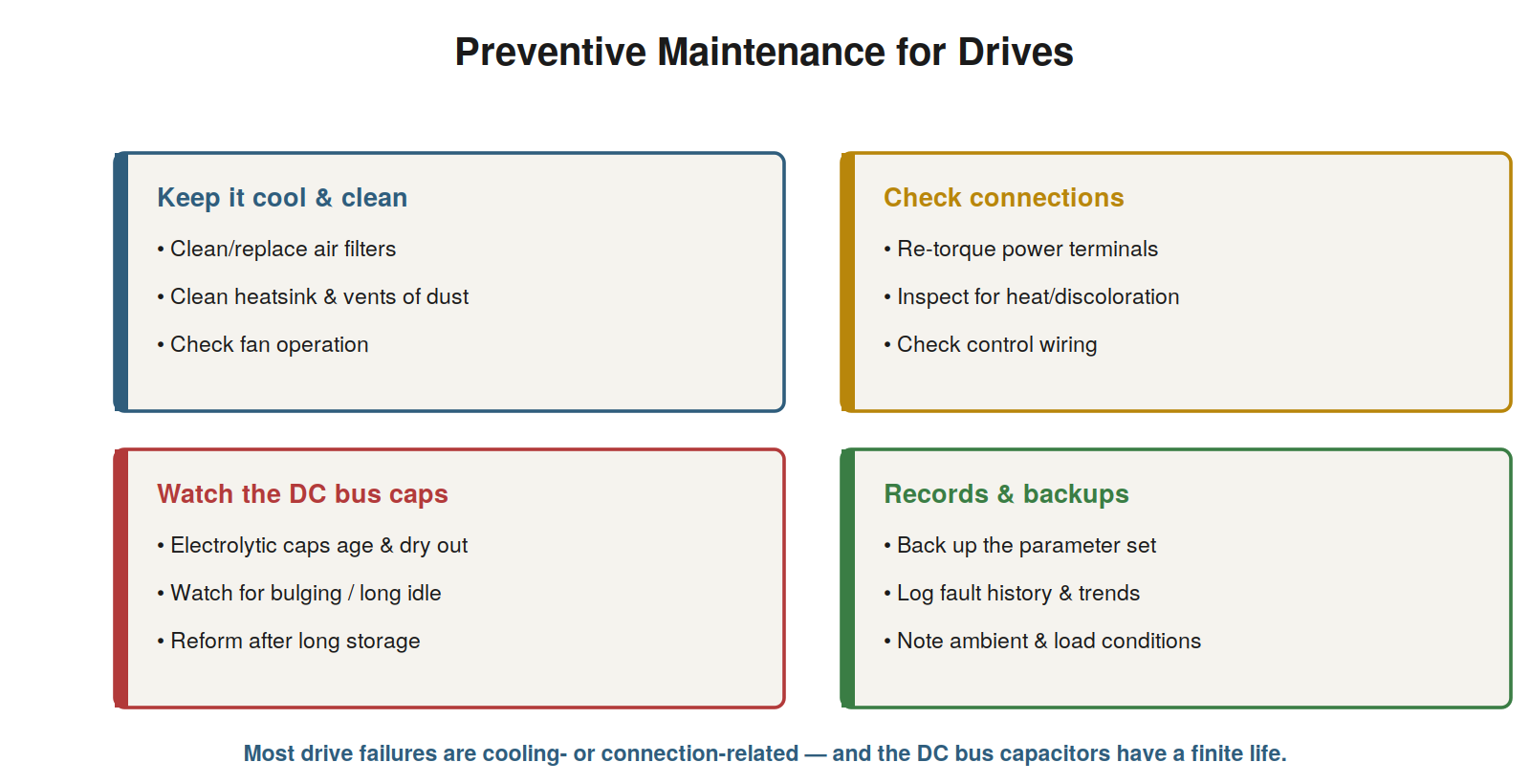
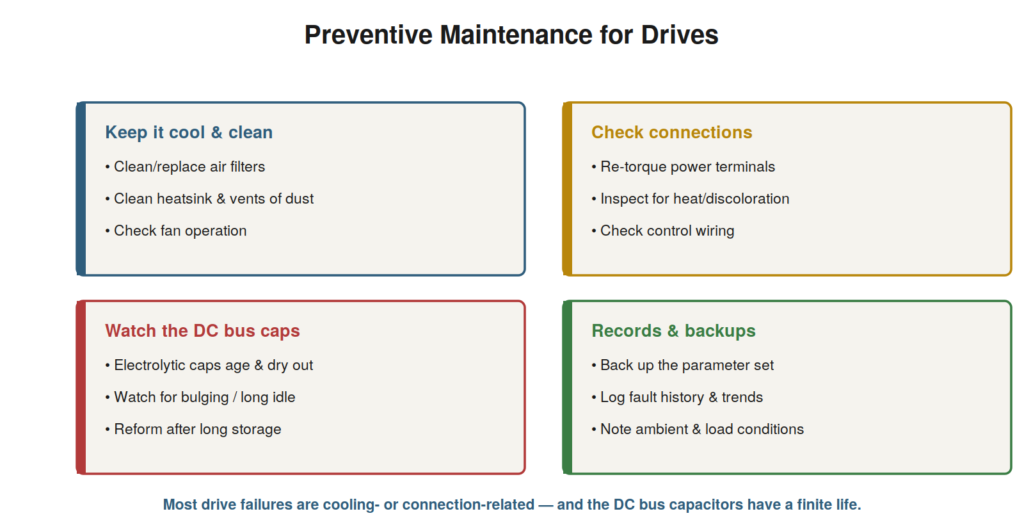
clean, check connections, watch the aging DC bus capacitors, and keep
records and backups. Most drive failures are cooling- or
connection-related, and the DC bus capacitors have a finite
life.
Preventive maintenance for drives
Effective preventive maintenance for drives centers on a few
high-value practices addressing the main causes of drive failure.
Keeping the drive cool and clean — cleaning or replacing air filters,
cleaning the heatsink and vents of dust, and checking the cooling fan —
prevents the cooling-related failures that are a leading cause of drive
problems. Checking connections — re-torquing power terminals (which can
loosen over time), inspecting for heat or discoloration (signs of a bad
connection), and checking control wiring — prevents connection-related
failures. Watching the DC bus capacitors — which are electrolytic
capacitors that age and dry out over years, and which may need reforming
after long storage — addresses a finite-life component that eventually
fails. And keeping records and backups — backing up the parameter set,
logging the fault history, noting conditions — supports both maintenance
and future troubleshooting. Understanding these practices — cooling and
cleaning, connections, DC bus capacitors, records — lets you prevent the
main causes of drive failure. It reinforces that most drive failures are
cooling- or connection-related, both preventable by maintenance, and
that the DC bus capacitors have a finite life that maintenance should
track. Understanding preventive maintenance for drives — keeping them
cool and clean, connections tight, capacitors watched, and configuration
backed up — lets the technician prevent many drive failures and be
prepared for others, addressing the cooling, connection, and
aging-component issues that cause most drive problems before they cause
failures.
Case: the overvoltage on stopping
A case shows the method resolving a common fault. A conveyor drive
tripped on overvoltage, but only sometimes — specifically when stopping
a loaded belt. Reading the fault confirmed it: the fault log showed
overvoltage every time, always at deceleration, and the recorded DC bus
voltage spiked high on stopping. Understanding the fault — overvoltage
from the DC bus rising — and its timing (deceleration) pointed to
regeneration: on deceleration, the loaded belt, with its momentum, drove
the motor, which regenerated energy back into the DC bus, pushing its
voltage up. Watching the live DC bus voltage confirmed it, the voltage
climbing sharply during each stop until it hit the overvoltage limit and
tripped. The cause was regeneration during too-fast a deceleration of
the loaded belt. The fix addressed the regeneration: extending the
deceleration ramp so the belt stopped more gently (returning energy more
slowly), and adding a braking resistor to absorb the regenerated energy.
Verifying, the loaded belt was stopped repeatedly, and the DC bus
voltage now stayed within limits with no more overvoltage trips. This
case shows the method at work: reading the fault (overvoltage on
deceleration), understanding it (regeneration), confirming with the live
DC bus voltage, and fixing the cause (slower decel, braking resistor).
It illustrates diagnosing a common drive fault by understanding what the
fault means and using the drive’s diagnostics to confirm the cause,
reaching the regeneration cause that the fault code alone would not have
revealed, and fixing it appropriately.
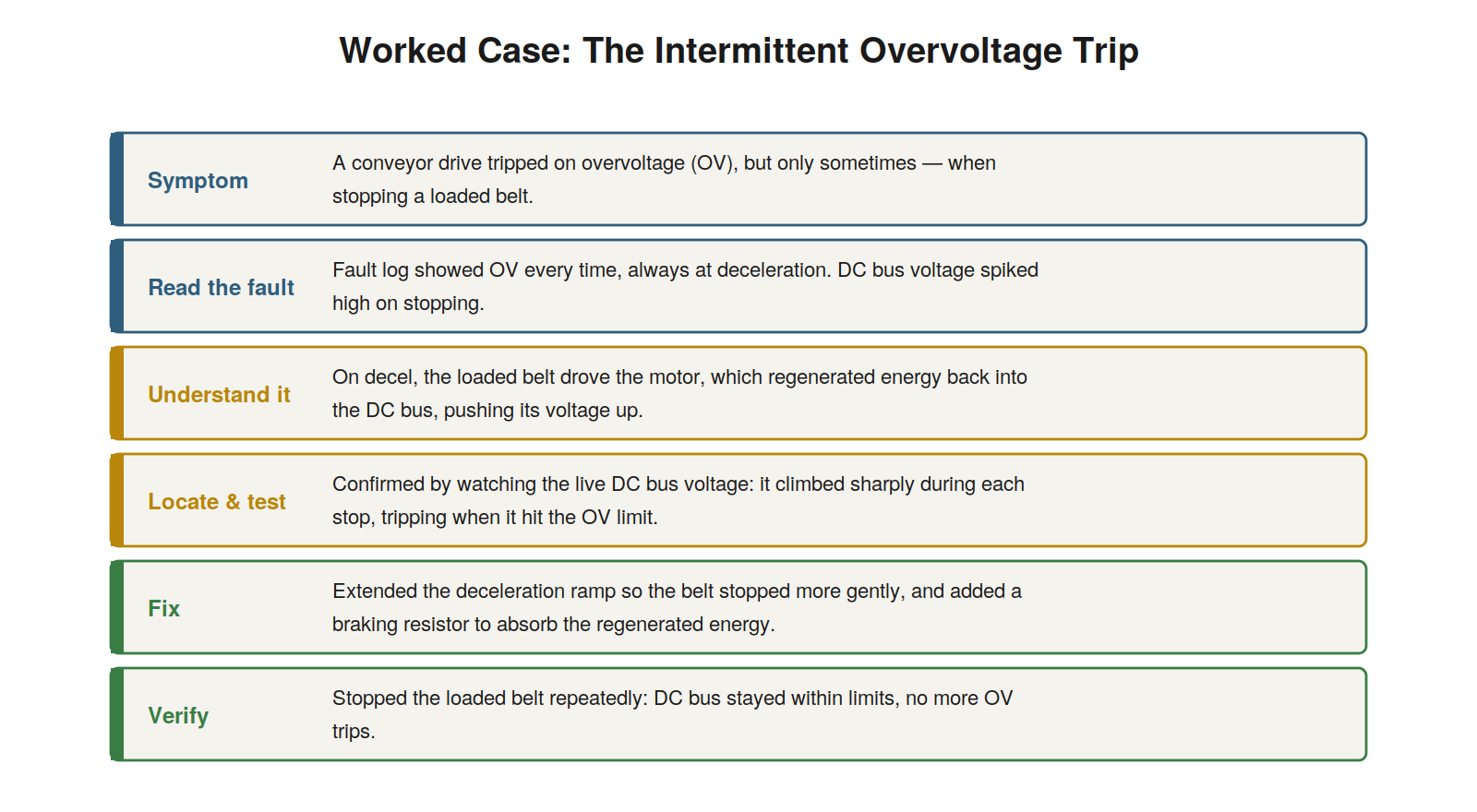
overvoltage case: from symptom (overvoltage on stopping a loaded belt)
through reading and understanding the fault (regeneration), locating and
confirming it (live DC bus voltage), to the fix (slower decel, braking
resistor) and verification.
Case: the nuisance trips that were noise
A case shows a noise problem diagnosed. A drive suffered occasional,
erratic trips — various faults, seemingly random, with no obvious
pattern — and also, it emerged, some nearby equipment had intermittent
problems. Conventional diagnosis found no hardware fault: the drive,
motor, and load all tested fine, and the trips did not correspond to
real fault conditions when the drive’s meters were checked. The erratic,
intermittent nature, the lack of a hardware cause, and the effect on
nearby equipment together pointed to noise. Investigating the grounding
and shielding revealed the cause: the drive’s grounding was poor (a
high-impedance connection) and the motor cable was not properly shielded
and bonded, so the drive’s switching noise was not contained, coupling
into the drive’s own control wiring and nearby equipment and causing the
erratic trips and problems. The fix addressed the noise: improving the
grounding to a solid low-impedance connection, and installing properly
shielded and bonded motor cable. This resolved the erratic trips and the
nearby equipment problems. This case shows a noise problem — erratic,
intermittent, no hardware cause, affecting nearby equipment — diagnosed
by recognizing the signature of noise and tracing it to poor grounding
and shielding. It illustrates that when faults are erratic and defy
hardware diagnosis, noise should be suspected, and the grounding and
shielding investigated, reaching a cause (noise from poor grounding and
shielding) that no amount of hardware testing would have found, and
fixing it through the grounding and shielding measures that control
noise.
The competent drive troubleshooter
The competent drive troubleshooter, whom this book has aimed to
develop, combines understanding, method, safety, and good practice. They
understand the drive — its power structure of rectifier, DC bus, and
inverter, how PWM makes the output, and how parameters govern
everything. They know how to install and set up a drive correctly, and
how to read its faults and use its diagnostics. They troubleshoot
systematically, always safely (respecting the DC bus): reading the
fault, understanding what it means, locating the domain, using the
drive’s meters, splitting the drive from the external, and fixing and
verifying. They know the common faults — overcurrent, DC bus
over/undervoltage, overtemperature, ground faults, overload,
communication and nuisance faults — and their diagnoses. They understand
the motor and cable the drive feeds, the electrical noise it generates,
and the preventive maintenance that keeps it running. This combination —
understanding, correct setup, systematic and safe method, knowledge of
the faults, and good practice — is what makes drive troubleshooting
confident and effective. The variable frequency drive, for all its
electronics, is a comprehensible machine built on clear principles, and
the technician who understands it and can troubleshoot it methodically
and safely holds a skill of growing value, as drives become ever more
widespread in industry. The drive that once seemed an intimidating black
box becomes, with understanding, a machine that reports its own faults
and reveals its own condition — and the competent troubleshooter,
equipped with the understanding and method this book has built, can meet
its faults with confidence, diagnosing and fixing them fault by fault,
keeping the drives that increasingly power industry running
reliably.
The finite life of the DC bus capacitors
A particular preventive-maintenance concern for drives is the DC bus
capacitors, which have a finite life, and understanding this helps
anticipate and prevent a characteristic drive failure. The DC bus uses
large electrolytic capacitors to store and smooth the DC, and these
capacitors age over time: their internal electrolyte gradually dries
out, especially at elevated temperatures, so they degrade over years of
service and eventually fail. This gives the drive a finite life largely
set by the capacitors, and their degradation can cause problems (a
failing capacitor gives poor smoothing, which can cause faults) before
outright failure. Additionally, capacitors that have been idle for a
long time (a stored or long-unused drive) may need reforming — a gradual
re-energizing — before full use, as their properties degrade with
disuse. Understanding the finite life of the DC bus capacitors — aging
and drying out over years, especially when hot, and needing reforming
after long idleness — helps anticipate this characteristic drive
failure. It reinforces watching the capacitors as a maintenance item:
they are a finite-life component, so an old drive may be approaching
capacitor-related failure, and a long-idle drive may need reforming.
Understanding that the DC bus capacitors age and eventually fail — a
characteristic, predictable drive failure mode — lets maintenance
anticipate it (planning replacement of aging drives or capacitors,
reforming after storage) rather than being surprised by it, addressing
the finite-life component that is a leading eventual cause of drive
failure and a specific preventive-maintenance concern for drives.
Scenario: the maintenance that caught the
filters
A scenario shows preventive maintenance preventing a failure. During
routine drive maintenance, a technician checked and cleaned the drive’s
air filters, finding them significantly clogged with accumulated dust
though the drive had not yet faulted. The clogged filters were reducing
the drive’s cooling, and had they not been cleaned, the drive would
eventually have overheated and tripped, or worse, suffered heat damage —
an unexpected breakdown. By catching and cleaning the clogged filters in
routine maintenance, before they caused a fault, the technician
prevented the overheating that would otherwise have occurred. The simple
maintenance — checking and cleaning the filters — averted a future
failure. This scenario shows preventive maintenance working as intended:
routine filter cleaning caught a developing cooling problem (clogged
filters) before it caused an overtemperature fault or heat damage.
Understanding that most drive failures are cooling- or
connection-related, and preventable by maintenance, explains the value:
cleaning the filters prevented the overheating the clogging would have
caused. It reinforces the value of preventive maintenance for drives,
particularly the cooling-related maintenance (filters, heatsink, fan),
because it catches the developing cooling problems that would otherwise
cause overtemperature faults and heat damage. The scenario reinforces
preventive maintenance’s payoff: the simple, routine act of checking and
cleaning the filters caught a developing problem before it caused a
failure, preventing the overheating that the clogged filters would
eventually have caused, which is exactly the kind of failure that drive
preventive maintenance is meant to prevent.
Building a maintenance schedule
Effective drive preventive maintenance is organized into a schedule,
and understanding how to build one makes the maintenance systematic and
reliable. The maintenance tasks — cleaning filters and heatsinks,
checking the fan, re-torquing connections, checking the DC bus
capacitors, backing up parameters, reviewing the fault log — have
different appropriate intervals: cleaning may be frequent (depending on
the environment’s dustiness), connection checks periodic, capacitor and
deeper checks less frequent, backups after any change. Building a
schedule assigns each task an appropriate interval and ensures it is
done regularly, rather than relying on ad-hoc attention. The schedule
should suit the environment (dustier or hotter environments needing more
frequent cooling maintenance) and the drive’s criticality (critical
drives warranting more attention). Understanding how to build a
maintenance schedule — assigning tasks appropriate intervals suited to
the environment and criticality — makes the preventive maintenance
systematic. It reinforces organizing drive maintenance into a schedule
of tasks at appropriate intervals, tuned to the environment and the
drive’s importance, so that the maintenance is done regularly and
reliably rather than sporadically. Understanding that effective
preventive maintenance requires a schedule — tasks at suitable
intervals, adapted to conditions — reinforces building and following
one, which ensures the cooling, connection, capacitor, and configuration
maintenance that prevents drive failures is done consistently, turning
the knowledge of what to maintain into a reliable, scheduled practice
that keeps drives running by catching and preventing the common causes
of drive failure on a regular, systematic basis.
The complete, competent drive troubleshooter
The complete, competent drive troubleshooter — the destination of
this book — combines understanding, method, safety, and good practice,
and seeing this whole shows what the book has aimed to build. Such a
technician understands the drive — its power structure, PWM, control,
and parameters; can install, set up, and commission it correctly; reads
its faults and uses its diagnostics; troubleshoots systematically and
safely, respecting the DC bus; knows the common faults — overcurrent, DC
bus over/undervoltage, overtemperature, ground faults, overload,
communication and nuisance faults — and their diagnoses; understands the
motor and cable the drive feeds, the noise it generates, and the
preventive maintenance that keeps it running. This combination makes
drive troubleshooting confident, effective, and safe, turning the drive
from an intimidating black box into a comprehensible machine that
reports its own faults and reveals its own condition. The book has built
each part to form this rounded competence. The variable frequency drive,
for all its electronics, is a comprehensible machine built on clear
principles, and the technician who has developed this complete
competence — understanding it, installing it, reading its faults,
troubleshooting it methodically and safely, and maintaining it — holds a
skill of growing value as drives become ever more widespread. The drive
that once seemed a mysterious box of electronics becomes, with the
understanding and method this book has built, a machine whose faults can
be met with confidence and diagnosed fault by fault. Given the drive’s
growing prevalence and its combination of capability and complexity, the
competence this book builds is a durable, valuable foundation for
keeping the drives that increasingly power industry running reliably,
which is the aim the book has worked throughout to achieve.