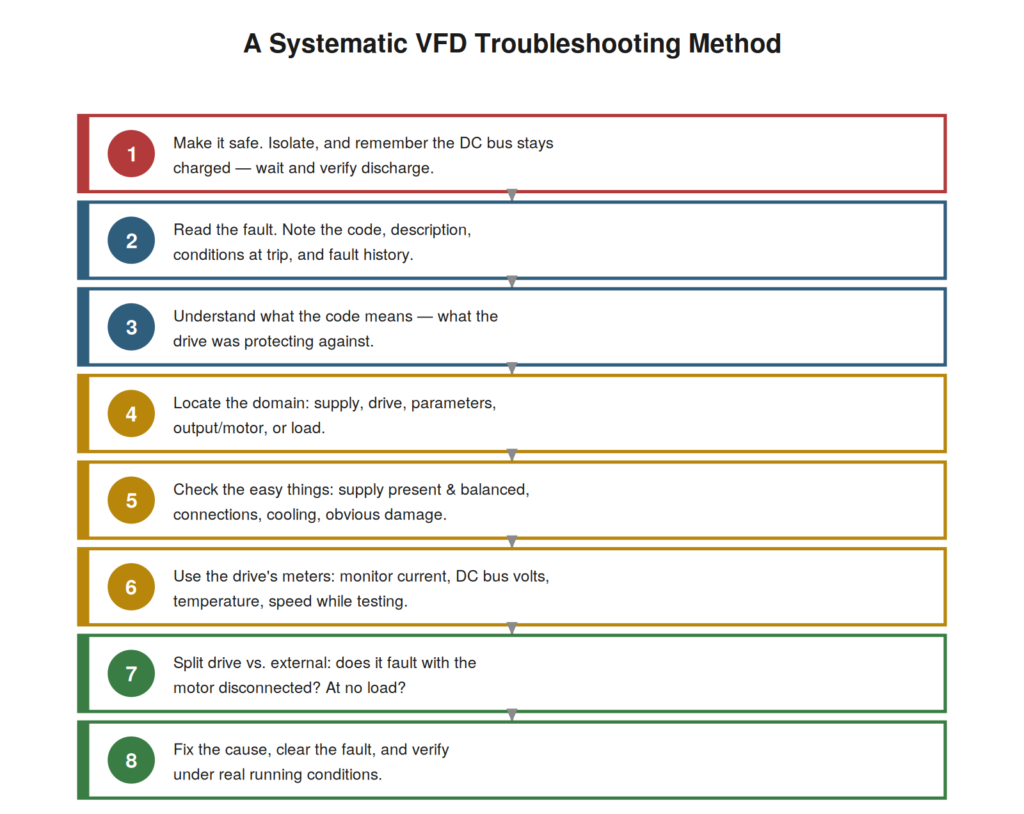
With the fault read from the display, a systematic method carries the
diagnosis from the reported fault to the located cause. Because a drive
fault can originate in the drive, its parameters, the supply, the motor,
the cable, or the load, a structured approach that safely and
efficiently narrows down the domain is essential. This method, built
around the drive’s self-reporting and its own diagnostic capabilities,
brings order to drive troubleshooting.
safe (respecting the DC bus), read the fault, understand what it means,
locate the domain, check the easy things, use the drive’s meters, split
drive from external, then fix and verify.
Safety first: respecting the DC bus
The first step of any drive troubleshooting is to make the work safe,
and for a drive this includes a specific hazard beyond ordinary motor
circuits: the stored energy in the DC bus. Like any motor circuit, a
drive carries lethal voltages, so it must be isolated, locked out, and
verified dead before work. But a drive has an additional danger: its DC
bus capacitors store energy and remain charged after the power is
removed, so the drive stays dangerous even when isolated, until the bus
has discharged. Making a drive safe therefore requires isolating it,
then waiting the manufacturer-specified discharge time (often several
minutes) for the DC bus to discharge, and verifying the bus is actually
discharged before working inside. Skipping this — working on a drive too
soon after isolation — risks a serious shock from the charged DC bus.
Understanding this drive-specific safety requirement — isolate, wait for
and verify DC bus discharge, then work — is the essential first step of
drive troubleshooting. It reinforces that a drive is not safe merely
when isolated, unlike a simple starter, but only after the DC bus has
discharged, so respecting the DC bus — the discharge wait and
verification — is a critical part of drive safety that must never be
skipped, making the safety-first step for drives specifically include
the DC bus discharge that the drive’s stored energy demands before any
internal work is safe.
From fault to domain
The core of the method is going from the reported fault to the domain
where the cause lies — the drive, its parameters, the supply, the motor,
the cable, or the load — and narrowing down which. After making it safe
and reading the fault, you use the fault code’s meaning to point toward
likely domains: an undervoltage fault points toward the supply, an
overcurrent toward the output and load, an overtemperature toward
cooling, a communication fault toward the network and noise. Then you
check the indicated domains, using the drive’s meters and simple tests,
to localize the cause. This progression — from the reported fault,
through its meaning, to the likely domains, to the localized cause —
structures the diagnosis. It ensures you use the fault code’s guidance
(pointing to domains) while systematically checking to find the actual
cause, rather than either ignoring the code or treating it as the
complete answer. Understanding this progression — fault to meaning to
domain to cause — is the heart of the method. It reinforces using the
fault code as a pointer to the likely domains, then investigating those
domains to localize the cause, which combines the advantage of the
drive’s self-reporting (pointing the way) with the discipline of
systematic investigation (finding the actual cause). This is how drive
troubleshooting proceeds efficiently: the fault points to the domain,
and the investigation of that domain — aided by the drive’s meters and
simple tests — localizes the cause, going from the drive’s report to the
real problem in a structured, reliable way.
Splitting the drive from the external
A powerful diagnostic step in drive troubleshooting is splitting the
drive from everything external to it — the motor, cable, and load — to
determine whether the fault is in the drive or downstream. Because many
faults could originate either in the drive or in what it feeds, a test
that separates them is valuable. Disconnecting the motor cable from the
drive output and seeing whether the drive still faults (some drives can
be tested without a motor, or with a known-good test load) separates
drive faults from motor, cable, and load faults: if the drive faults
with the output disconnected, the problem is in the drive; if it faults
only with the motor connected, the problem is downstream. Similarly,
running the drive at no load or with an uncoupled motor separates the
drive and motor from the load. These splitting tests — disconnect the
output, run at no load — are among the most useful in drive
troubleshooting, because they cleanly separate the drive from the
external circuit, focusing the diagnosis on the correct side.
Understanding and using them — always safely, respecting the DC bus —
directs the diagnosis efficiently. It reinforces that splitting the
drive from the external circuit, by disconnecting the output or running
unloaded, is a key technique that determines whether a fault is in the
drive itself or in the motor, cable, or load it feeds, which is a major
fork in the diagnosis that focuses subsequent effort on the drive or on
the external circuit, rather than searching both, making these splitting
tests high-value steps in the systematic method.
Why the method suits drives especially
A systematic method suits drive troubleshooting especially well, and
understanding why reinforces the value of following it. Drives present a
particular challenge: they are complex, with many possible fault sources
(drive, parameters, supply, motor, cable, load), and their faults can be
electronic and non-obvious. This complexity makes unsystematic guessing
especially unreliable for drives — there are too many possibilities to
guess among effectively. But drives also offer a particular advantage:
they report their own faults and provide extensive diagnostics. A
systematic method exploits this advantage (starting from the fault
report, using the diagnostics) while managing the complexity
(systematically narrowing among the many possible sources). So the
method fits drives especially well, turning their self-reporting and
diagnostics into a structured diagnosis that handles their complexity.
Understanding why the method suits drives — exploiting their
self-reporting while managing their complexity — reinforces following
it. It reinforces that drives, being complex but self-reporting, are
ideal subjects for a systematic method that starts from the fault report
and diagnostics and works methodically through the possible domains,
rather than guessing among the many possibilities. Understanding that
the method’s structure is especially valuable for drives — because their
complexity defeats guessing while their self-reporting aids systematic
diagnosis — reinforces the discipline of the method for drive
troubleshooting, where it turns the drive’s own diagnostics into a
reliable, structured path from fault report to cause.
Scenario: the DC bus that was still charged
A scenario underscores the drive-specific safety step. A technician
was called to a faulted drive and, following the method’s safety-first
step, isolated the drive — but then, understanding the DC bus hazard,
waited the specified discharge time and verified the DC bus was
discharged before opening the drive to work. This proved important:
checking the DC bus voltage showed it still charged for some time after
isolation, holding a dangerous voltage that would have delivered a
serious shock had the technician worked immediately after isolating.
Only after the verified discharge was the drive safe to work on. Had the
technician treated the drive like a simple starter — safe once isolated
— they would have been exposed to the charged DC bus. This scenario
shows why the drive-specific safety step matters: the DC bus stays
charged after isolation, so a drive is not safe merely when isolated,
and only waiting for and verifying the discharge makes it safe.
Understanding this hazard — the stored energy in the DC bus — and the
required step — wait and verify discharge — protected the technician. It
reinforces that drive safety includes the DC bus discharge, a step
beyond ordinary isolation, because the drive’s stored energy keeps it
dangerous after isolation until the bus discharges. The scenario
reinforces respecting the DC bus: the verified discharge revealed the
bus still charged after isolation, showing why this drive-specific
safety step is essential and must never be skipped, as the DC bus hazard
is real and would cause injury if the discharge step were omitted.
Adapting the method to the fault
The systematic method is a framework to be adapted to the specific
fault, and understanding how to adapt it makes it practical rather than
rigid. The method’s steps — safety, read the fault, understand it,
locate the domain, check the easy things, use the meters, split drive
from external, fix and verify — provide the structure, but their
application varies by fault. For an overtemperature fault, the domain is
clearly the cooling, so the method focuses there quickly. For an
overcurrent, the disconnected-motor test is central. For an erratic
fault, the noise investigation is emphasized. So the method adapts: the
fault type and the drive’s diagnostics guide which steps matter most and
where to focus, while the overall structure (and especially safety)
remains. Understanding how to adapt the method — focusing its steps
according to the fault type and the evidence — makes it a practical,
flexible framework. It reinforces using the method as a structure
adapted to each fault, not a rigid sequence: the fault code and
diagnostics point to the relevant domain and steps, which the method
then addresses, while the safety-first step and the overall systematic
approach are always retained. Understanding that the method adapts to
the fault — its steps focused by the fault type and evidence — makes it
practical for real troubleshooting, where different faults call for
emphasis on different steps, all within the method’s reliable structure
and its constant safety-first foundation, so that the method guides the
diagnosis flexibly and reliably regardless of the specific fault at
hand.
The method integrates the book
The systematic method integrates the whole book, and recognizing this
shows the method as the culmination of the drive understanding. Each
step of the method draws on the book’s topics: safety (with the DC bus)
from the safety emphasis; reading the fault from the fault display
understanding; understanding the fault from the fault-category
knowledge; locating the domain from the power structure and the
drive-motor-supply understanding; using the meters from the diagnostics;
splitting drive from external from understanding the drive and its
connections; fixing and verifying from knowing the faults and correct
operation. So the method is where all the book’s understanding — the
drive, its faults, its diagnostics — comes together in the practical act
of troubleshooting. Recognizing that the method integrates the book
shows it as the culmination: mastering the method applies the whole
book’s understanding. It reinforces that the method embodies everything
the book teaches, organized into a reliable, safe process for diagnosing
drives. Understanding the method as the integration of the book —
bringing all its topics together in troubleshooting — shows that the
method is not a separate technique but the application of the whole
understanding, so that mastering it means bringing the full
understanding of the drive, its faults, and its diagnostics to bear on
the practical goal of finding and fixing drive faults. The method is
where understanding becomes competent, safe, practical drive
troubleshooting, the culmination of the book’s aim realized in the
systematic diagnosis of drive faults.