A great many drive problems trace back to installation — particularly
wiring and grounding — so getting these right is the foundation of
reliable drive operation and a frequent focus of troubleshooting. Drives
are more demanding than simple starters in their wiring and grounding
requirements, because of the electrical noise they generate and their
sensitivity to it, and installation shortcuts that would not matter for
a starter cause real problems for a drive. Understanding correct drive
wiring and grounding both prevents problems and helps diagnose them.
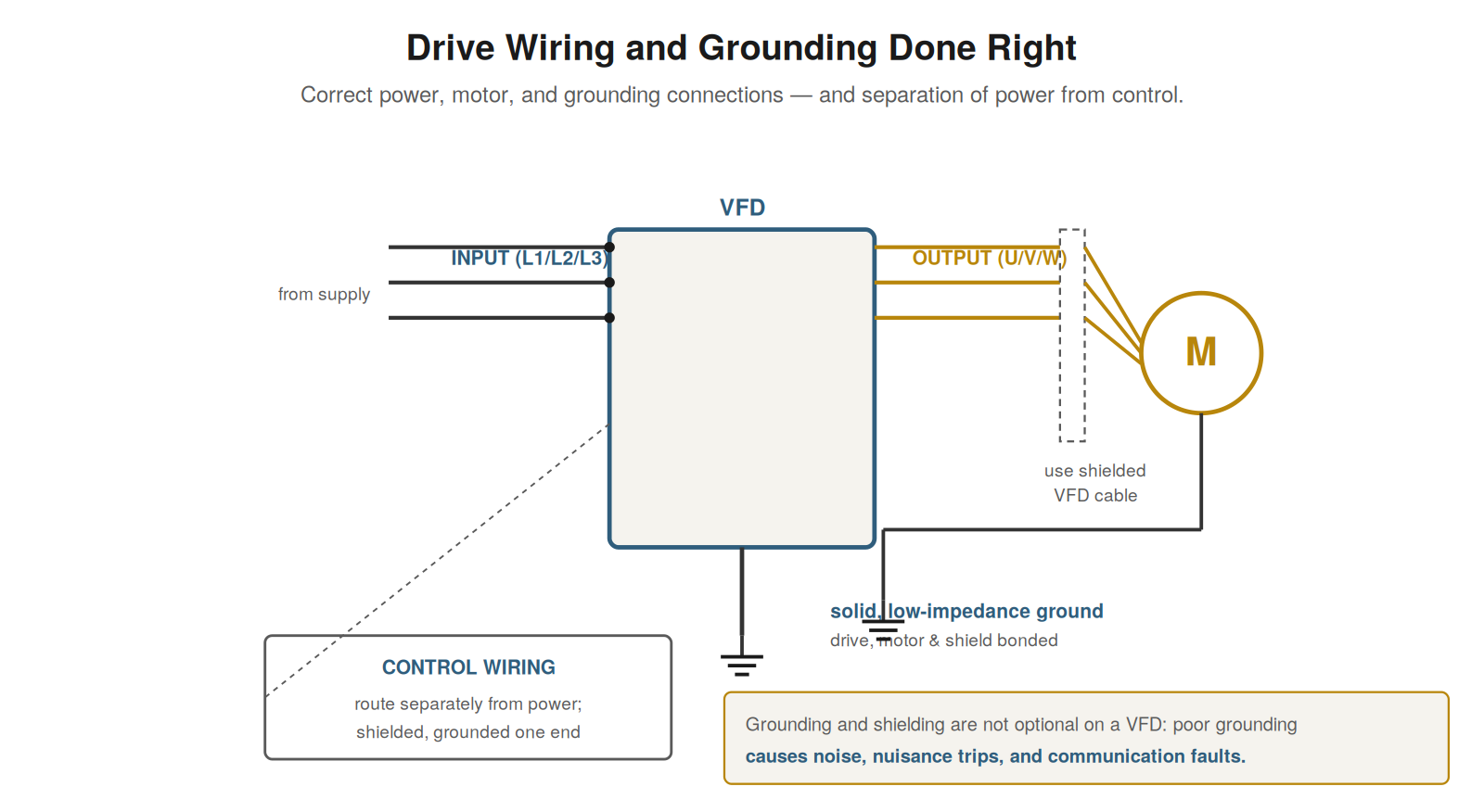
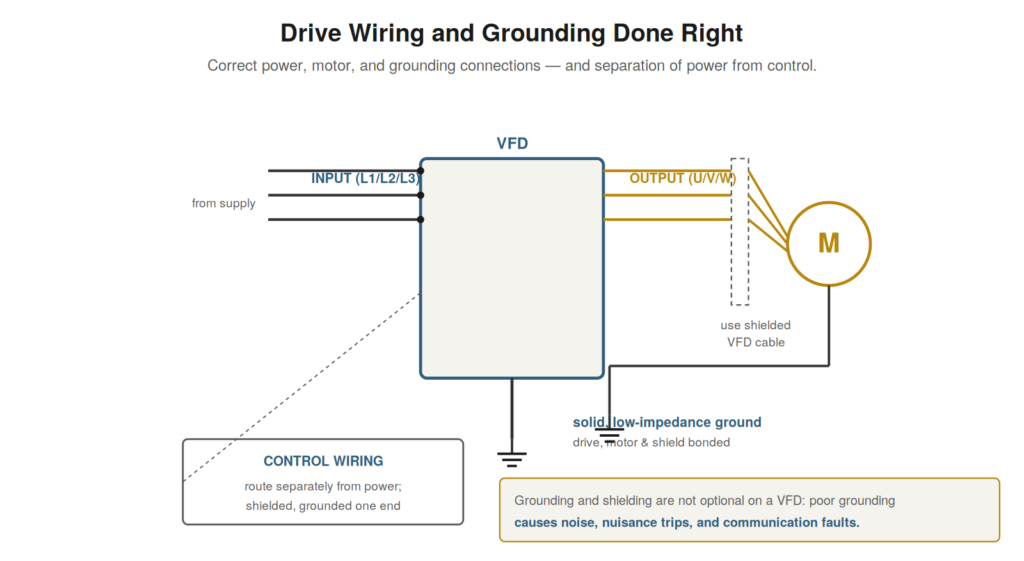
and output connections, shielded motor cable, a solid low-impedance
ground bonding drive, motor, and shield, and control wiring routed
separately from power. Poor grounding causes noise, nuisance trips, and
comms faults.
Power and motor connections
The drive’s power connections are straightforward in principle: the
supply connects to the drive’s input terminals, and the motor to the
drive’s output terminals. But several details matter. The drive must be
rated for the supply voltage, and the input must be correctly connected
and protected. The output goes to the motor, and here the cable matters:
because the drive’s output is a fast-switched PWM waveform, the motor
cable should be the correct type — often shielded VFD cable — and kept
within length limits, since long cables cause voltage reflections that
stress the motor and can cause faults. The output must never be
connected to anything but the motor (never to a supply, and never should
the input and output be confused, which would damage the drive).
Understanding the power and motor connections — supply to input, motor
to output, with correct voltage rating and appropriate output cable — is
the basis of connecting a drive correctly. The output cable’s type and
length are more important than for a simple starter because of the PWM
waveform, and getting the connections and cable right is part of a
correct installation that avoids the wiring-related problems — output
cable stress, wrong connections — that can cause drive faults and motor
stress.
Grounding and shielding
Grounding and shielding are critical for a drive — far more so than
for a simple starter — and poor grounding is one of the most common
underlying causes of drive problems. The drive generates significant
electrical noise from its fast switching, and good grounding and
shielding are what keep this noise from causing problems: a solid,
low-impedance ground for the drive, the motor, and the cable shield, all
properly bonded, provides the path that contains the noise. Poor
grounding — high-impedance, loose, or missing ground connections — lets
the noise disturb the drive’s control and communications and nearby
equipment, causing erratic behavior, nuisance trips, and communication
faults that can be very hard to diagnose. The motor cable shield, bonded
correctly, contains the noise from the cable. So grounding and shielding
are not optional refinements but essential to reliable drive operation.
Understanding their importance — that good grounding and shielding
contain the drive’s noise and prevent a whole class of problems, while
poor grounding causes noise-related faults — is essential. It reinforces
that a drive installation must have excellent grounding and shielding,
and that when a drive has erratic or noise-related problems, the
grounding and shielding are a prime suspect. Good grounding, done from
the start, prevents most noise problems, which are otherwise frustrating
to diagnose and hard to remedy after the fact, making correct grounding
and shielding a foundation of reliable drive operation.
Separating power and control wiring
A specific and important wiring practice for drives is separating the
power wiring from the control and signal wiring, because the noisy power
wiring can couple interference into the sensitive control wiring if they
run together. The drive’s power wiring — especially the switched output
cable to the motor — carries significant noise, and the control wiring —
speed reference signals, start/stop, communications, sensor signals — is
sensitive to noise. Running them together, in the same conduit or
bundled closely, lets the power wiring’s noise couple into the control
wiring, disturbing the signals and causing erratic operation, false
readings, and communication problems. Separating them — routing power
and control wiring apart, crossing at right angles if they must cross,
using shielded control cable — keeps the noise from coupling in.
Understanding this separation — keeping noisy power wiring away from
sensitive control wiring — is an important drive installation practice.
It reinforces that drive wiring requires attention to noise coupling:
the control and signal wiring must be kept separate from and protected
against the noisy power wiring, or noise problems result. When a drive
has erratic control behavior or communication faults, wiring that fails
to separate power from control is a possible cause, and understanding
the practice — separate the wiring, shield the control cable — both
prevents these problems and helps diagnose them, as part of the
noise-conscious wiring that reliable drive operation requires.
The cost of installation shortcuts
It is worth emphasizing the cost of installation shortcuts on a
drive, because shortcuts that seem harmless cause disproportionate
problems. On a simple starter, some installation details matter little:
grounding needs to be adequate for safety, but the demanding
noise-control grounding of a drive is not needed, and cable type and
routing are less critical. This can lead to treating a drive
installation with the same relaxed approach — taking shortcuts on
grounding, shielding, cable type, and wiring separation — which for a
drive causes real, ongoing problems: noise, nuisance trips,
communication faults, and motor stress. These problems are often
intermittent and hard to diagnose, and hard to fix after the fact
(improving grounding and shielding in an existing installation is
difficult). So installation shortcuts on a drive have a high cost,
creating persistent problems that are expensive in troubleshooting time
and difficult to remedy. Understanding this cost — that drive
installation shortcuts cause disproportionate, persistent, hard-to-fix
problems — motivates doing the installation properly from the start. It
reinforces that a drive installation warrants care that a simple starter
does not: proper grounding, shielding, cable, and wiring separation,
done correctly from the start, because the cost of shortcuts — ongoing
noise and fault problems that are hard to diagnose and remedy — far
exceeds the effort of doing it right initially, making a careful drive
installation a wise investment against the persistent problems that
installation shortcuts cause.
Scenario: the ground that fixed everything
A scenario shows the power of good grounding. A drive suffered a
variety of erratic problems — occasional nuisance trips, intermittent
communication faults, and disturbances in nearby equipment — that
resisted diagnosis, as no single hardware fault could be found.
Recognizing the pattern of erratic, noise-like problems, the technician
checked the grounding and found it inadequate: the drive’s ground
connection was high-impedance and the grounding scheme was poor, so the
drive’s switching noise was not properly contained. Improving the
grounding — establishing a solid, low-impedance ground for the drive and
bonding the system properly — resolved the whole array of problems at
once: the nuisance trips, the communication faults, and the nearby
equipment disturbances all stopped, because the noise was now contained.
This scenario shows how poor grounding can cause multiple erratic
problems, and how fixing the grounding resolves them together.
Understanding that good grounding contains the drive’s noise — and that
poor grounding lets the noise cause erratic, wide-ranging problems —
explains this: the various problems shared a root cause in the poor
grounding, fixed by improving it. It reinforces that when a drive has
multiple erratic, noise-like problems, the grounding is a prime suspect,
and improving it can resolve them all at once, because good grounding is
foundational to containing the noise that causes such problems. The
scenario reinforces grounding’s importance: a single grounding fix
resolved an array of erratic problems, illustrating why good grounding
is the foundation of reliable drive operation.
Checking connections in troubleshooting
Because connection problems are a common cause of drive faults,
checking connections is an important troubleshooting practice, and
understanding how connections fail directs the checking. Connections —
at the power terminals, the motor terminals, the control wiring, the
ground — can loosen over time (from vibration, thermal cycling) or
corrode, developing high resistance or intermittent contact. A loose or
high-resistance connection causes problems: a loose power connection can
cause phase loss or intermittent operation, a loose ground undermines
noise control, a loose control connection causes signal problems. These
connection problems are often intermittent (the connection making and
breaking) and can be hard to find. Checking connections — inspecting for
tightness (re-torquing power terminals to specification), looking for
signs of heat or discoloration (indicating a bad connection), and
checking for corrosion — finds these problems. Understanding that
connections loosen and corrode, causing intermittent and
resistance-related faults, directs this checking. It reinforces checking
connections as a troubleshooting step, especially for intermittent or
erratic faults, because connection problems are common and often
intermittent, found by inspecting and re-torquing connections and
looking for signs of heat or corrosion. Understanding how connections
fail — loosening and corroding to cause intermittent, resistance-related
faults — reinforces checking them in troubleshooting, particularly the
power and ground connections whose failure causes phase loss, noise
problems, and intermittent operation, making connection checking a
valuable diagnostic step for the common and often-elusive
connection-related drive faults.
Installation quality determines reliability
A consolidating lesson from wiring and grounding is that installation
quality largely determines a drive’s reliability, and recognizing this
frames the importance of doing the installation right. A drive well
installed — correct wiring, excellent grounding, proper shielding, good
cable, separated control wiring, adequate cooling clearances — tends to
run reliably, free of the noise, nuisance-trip, and stress problems that
installation shortcuts cause. A drive poorly installed tends to have
persistent, hard-to-diagnose problems. So the installation quality, more
than almost anything else, determines whether a drive runs reliably or
suffers ongoing problems. This makes a careful installation the
foundation of drive reliability, and installation shortcuts a false
economy. Recognizing that installation quality determines reliability
frames the importance of the wiring and grounding: they are foundational
to how well the drive will run. It reinforces investing in a proper
installation — grounding, shielding, cable, wiring, cooling — because it
determines the drive’s reliability, and shortcuts cause persistent
problems. Understanding that installation quality largely determines
drive reliability — a well-installed drive running reliably, a
poorly-installed one suffering ongoing problems — consolidates the
importance of the wiring and grounding, making a careful installation
the foundation of reliable drive operation and one of the highest-value
investments in a drive system, because it determines whether the drive
will run reliably or suffer the persistent, hard-to-diagnose problems
that poor installation causes and that are difficult to remedy
afterward.