This chapter builds one of the mental models that everything else in electronics depends on. Voltage is potential difference between two points.
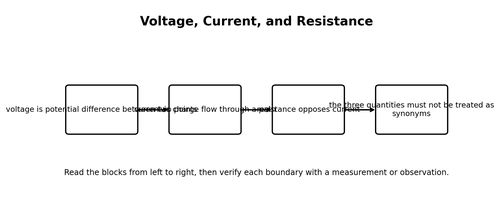
The core ideas are straightforward when separated. Voltage is potential difference between two points. Current is charge flow through a path. Resistance opposes current. The three quantities must not be treated as synonyms.
Keep definitions separate from equations. A definition tells you what a quantity means; an equation tells you how quantities relate in a particular model. Real parts have tolerances and real sources have internal resistance, so small differences between calculation and measurement are normal. Large differences deserve an explanation.
When the idea feels abstract, return to two questions: where can current flow, and what voltage should exist between the important nodes? In practical work, this means you should be able to describe what you expect before you connect power.
A concrete example makes the idea easier to test. A 9 V battery can still measure 9 V across its terminals even when an open circuit means essentially no load current. Do not treat the numbers in an example as universal values; use them to learn the method, then check the ratings and datasheet for the actual parts on your bench.
Focus on this point: voltage is potential difference between two points. Ask what you could measure to prove that statement in a real circuit. If the expected behavior is present, move to the next block. If it is absent, stay at that stage until the reason is understood.
The phrase “current is charge flow through a path” also has a troubleshooting meaning. Consider the failure modes that would make the quantity too high, too low, stuck, noisy, or intermittent. Learning normal behavior and failure behavior together makes the concept far easier to remember.
Focus on this point: resistance opposes current. Ask what you could measure to prove that statement in a real circuit. If the expected behavior is present, move to the next block. If it is absent, stay at that stage until the reason is understood.
The phrase “the three quantities must not be treated as synonyms” also has a troubleshooting meaning. Consider the failure modes that would make the quantity too high, too low, stuck, noisy, or intermittent. Learning normal behavior and failure behavior together makes the concept far easier to remember.
Do not chase precision before you have correctness. First confirm polarity, connectivity, supply voltage, approximate current, and the correct component value. Once the circuit behaves in the right direction, smaller effects such as tolerance, temperature, noise, and measurement loading become worth investigating.
One final bench habit is to keep a last-known-good state. A quick photo, sketch, or table of expected voltages gives you a reference after later changes. This simple habit turns many future faults into comparisons instead of mysteries.
Worked Example
A 9 V battery can still measure 9 V across its terminals even when an open circuit means essentially no load current.
Hands-On Mini-Lab
- Write the key quantities or states on paper before building anything.
- Choose a safe low-voltage example that demonstrates the idea.
- Calculate or predict at least two values before powering the circuit.
- Measure the real circuit and compare the results with the prediction.
- Explain any difference that is larger than normal tolerance or meter error.
Common Beginner Mistakes
- Changing several variables at once.
- Mixing units such as ma and a.
- Treating a simplified model as an exact description of every component.
- Measuring without first deciding what result is expected.
Fault-Finding Lens
- Start by verifying the power source and the actual supply voltage at the stage you are testing.
- Check the physical connections and polarity before assuming a semiconductor or IC has failed.
- Use the chapter model to find the last point that behaves normally and the first point that does not.
- If the result is ambiguous in circuit, isolate the stage or component and repeat the test with a known reference.
- After correction, reproduce the original operating condition and confirm that current, voltage, temperature, and function remain normal.
Check Your Understanding
- Explain voltage, current, and resistance in your own words without using the diagram.
- Which measurement would give the quickest evidence that this circuit or concept is behaving normally?
- Name one beginner mistake that could create a misleading symptom.
- What would you test next if the measured value were much higher or lower than expected?
- How could you demonstrate the key idea with a safe low-voltage experiment?
Key Points
- Voltage is potential difference between two points.
- Current is charge flow through a path.
- Resistance opposes current.
- The three quantities must not be treated as synonyms.