Drain faults are commonly blockages before they are failed pumps.
Start Here
Use the emergency drain procedure.
Clean the pump filter.
Inspect the drain hose for kinks.
Check the standpipe height/setup.
Listen for a pump hum.
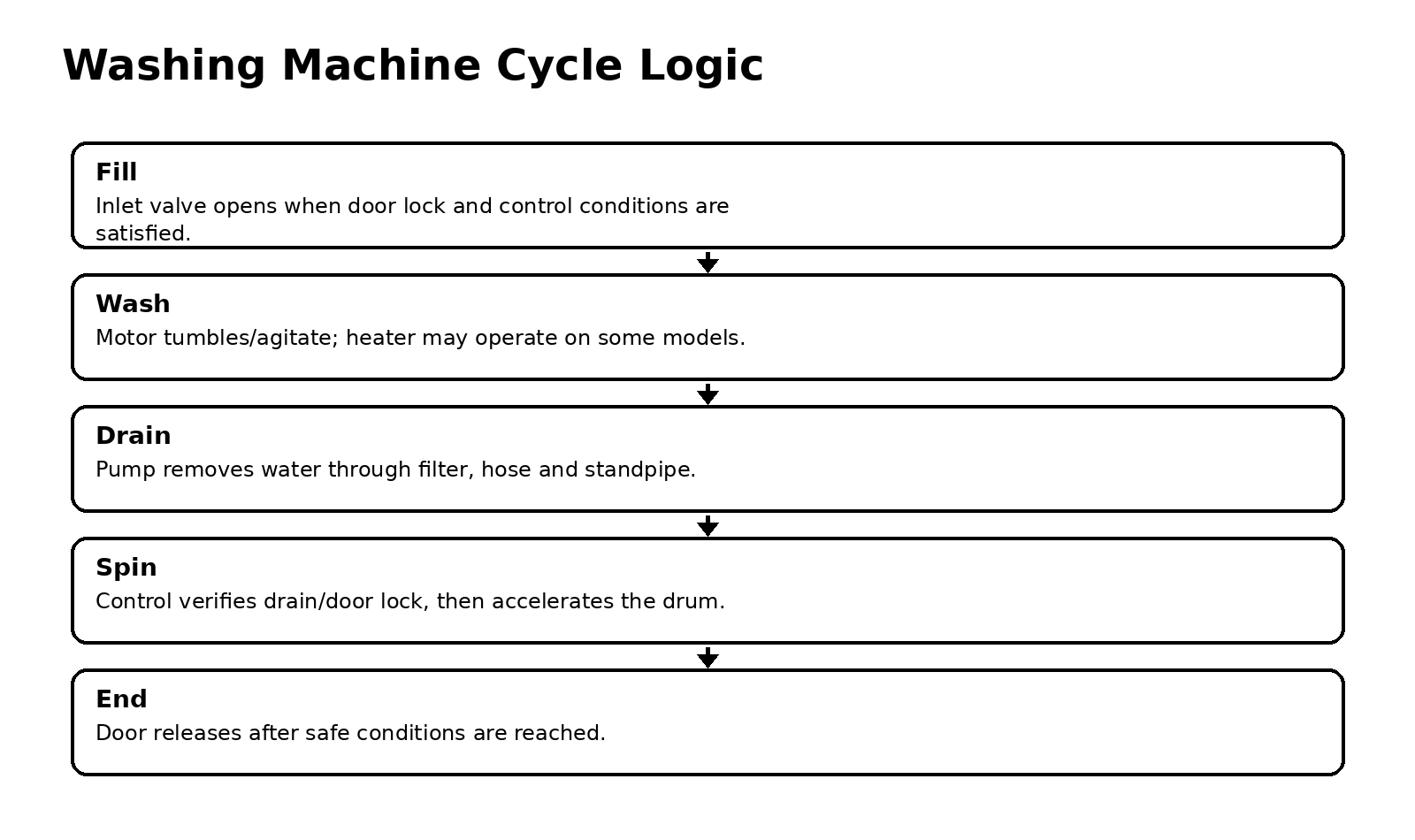
Appliances rarely fail in a way that names the defective component for you. Drain faults are commonly blockages before they are failed pumps. For washer will not drain, concentrate on the fill, wash, drain, lock and spin sequence. Use every working function as evidence: if one stage still behaves normally, that fact eliminates causes that would have stopped the appliance earlier in the sequence.
Observe the timing before touching anything. Note what happens immediately after Start, what changes just before the fault, and what remains normal afterward. Lights, relay clicks, water movement, motor or fan sounds, heat, vibration and error codes are useful only when tied to a point in the cycle. A fault that appears instantly is a different problem from one that appears only after the machine warms up or reaches a later stage.
Begin with the cheapest conditions to verify: use the emergency drain procedure, then clean the pump filter. Do not merely glance at them. Compare the actual condition with the manual, correct anything obviously wrong, and retest before moving deeper. Simple installation, maintenance and user-setting problems regularly imitate failed electrical parts.
If those checks pass, move to inspect the drain hose for kinks. Then decide whether check the standpipe height/setup can be evaluated safely with power isolated. Choose one test that answers one question: blocked or clear, open or closed, free or jammed, intact or electrically open. If a test result would not change your next decision, the test is probably not worth doing.
Avoid opening a filter full of water without a tray, running repeated spin cycles against a blockage, and putting hands near a pump impeller with power connected. All three skip evidence and can turn a minor fault into an expensive one. After a correction, reassemble guards and connectors, restore normal settings, and reproduce the original operating conditions. A single successful start is not proof; the original symptom must stay gone through the stage that used to fail.
A Safe Step-by-Step Check
Document the exact symptom and pay special attention to use the emergency drain procedure.
Remove external causes first; specifically verify clean the pump filter.
With power isolated where required, inspect inspect the drain hose for kinks and then evaluate check the standpipe height/setup only if it can be done safely.
Reassemble fully and run a controlled test under the conditions that previously caused the fault.
Common Beginner Mistakes
Opening a filter full of water without a tray.
Running repeated spin cycles against a blockage.
Putting hands near a pump impeller with power connected.
STOP AND GET HELP: If the next useful test requires exposed live mains, defeating a safety interlock, opening a sealed refrigeration circuit, disturbing gas controls, or entering a microwave high-voltage section, the diagnosis has reached the professional-service boundary.