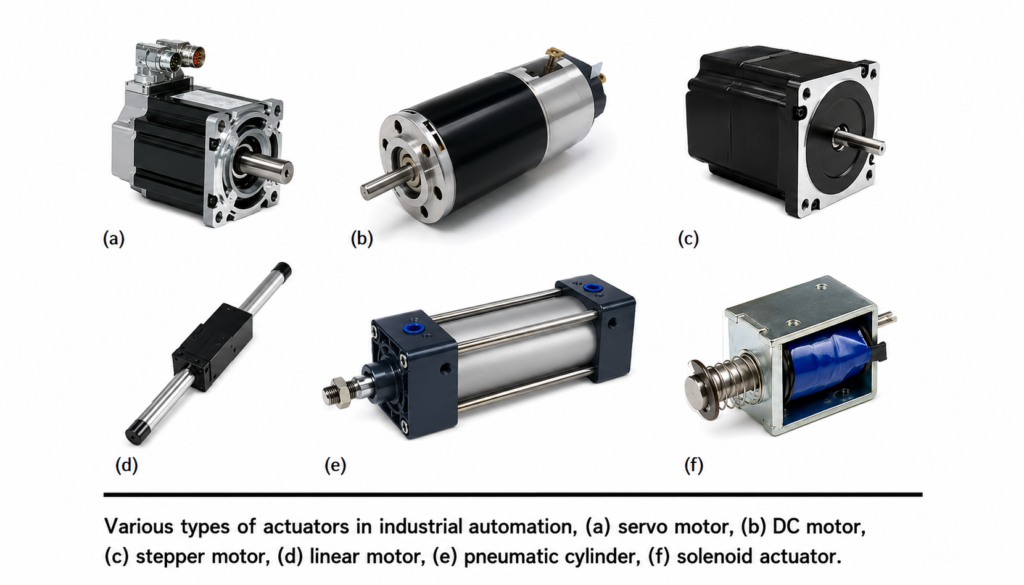
An actuator is a device that creates movement or force.
In industrial automation, actuators are the parts of a machine that actually do the physical work. They move, push, pull, open, close, lift, rotate, press, or control something in the process.
Without actuators, an automated machine would not really be able to do anything useful. You could still have the metal frame, plastic covers, sensors, PLC, wires, and control cabinet, but the machine would not be able to move or affect the product.
In simple words:
Sensors collect information.
Controllers make decisions.
Actuators perform the action.
For example, an actuator can:
Open a valve
Move a conveyor
Push a product into position
Rotate a motor shaft
Lift a load
Clamp a part
Move a robotic arm
Switch a mechanical contact
Actuators are controlled devices. This means they receive a signal from a control system, such as a PLC, relay, drive, or controller, and then perform the required movement or operation.
There are many different types of actuators used in industry. They can be grouped by the type of energy they use.
Common actuator types include:
Electric actuators
Pneumatic actuators
Hydraulic actuators
Thermal actuators
Micro-electro-mechanical actuators, also called MEMS actuators
Each type is used for different applications depending on the required force, speed, accuracy, size, and working environment.
Thermal Actuators
A thermal actuator uses heat to create movement.
One common example is a bimetallic strip. This strip is made from two different metals joined together, such as steel and copper.
These two metals expand at different rates when heated. Because one metal expands more than the other, the strip bends.
This bending movement can then be used to activate a mechanical or electrical function.
For example, a bimetallic strip can bend enough to open or close an electrical contact.
This principle is commonly used in thermal overload relays. When too much current flows through a motor circuit, heat builds up. The bimetallic strip bends because of this heat and eventually trips the relay to protect the motor.
So even though a thermal actuator may look simple, it plays an important role in industrial protection and control systems.