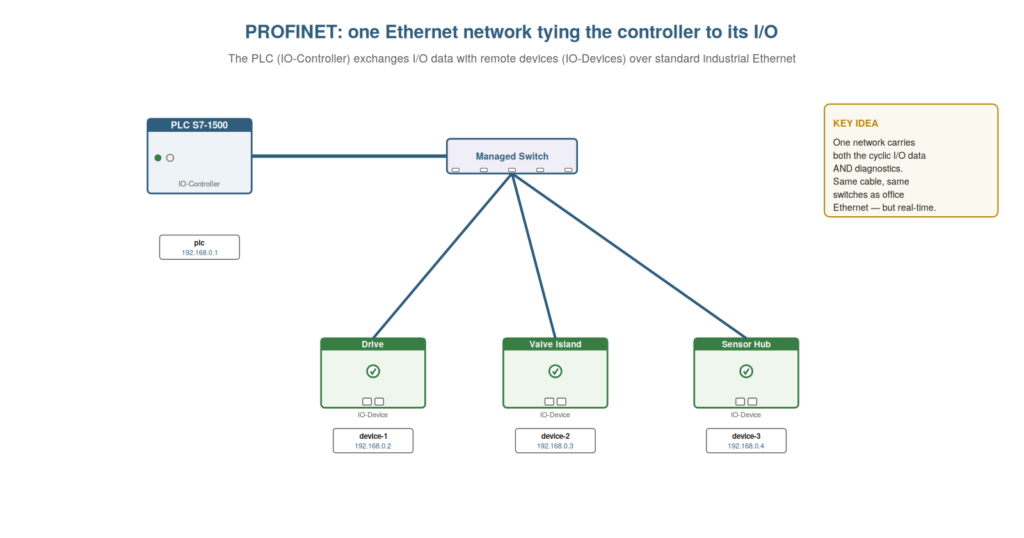
Before you can diagnose PROFINET faults, you need a clear picture of
what PROFINET actually is and does. At its simplest, PROFINET is a way
for a controller — a PLC — to exchange data with the input and output
devices scattered around a machine, using standard Ethernet as the
physical means. Where an older machine might have run individual wires
from the PLC to every sensor and actuator, a PROFINET machine runs a
network cable that carries all that I/O data between the PLC and the
remote devices. Understanding this basic nature — a network carrying I/O
data between a controller and its devices — is the foundation for
everything that follows.
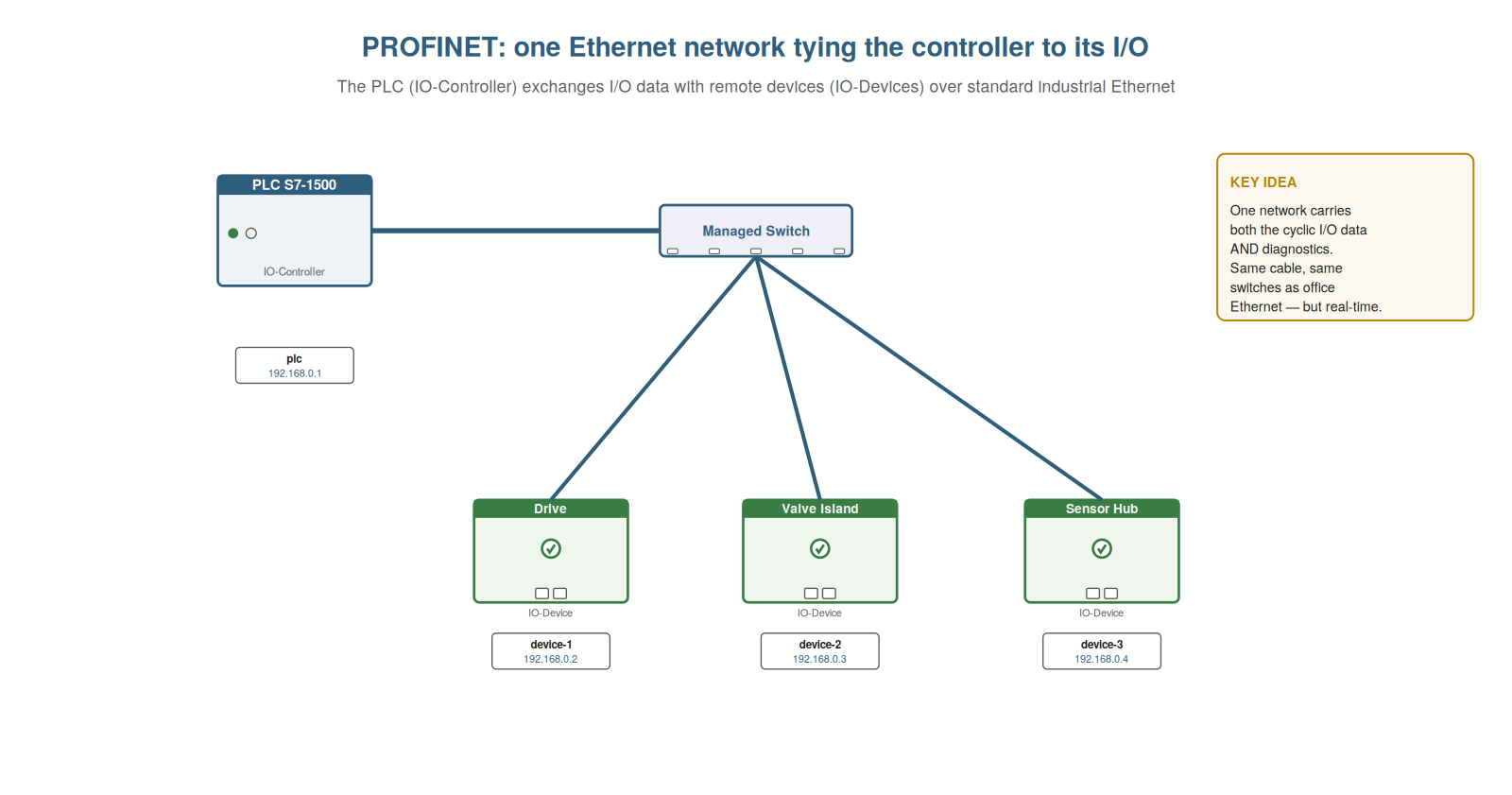
its remote I/O devices (IO-Devices) over one industrial Ethernet
network. The same cable and switches carry both the fast cyclic I/O data
and the diagnostics — real-time, but built on standard
Ethernet.
A network in place of wires
The core idea of PROFINET is replacing many individual wires with one
network, and understanding this shift clarifies what the network does
and why its faults matter so much. On a traditional machine, each input
and output has its own wire back to the PLC, and a fault in one wire
affects only that one signal. On a PROFINET machine, the I/O is gathered
at remote devices out on the machine, and a single network connects
those devices to the PLC, carrying all their data. This is efficient —
far less wiring, easier to extend, with rich diagnostics — but it also
means the network is now critical: a fault in the network can affect
many signals or a whole section of the machine at once, because so much
depends on it. So PROFINET replaces many wires with one shared network,
which brings great benefits but makes the network’s health central to
the machine’s operation. Understanding this — that the network carries
what many wires once did — explains both PROFINET’s value and why
network faults can be so disruptive. It reinforces that PROFINET gathers
I/O onto remote devices connected by one network to the PLC, replacing
individual wiring, so that the network’s health is critical to the
machine. Understanding PROFINET as a network in place of wires —
carrying the I/O data that individual conductors once carried — is the
foundation for appreciating both its efficiency and the importance of
diagnosing its faults, because when one network carries the data of many
signals, keeping that network healthy is essential to keeping the
machine running, which is exactly what PROFINET troubleshooting is
about.
Controller and devices: the roles
PROFINET organizes its participants into clear roles, and
understanding these roles — chiefly the IO-Controller and the IO-Devices
— gives you the vocabulary and structure for everything that follows.
The IO-Controller is the PLC (the CPU): it is the master of the network,
the one that initiates communication, assigns addresses, and exchanges
I/O data with the devices; it runs the show. The IO-Devices are the
remote stations out on the machine — the distributed I/O modules,
drives, valve islands, sensor hubs — each of which exchanges its inputs
and outputs with the controller over the network. There is also,
sometimes, an IO-Supervisor role: the engineering or diagnostic station
(your laptop with the tool), which connects to commission and diagnose.
So the structure is one controller (the PLC) exchanging data with many
devices (the remote I/O), with a supervisor (your tool) able to connect
for engineering and diagnosis. Understanding these roles — controller,
devices, supervisor — gives you the framework for the network. It
reinforces that the PLC is the IO-Controller (the master), the remote
stations are IO-Devices, and your diagnostic tool is the supervisor,
which is the basic cast of a PROFINET network. Understanding the roles
of controller and devices — the PLC as the IO-Controller that runs the
network, the remote stations as the IO-Devices it exchanges data with,
and your tool as the supervisor that connects to diagnose — gives you
the essential structure and vocabulary of PROFINET, so that when you
read a diagnosis or reason about a fault, you understand who the
participants are and what each does, which is the foundation for making
sense of the network and its problems.
Built on Ethernet, but real-time
A defining characteristic of PROFINET, important for diagnosis, is
that it is built on standard Ethernet yet designed for real-time
industrial use, and understanding this dual nature explains both its
familiarity and its special requirements. PROFINET uses the same
fundamental Ethernet technology as office networks: the same kind of
cables, connectors, and switches, the same basic signalling. This is why
the physical components look familiar and why standard Ethernet
knowledge partly applies. But PROFINET adds real-time behaviour on top:
it exchanges I/O data cyclically at fast, predictable intervals, with
timing guarantees that ordinary office networking does not need, because
a machine’s control depends on data arriving reliably and on time. So
PROFINET is Ethernet (familiar hardware and basis) made real-time (fast,
cyclic, timing-critical) for industrial control. This dual nature
matters for diagnosis: the physical layer is familiar Ethernet (so
physical faults are Ethernet faults — cables, connectors), but the
real-time requirement means timing and reliability matter more than in
an office network, so problems that an office network would shrug off
can disrupt PROFINET. Understanding this — standard Ethernet made
real-time — explains PROFINET’s nature and its sensitivity. It
reinforces that PROFINET uses standard Ethernet hardware but adds
real-time cyclic communication, so it is both familiar and more
demanding than office networking. Understanding that PROFINET is built
on Ethernet but designed for real-time — sharing office Ethernet’s
physical basis while adding the fast, reliable, cyclic communication
that machine control requires — clarifies both why its hardware is
familiar and why it is more sensitive to physical and timing problems
than an office network, which is important context for diagnosing the
faults that this demanding, real-time use of standard Ethernet is prone
to.
PROFINET versus the older fieldbuses
A piece of context that helps in a real plant is understanding
PROFINET’s relationship to the older fieldbuses it succeeded, because
you may encounter both and the distinction clarifies what PROFINET is.
Before industrial Ethernet, distributed I/O used fieldbuses — notably
PROFIBUS, a serial bus — which carried I/O data over a different,
slower, non-Ethernet physical medium with its own connectors and rules.
PROFINET is, in effect, the Ethernet-based successor: it does the same
job (connecting a controller to distributed I/O) but over standard
Ethernet, with far more bandwidth, easier integration, and richer
diagnostics. Many plants run both: older machines on PROFIBUS, newer
ones on PROFINET, sometimes bridged together. Understanding this
succession — PROFINET as the Ethernet successor to PROFIBUS and similar
fieldbuses — helps you recognize which network a machine uses and
clarifies PROFINET’s nature by contrast. Understanding PROFINET versus
the older fieldbuses — that it is the Ethernet-based successor to serial
buses like PROFIBUS, doing the same job with more bandwidth and better
diagnostics — gives useful context for a real plant, where machines of
different ages may use PROFINET or an older fieldbus, so that you
recognize which network a machine uses and understand PROFINET’s place
as the modern, Ethernet-based way of connecting a controller to its
distributed I/O, which is helpful context when a plant’s machinery spans
the transition from fieldbuses to industrial Ethernet.
Scenario: the technician who feared the network
A scenario shows the value of understanding what PROFINET is. A
capable electrical technician, confident with wiring and relays, froze
when a machine’s fault was ‘a network problem’ — the network felt
intangible and beyond his skills. But once he understood that PROFINET
is simply a network carrying the I/O data that wires once carried,
connecting a controller to remote devices, the mystery lifted. He
realized a network fault was, at heart, still about signals not getting
through — and that the network reported its own faults and had a
physical layer (cables and connectors) he could inspect just like
wiring. Approaching it this way, he read the device LEDs, found a dark
link, traced it to a damaged cable, and fixed it — a physical fault,
well within his skills. The understanding turned an intangible fear into
an approachable problem. This scenario shows how understanding
PROFINET’s nature turns network fear into capability. Understanding that
PROFINET is a network carrying I/O data, with a physical layer he could
inspect, let the technician approach a network fault with his existing
skills. It reinforces that grasping what PROFINET is — a network in
place of wires, with an inspectable physical layer — makes its faults
approachable rather than intangible. The scenario reinforces the book’s
opening message: understanding PROFINET as a network carrying I/O data,
with a physical layer much like wiring, turns the intangible fear of ‘a
network problem’ into an approachable, diagnosable fault, which is what
the technician discovered when his understanding let him find and fix a
damaged cable using the skills he already had.
PROFINET, PROFIsafe, and PROFIenergy
A point of context worth knowing is that PROFINET has related
extensions — notably PROFIsafe and PROFIenergy — because you may
encounter them and understanding their nature clarifies what is and is
not ordinary PROFINET. PROFIsafe is a safety extension: it carries
safety-related signals (like emergency stops and safety guards) over the
same PROFINET network, with extra measures to ensure safety integrity.
PROFIenergy is an extension for managing energy (coordinating device
power-saving). For the maintenance technician, the key point about
PROFIsafe is that safety-related communication is involved, which
demands extra care and often falls under stricter procedures and
authorization — a safety network is not something to change casually.
Understanding that these extensions exist, and that PROFIsafe in
particular involves safety, clarifies when you are dealing with ordinary
PROFINET versus safety-related communication. Understanding PROFINET’s
extensions — PROFIsafe for safety-related signals and PROFIenergy for
energy management — clarifies what is ordinary PROFINET and what
involves safety, so that when you encounter PROFIsafe you recognize that
safety-related communication is involved, demanding extra care and often
stricter procedures and authorization, which is important because a
safety network must not be treated casually, and knowing the extensions
helps you recognize when you are dealing with more than ordinary
PROFINET communication and must apply the appropriate additional
care.
Why understanding the basics pays off
It is worth closing this chapter by appreciating why the basic
understanding it provides pays off in real troubleshooting, because it
justifies the effort of learning the fundamentals rather than jumping
straight to fault-fixing. A technician who understands what PROFINET is
— a network carrying I/O data between a controller and its devices,
built on Ethernet, with an inspectable physical layer and self-reported
diagnostics — approaches every fault with a mental model that guides the
diagnosis. When a device fails, they understand what that means
(communication interrupted); when they read a diagnosis, they understand
the participants and roles; when they inspect the physical layer, they
know what they are looking at. Without this understanding,
troubleshooting is blind part-swapping; with it, every step is reasoned.
So the basics pay off by turning blind guessing into reasoned diagnosis,
which is why they are worth learning first. Understanding why the basics
pay off — that they turn every fault into a reasoned diagnosis rather
than blind guessing — justifies learning the fundamentals. Understanding
why the basic understanding pays off — that a technician who grasps what
PROFINET is approaches every fault with a mental model guiding the
diagnosis, turning blind part-swapping into reasoned troubleshooting —
justifies the effort of learning the fundamentals first, so that you
appreciate the basics not as abstract theory but as the foundation that
makes every subsequent diagnosis reasoned and effective, which is why
this book builds understanding before diagnosis and why the effort to
grasp what PROFINET is repays itself in every fault you later resolve
with the mental model it provides.