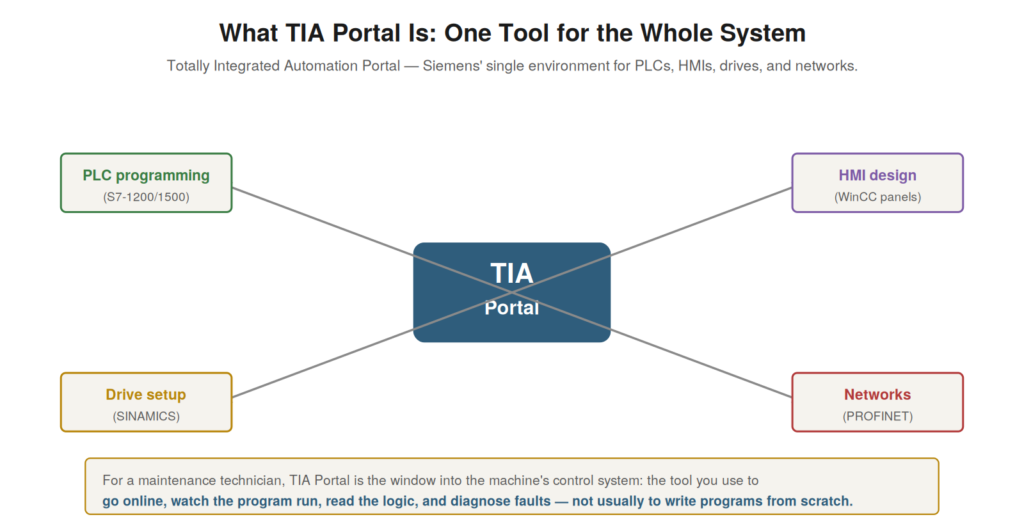
Before using TIA Portal, it helps to understand what it is and,
importantly, what your relationship to it is as a maintenance
technician. TIA Portal is Siemens’ single software environment for
engineering their automation products — the controllers, operator
panels, drives, and networks that make up a machine’s control system.
Where older systems used separate programs for each device, TIA Portal
integrates them all into one tool, which is the meaning of ‘Totally
Integrated Automation’. For you, TIA Portal is the window into the
machine’s control system: the tool through which you see and understand
what the controller is doing.
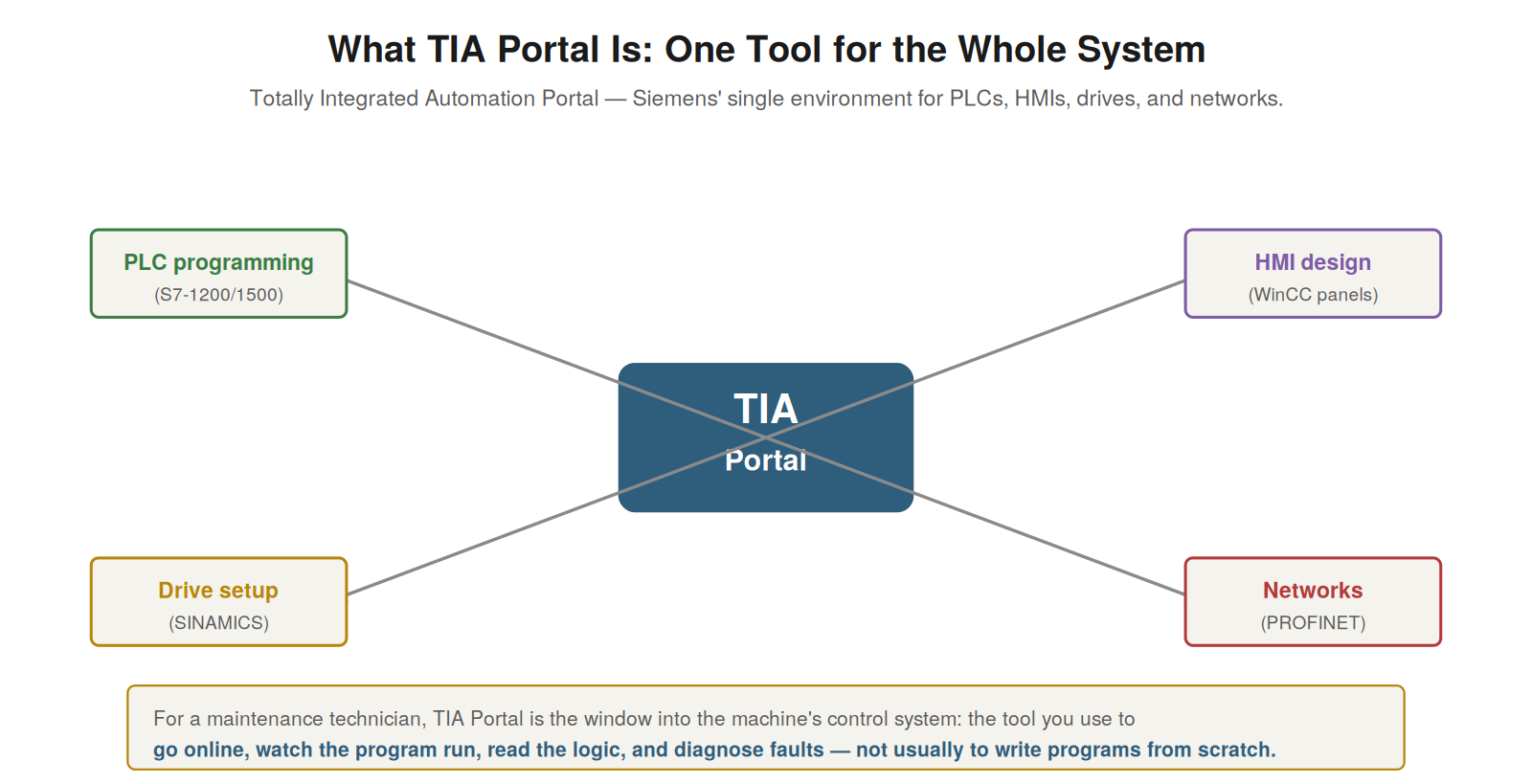
whole automation system: PLC programming, HMI design, drive setup, and
networks. For maintenance, it is the window into the machine’s control
system — for going online, monitoring, reading logic, and
diagnosing.
One tool for the whole system
TIA Portal’s defining feature is integration: it engineers the whole
automation system in one environment. The programmable controller (PLC)
that runs the machine’s logic, the human-machine interface (HMI) panel
the operator uses, the drives that control motors, and the networks that
connect them are all configured in the single TIA Portal project. This
integration is convenient for engineers building systems, but for a
maintenance technician it means something practical: everything about a
machine’s control — its logic, its operator screens, its device
configuration, its diagnostics — is accessible through this one tool.
When you open a machine’s TIA Portal project, you have access to the
whole control system in one place. Understanding this integration — that
TIA Portal covers the PLC, HMI, drives, and networks together — orients
you to what the tool can show you: not just the PLC program, but the
whole control system. It reinforces that TIA Portal is the comprehensive
window into a machine’s control, so that learning to navigate it gives
you access to everything about the machine’s control system — the logic,
the operator interface, the devices, and the diagnostics — all through
the one integrated tool, which is why it is the essential software for
anyone maintaining Siemens-controlled machinery.
The maintenance technician’s relationship to TIA
Portal
Your relationship to TIA Portal as a maintenance technician is
different from an engineer’s, and understanding this difference focuses
your learning on what you actually need. An engineer uses TIA Portal to
create automation systems: to write the PLC program, design the HMI
screens, configure the devices, and build the whole system from nothing.
That is a large, complex task requiring deep knowledge of the whole
tool. Your task is different: you inherit machines that already work,
with programs someone else wrote, and your job is to keep them working —
to go online and see what the running machine is doing, to read and
understand the existing logic, to diagnose why something is not working,
and to handle practical tasks like backups. You are a reader and
diagnostician, not usually a writer. Understanding this relationship —
that you read and diagnose rather than create — focuses your learning on
the parts of TIA Portal you need: going online, monitoring, reading
programs, and using the diagnostic tools, rather than the extensive
program-creation features an engineer needs. It reinforces that you need
only a focused subset of TIA Portal’s vast capability, the subset for
understanding and diagnosing existing machines, which is entirely
learnable and is what this book teaches, so that you can be effective
with TIA Portal without mastering the whole tool, by focusing on the
maintenance technician’s real needs: reading, monitoring, and diagnosing
the machines you maintain.
What you can do without being a programmer
It is worth appreciating how much you can accomplish in TIA Portal
without being a programmer, because it may be more than you expect.
Without writing any logic, you can go online with a controller and watch
its program run live, seeing exactly which conditions are true and
false. You can read the diagnostics buffer to find what fault stopped a
machine. You can view device diagnostics to spot a failed module. You
can trace a signal through the program using cross-references. You can
monitor values in watch tables. You can read the operator panel’s
alarms. You can back up and restore programs. All of this — the heart of
maintenance work — requires reading and navigating, not programming.
Understanding how much is possible without programming encourages you:
the maintenance skills are accessible, not requiring you to become a
programmer. It reinforces that the valuable maintenance capabilities —
monitoring, diagnosing, tracing, backing up — are reading and navigation
skills, well within reach of a technician who is not a programmer.
Understanding that you can do the essential maintenance work — going
online, monitoring, diagnosing, backing up — without programming
reassures that TIA Portal’s maintenance value is accessible to you, and
focuses your learning on these achievable, high-value skills rather than
the programming that engineers do, so that you can become genuinely
effective with TIA Portal as a maintenance tool by learning to read,
monitor, and diagnose, which is what this book sets out to teach.
Versions and why they matter
A practical detail worth understanding early is that TIA Portal comes
in versions, and the version matters for opening a machine’s project.
TIA Portal is released in successive versions (V15, V16, V17, and so
on), and a project is generally tied to the version it was made in: a
project made in a given version needs that version (or a compatible one)
to open. So when you go to work on a machine, you need a TIA Portal
version that can open its project — and a plant may have machines on
several different versions, requiring several TIA Portal versions
installed. This is a common practical hurdle: you cannot open a
machine’s project if you do not have a compatible TIA Portal version.
Understanding versions — that projects are tied to versions and you need
a compatible one to open a project — prepares you for this practical
reality. It reinforces that part of being ready to work on a machine is
having the right TIA Portal version for its project, and that a plant
with machines of various vintages may need several versions available.
Understanding TIA Portal versions — and their importance for opening
projects — prepares you for the practical matter of having the right
version to work on a given machine, avoiding the frustration of being
unable to open a project because your TIA Portal version does not match
the one it was created in, which is a common and important practical
consideration in maintaining a plant’s diverse Siemens-controlled
machinery.
Scenario: the new technician’s first machine
A scenario shows the value of understanding TIA Portal’s role. A
technician new to a plant faced a stopped Siemens-controlled machine and
felt intimidated by TIA Portal, imagining they needed to be a programmer
to help. But understanding that TIA Portal, for maintenance, is a window
for reading and diagnosing — not writing — changed their approach. They
opened the machine’s project, went online (safely, changing nothing),
read the diagnostics buffer, and found the CPU had stopped on a module
fault. Without writing a line of logic, they had located the problem — a
reading-and-diagnosing task, exactly what maintenance requires. The
intimidation had come from misunderstanding their role; understanding it
as reading and diagnosing made the task approachable. This scenario
shows how understanding TIA Portal’s maintenance role — reading and
diagnosing, not programming — turns intimidation into capability.
Understanding that the maintenance technician reads and diagnoses rather
than programs made the machine approachable, letting the technician find
the fault through reading the diagnostics. It reinforces that TIA
Portal’s maintenance value is accessible through reading and diagnosing,
so that a technician who understands this can be effective without being
a programmer. The scenario reinforces the book’s core message:
understanding TIA Portal as a reading-and-diagnosing tool for
maintenance makes it approachable, turning the intimidation of a vast
programming environment into the confidence of a technician who knows
they need only read and diagnose, which is what the new technician
discovered in successfully locating the fault through the diagnostics
buffer without any programming.
TIA Portal alongside the older Step 7
A point of context that helps in a real plant is understanding TIA
Portal’s relationship to the older Siemens software it succeeded,
because you may encounter both. Before TIA Portal, Siemens PLCs were
engineered with separate tools, notably the classic Step 7 (for the
older S7-300 and S7-400 controllers) and separate HMI software. TIA
Portal integrated and succeeded these, and the modern S7-1200 and
S7-1500 controllers are engineered in TIA Portal. But older machines
with S7-300 or S7-400 controllers may still use classic Step 7, so a
plant with a mix of machine ages may need both the classic tools (for
older controllers) and TIA Portal (for newer ones). Understanding this
succession — TIA Portal following and integrating the older separate
tools — helps you recognize which software a given machine needs.
Understanding TIA Portal’s relationship to the older Step 7 — that it
succeeded and integrated the classic tools, while older controllers may
still use them — gives useful context for a real plant, where machines
of different ages may need TIA Portal (for S7-1200/1500) or the classic
Step 7 (for older S7-300/400), so that you recognize which tool a
machine requires and understand TIA Portal’s place as the modern
successor to the older, separate Siemens engineering tools, which is
helpful context when a plant’s machinery spans several generations of
Siemens controllers and their associated software.
Why this tool is worth learning
It is worth reflecting on why learning TIA Portal is so valuable for
a maintenance technician, because appreciating the value motivates the
effort. Siemens controllers are among the most widely used in industry,
especially in Europe, so a great deal of machinery is controlled by
systems engineered in TIA Portal. A technician who can work in TIA
Portal can therefore diagnose and maintain a large fraction of the
automated machinery they encounter — a broadly applicable, valuable
skill. And because so many technicians find the software intimidating
and avoid it, the one who is comfortable with it stands out, able to
resolve problems that others cannot approach. The investment in learning
TIA Portal thus pays off across many machines and distinguishes you as a
technician. Understanding why the tool is worth learning — its broad
applicability and the advantage of comfort with it — motivates the
effort to learn it. Understanding why TIA Portal is worth learning — the
huge amount of machinery it controls and the advantage of being
comfortable with a tool many avoid — motivates the effort, because the
skill applies across a large fraction of industrial machinery and
distinguishes you as a technician able to diagnose and maintain what
others find intimidating, making the investment in learning TIA Portal
one that pays off repeatedly across the many Siemens-controlled machines
you will encounter and in the professional advantage of confident
competence with the essential software for maintaining them.