Two design choices define the 4–20 mA standard: that the signal is a current rather than a voltage, and that the range runs from 4 to 20 rather than from 0. Both choices are deliberate and clever, and understanding why they were made illuminates how the loop resists the problems that would plague simpler schemes. These are not arbitrary conventions but solutions to real engineering problems, and appreciating them is central to understanding the loop’s behavior.
Why current beats voltage
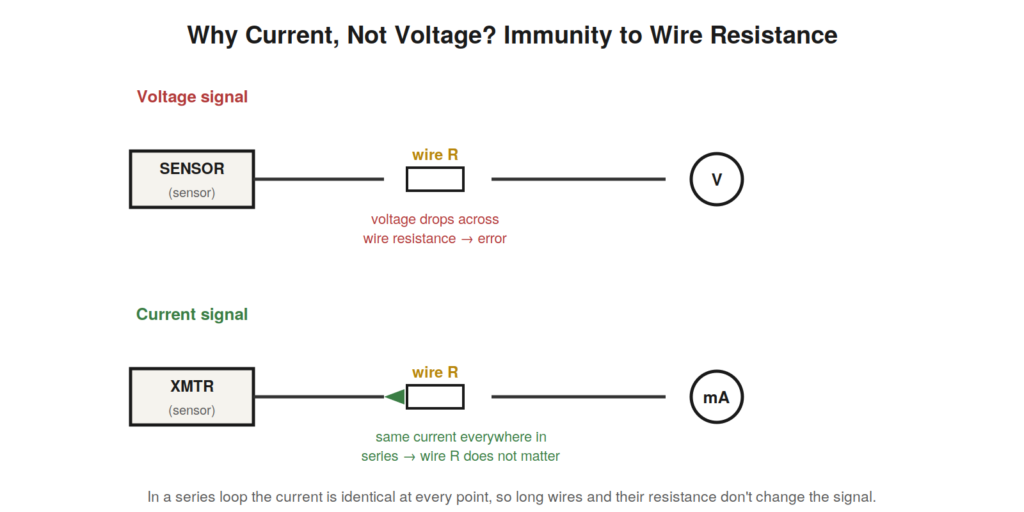
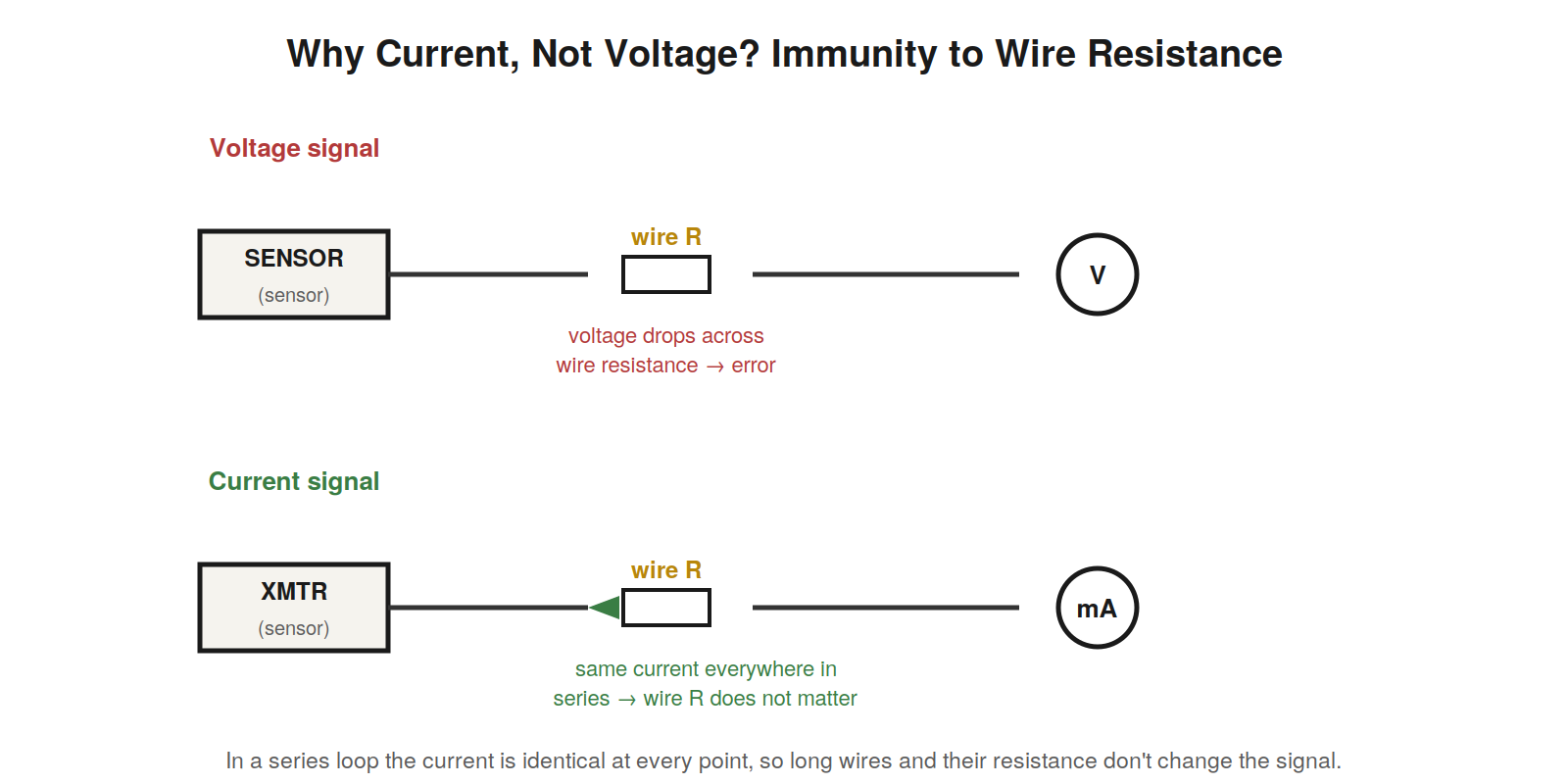
The choice of current over voltage solves the problem of wire resistance. A voltage signal sent down a long pair of wires arrives diminished, because the wire’s resistance drops some of the voltage along the way, and the longer the run, the greater the error — a serious problem in a plant where transmitters may be far from the control room. A current signal has no such problem. In a series loop, the current is the same at every point regardless of the wire’s resistance, because the transmitter regulates the current to the correct value whatever the loop resistance happens to be (within its capability). So the current that leaves the transmitter is exactly the current that reaches the receiver, unaffected by wire length or resistance. This immunity to wire resistance is the great advantage of current signaling, and it is why the loop can run long distances through a plant without loss of accuracy — the message is carried by a current that the transmitter holds constant regardless of the wiring.
Live zero: why 4 mA, not 0
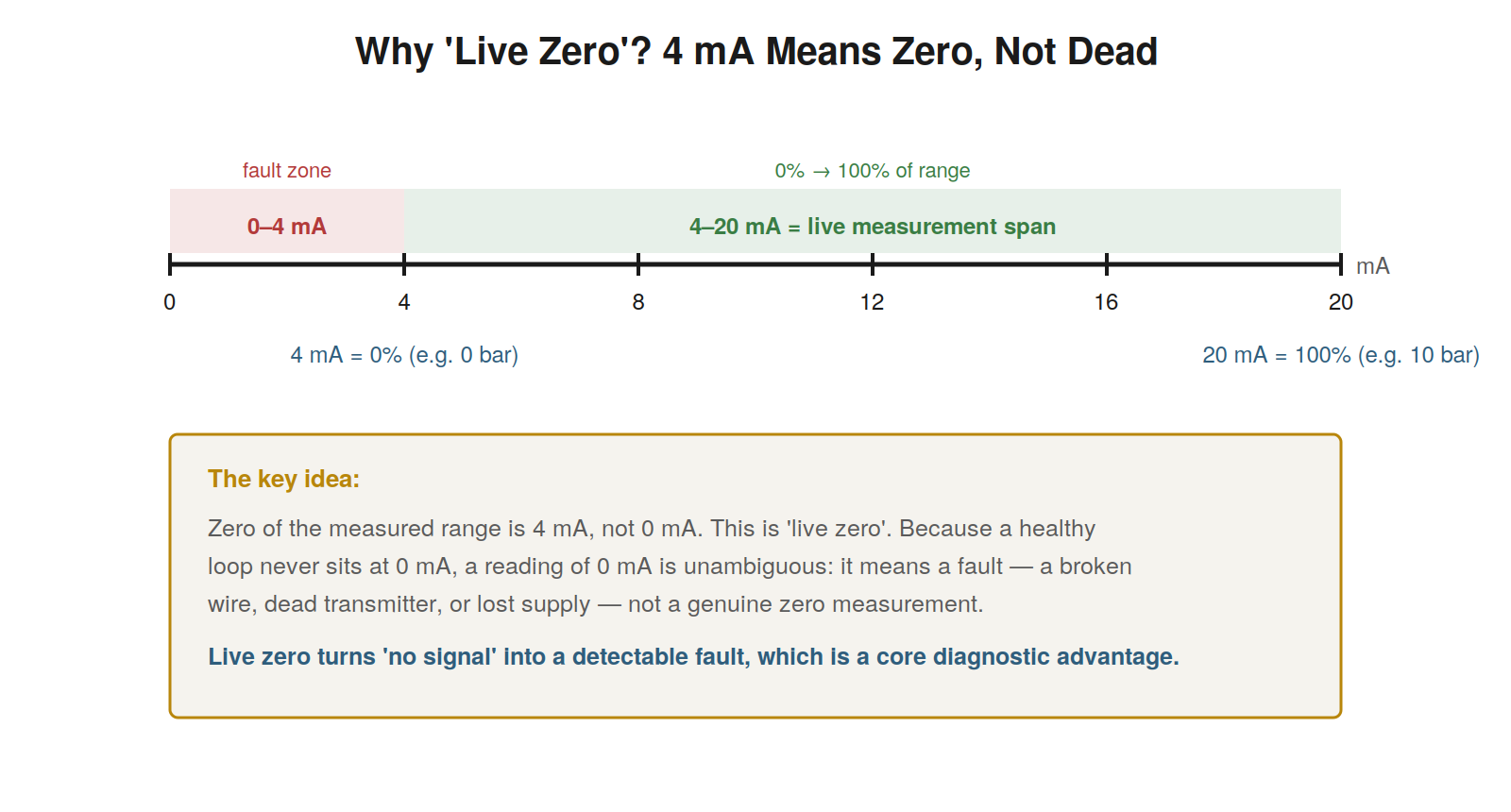
The choice to start at 4 mA rather than 0 gives the loop its second great advantage: live zero. The bottom of the measured range — zero pressure, minimum level, the low end of the span — corresponds to 4 mA, not 0 mA. This means a healthy loop always carries at least 4 mA whenever it is working and the process is anywhere in range. The consequence is powerful: a reading of 0 mA is not a valid measurement but a sign of a fault, because a working loop never sits at zero. A broken wire, a dead transmitter, a lost power supply — any of these drops the current to 0 mA, which the receiver can recognize as a fault rather than misinterpreting as a genuine minimum reading. Live zero turns ‘no signal’ into a detectable, distinguishable fault condition, which a 0-based signal could not do because it could not tell a true zero from a dead loop. This built-in fault detection is a major reason the 4–20 mA standard has endured.
The extra headroom
Starting at 4 mA also provides a small amount of current — the 4 mA that flows even at zero measurement — that can be used to power the transmitter itself, which is the basis of the loop-powered two-wire transmitter covered later. And the region below 4 mA and above 20 mA, outside the normal signal range, provides headroom that can be used for diagnostic signaling: a transmitter can deliberately drive the current slightly below 4 mA or above 20 mA to indicate a fault it has detected in itself. So the choice of 4–20 mA, rather than 0–20 or 0–25, reserves useful regions outside the measurement span for powering the device and for signaling faults, both of which add to the loop’s capability. These design choices — current signaling and the 4–20 range with its live zero and headroom — together make the loop robust, self-powering in its common form, and self-diagnosing, which is why it remains a standard after decades.
The genius of live zero, revisited
It is worth dwelling on how much the choice of live zero accomplishes with so little. By simply shifting the bottom of the scale from 0 mA to 4 mA, the designers gained three distinct benefits at once. First, fault detection: because a healthy loop never sits below 4 mA, any reading of 0 mA — or anything well below 4 — is instantly recognizable as a fault rather than a valid low measurement, something a 0-based scale simply cannot do. Second, device power: the guaranteed minimum of 4 mA provides a trickle of current that a two-wire transmitter can use to power itself, enabling the loop-powered device that needs no separate supply. Third, diagnostic headroom: the space below 4 and above 20 is available for signaling. One design decision — start at 4, not 0 — delivers fault detection, self-powering, and diagnostic signaling together, which is a remarkable economy of design and a large part of why the standard has proven so enduring and capable.
What 0-based signals cannot do
To appreciate live zero, consider what a hypothetical 0–20 mA signal could not do. At 0 mA, such a signal would be ambiguous: is the process genuinely at its minimum, or is the loop broken? There would be no way to tell from the current alone, because a true zero measurement and a dead loop would look identical. This ambiguity would be a serious safety and reliability problem, since a broken sensor would silently read as a legitimate minimum — a tank might read empty when in fact the wire had simply broken, with no indication of the fault. The 4–20 mA scheme eliminates this ambiguity entirely: a genuine minimum reads 4 mA, and a broken loop reads 0 mA, and the two are cleanly distinguished. This is why live zero is not a minor detail but a core safety feature, and why the extra design effort of a live zero was worth it — it makes the difference between a measurement system that can detect its own failures and one that cannot, which in an industrial setting is a critical distinction.
Scenario: the tank that read empty
A scenario shows live zero’s safety value concretely. A tank level was displayed in a control room, and one day it read empty — the minimum. An operator, trusting the reading, might have started a fill, but the system flagged the reading as a fault, not a genuine empty, because the loop current was 0 mA, not the 4 mA that a true empty tank would produce. Investigation found a broken wire: the tank was not empty at all, and the broken loop had merely dropped the current to zero, which live zero correctly identified as a fault rather than a valid empty reading. Had this been a 0-based signal, 0 mA would have looked like a legitimate empty tank, the fault would have gone undetected, and acting on the false empty reading could have caused an overfill or other problem. Live zero turned a potentially dangerous undetected sensor failure into a clearly flagged fault. This scenario captures why live zero matters: it distinguishes a real minimum from a dead loop, so a broken sensor announces itself as a fault instead of masquerading as a valid extreme reading.
The standard’s compatibility across generations
A quiet virtue of the 4–20 mA standard is its compatibility across generations and manufacturers, which flows from its simplicity. Because the standard is just ‘a current from 4 to 20 mA represents 0 to 100 percent,’ any transmitter that produces this and any receiver that reads it work together, regardless of make, age, or model. A modern transmitter can feed a decades-old receiver, and a new control system can read an ancient transmitter, because they share the simple current-loop convention. This interoperability has huge practical value: equipment from different eras and vendors mixes freely, replacements need only meet the same simple standard, and there is no compatibility matrix to worry about. Contrast this with digital protocols, which can have version and vendor compatibility complications. The 4–20 mA standard’s simplicity is exactly what makes it so universally compatible, and that compatibility is a major reason it persists — an installed base of interoperable equipment spanning generations, all speaking the same simple analog language. Understanding this explains why the standard is so entrenched and why new equipment still supports it: it is the universal common denominator of analog measurement.
Appreciating good engineering design
The 4–20 mA standard is worth appreciating as a piece of elegant engineering design, because understanding why it is good deepens your grasp of it and of design in general. The designers faced real problems — signal degradation over wires, the need to detect faults, the desire to power field devices simply — and solved them with two clean choices: use current, and start at 4 not 0. From these two choices flow all the loop’s virtues: immunity to wire resistance, fault detection via live zero, self-powering of two-wire devices, and diagnostic headroom. That so much capability comes from such simple choices is the mark of good design — elegance, where a few well-chosen decisions solve many problems at once. Appreciating this helps you understand the loop not as an arbitrary convention to memorize but as a coherent design whose every feature has a reason, which makes it more memorable and more deeply understood. It also offers a lesson in design thinking: the best solutions are often simple choices that address multiple problems together, as the 4–20 mA standard so nicely demonstrates. Understanding the loop as elegant design, not arbitrary convention, is understanding it at its deepest level.
The cost of getting the fundamentals wrong
A brief reflection on what happens when the fundamentals are misunderstood underscores their importance. A technician who does not understand live zero might see a 0 mA reading and interpret it as a genuine zero measurement, missing that it signals a fault — and act on a false reading. One who does not understand why current is used might worry needlessly about wire resistance affecting the signal, or fail to appreciate that the current is preserved end to end. One who does not grasp the 4–20 range might mishandle the diagnostic currents or the scaling. Each misunderstanding leads to errors: misreading faults as measurements, misdiagnosing, or mishandling the signal. The fundamentals are not academic; they directly shape whether you interpret the loop correctly. Getting them wrong means getting readings and diagnoses wrong, sometimes with real consequences. This is why the book insists on the fundamentals before troubleshooting: the troubleshooting rests on them, and a fault understood through correct fundamentals is diagnosed correctly, while one approached with misunderstood fundamentals may be misdiagnosed. The cost of getting the fundamentals wrong is getting the loop wrong, which is why understanding them properly — live zero, current signaling, the 4–20 range — is the essential foundation for everything else.
Fundamentals as the key to everything else
The fundamentals of why current and why 4–20 are the key that unlocks everything else about the loop, and it is worth stating this explicitly as the fundamentals conclude. From understanding current signaling comes the immunity to wire resistance that explains the loop’s robustness over distance. From understanding live zero comes the fault detection, the self-powering of two-wire devices, and the meaning of a 0 mA reading. From understanding the 4–20 range comes the scaling, the diagnostic currents, and the headroom for signaling. Every later topic — wiring, scaling, troubleshooting, diagnostics — builds on these fundamentals, which is why they come first and why they must be understood properly. Grasping them well makes everything that follows comprehensible, because the later topics are consequences and applications of these core ideas. A reader who truly understands why current and why 4–20 has the key to the whole subject, because the rest follows from these foundations. This is the payoff of insisting on the fundamentals: they are not preliminary hurdles but the key ideas from which the entire understanding of loops — their behavior, their wiring, their scaling, their faults, their diagnostics — unfolds, and mastering them is mastering the foundation on which all loop competence is built.