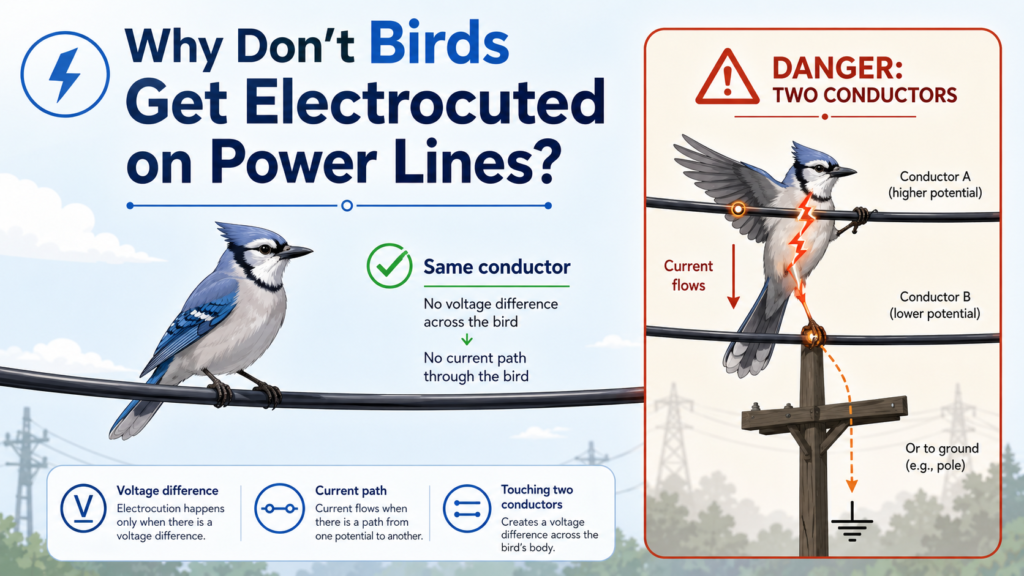
A bird lands on a power line carrying thousands of volts, looks around, shuffles its feet, and carries on as though nothing unusual is happening.
Meanwhile, a person touching the same conductor could be killed almost instantly.
It seems contradictory. The wire is energised, the bird is standing directly on it, and electricity is supposedly looking for somewhere to go. So why doesn’t current pour through the bird?
The answer comes down to three closely related ideas:
- Voltage difference
- Current paths
- The points the bird touches
Electricity does not injure an animal simply because the animal is close to high voltage. Dangerous current must actually flow through its body, and for that to happen, there must be a voltage difference between two points on the body.
A bird sitting on one conductor usually does not provide that difference.
High Voltage Alone Is Not the Whole Story
People often talk about voltage as though it behaves like an invisible substance inside a wire.
It doesn’t.
Voltage is an electrical potential difference between two points. Saying that a power line is at 10,000 volts only makes sense when that voltage is compared with another reference point, usually the ground, a neutral conductor, or another phase conductor.
The bird may be sitting on a wire that is thousands of volts above ground potential. However, both of its feet are touching almost the same section of the same conductor.
That means one foot might be at approximately 10,000 volts relative to ground, while the other foot is also at approximately 10,000 volts relative to ground.
The voltage across the bird’s body is therefore close to zero.
No significant voltage difference means no significant current through the bird.
It sounds strange at first because the bird itself rises to the electrical potential of the wire. The important point is that its entire body rises to nearly the same potential.
Current Requires a Complete Path
Electric current flows when there is both:
- A voltage difference
- A complete conductive path
A person standing on the ground and touching an energised conductor may create a path from the power line, through the body, and into the earth.
The line and the ground are at very different electrical potentials. That difference can drive a dangerous current through the person.
A bird sitting on only one wire does not normally connect the wire to the ground. It is simply another small conductive object resting on the conductor.
Current already has a much easier route through the metal power line. The wire has very low resistance compared with the bird’s body, and the bird does not provide a useful alternative path to a lower potential.
Electricity is not consciously choosing the easiest route, of course. Current divides among all available conductive paths according to their resistance and impedance. In this case, practically all of it remains in the wire.
Ohm’s Law Explains the Basic Idea
The relationship between voltage, current, and resistance can be described using Ohm’s law:
Current = Voltage ÷ Resistance
Or:
I = V ÷ R
A bird’s body has electrical resistance. If there is almost no voltage difference between its feet, the resulting current through its body will also be extremely small.
Imagine that the voltage difference between the bird’s feet is only a tiny fraction of a volt. Even if the bird’s body were reasonably conductive, that small voltage would not normally drive a harmful amount of current through it.
Now place one foot on an energised conductor and the other on a grounded metal structure.
The voltage difference could suddenly become thousands of volts.
The bird’s resistance has not magically disappeared, but the voltage driving current through it has become enormous. The resulting current may then be fatal.
Same bird. Very different circuit.
Aren’t Two Points on a Wire at Different Voltages?
Technically, yes.
A real conductor has some resistance. As current flows through a long power line, a small voltage drop appears along its length.
This means the voltage at one of the bird’s feet is not perfectly identical to the voltage at the other foot.
However, a bird’s feet are normally only a few centimetres apart. The resistance of such a short section of power line is extremely low, so the voltage difference between those two points is usually tiny.
Not literally zero. Just far too small to push a dangerous current through the bird.
This is also why body size can matter.
A small bird has a short distance between its feet and wings. A larger bird may span a much greater distance and is more likely to contact two points with a dangerous voltage difference.
Large birds such as eagles, storks, vultures, and owls are therefore more vulnerable around certain power-line structures, especially where conductors are positioned close to grounded hardware.
What Happens If a Bird Touches Two Conductors?
Things can go wrong very quickly.
Many power systems use several conductors carrying different electrical phases. In a three-phase system, the voltage between two phase conductors may be very high.
If a bird touches one phase conductor with one wing or foot and another phase conductor with another part of its body, it bridges the two phases.
Current can then flow:
From the first conductor → through the bird → into the second conductor
Because the two conductors are at different electrical potentials, a substantial voltage exists across the bird’s body.
The result can be severe burns, internal injury, or immediate death.
The bird has effectively become part of the electrical circuit.
Fortunately, conductors are usually spaced far enough apart that small birds cannot reach two of them at once. Larger birds are at greater risk because their wingspan may be wide enough to bridge the separation.
A bird does not even need to grip both wires with its feet. One foot could remain on the first conductor while a wingtip, beak, tail feather, or another body part reaches the second.
And yes, wet feathers or contaminated surfaces may make an already dangerous situation worse.
Touching a Wire and a Grounded Object Is Also Dangerous
A bird can also be electrocuted without touching two phase conductors.
Suppose it stands on an energised wire and touches a grounded crossarm, pole fitting, transformer enclosure, support bracket, or another metal structure.
The energised conductor may be thousands of volts above ground potential, while the metal structure is close to ground potential.
The bird now connects two points with a large voltage difference.
Current flows through its body toward ground.
This is essentially the same type of danger faced by a person who touches a live conductor while standing on the earth.
Utility structures are designed with insulation and clearance distances to prevent this kind of contact. Still, faults, damaged insulators, poor equipment design, contamination, and unusually large birds can create hazardous conditions.
Why Doesn’t the Bird’s Weight Push Electricity Through It?
Because current is not caused by weight or pressure on the wire.
A bird could grip the line tightly, sit there for an hour, or perform whatever tiny balancing act birds perform in strong wind. None of that creates a meaningful voltage difference across its body.
The electrical risk depends on what points it connects, not how firmly it touches the conductor.
Better contact could lower the resistance between the bird’s feet and the wire, but if both feet remain at nearly the same voltage, there is still almost no electrical force driving current through the body.
A low-resistance path is only dangerous when there is voltage across it.
Could Electricity Jump Through the Air?
Yes. Under the right conditions, electricity can arc through air.
Air is normally an insulator, but a sufficiently strong electric field can break it down. Once ionised, the air becomes conductive and an electrical arc may form.
This means a bird does not always have to make perfect physical contact with both electrical points. If it comes close enough to high-voltage equipment, an arc may bridge the remaining air gap.
The risk depends on several factors, including:
- System voltage
- Distance between the bird and the conductor
- Shape of the equipment
- Moisture and contamination
- Air pressure and weather conditions
- Whether the bird is taking off or spreading its wings
On very high-voltage transmission systems, safe clearance distances become especially important.
There is also a brief charging current when a bird first approaches or lands on a high-voltage line. Its body must change from its original electrical potential to the potential of the conductor. For an ordinary small bird, this transient current is generally too small and too brief to cause harm.
Why Are Birds Sometimes Found Dead Near Power Lines?
Power lines are not automatically safe for birds.
Birds may be injured or killed by:
- Contacting two phase conductors
- Touching a live conductor and grounded hardware
- Electrical arcing
- Damaged or poorly insulated equipment
- Colliding with wires
- Nesting near transformers or switchgear
- Creating a fault with nesting materials
A bird may also cause a short circuit that trips protective equipment. In more serious cases, the fault can damage insulators, start a fire, or interrupt the electrical supply.
Utility companies sometimes install protective covers, insulated jumpers, perch deterrents, redesigned crossarms, and larger conductor clearances in areas where bird electrocution is common.
So the popular statement that “birds cannot be electrocuted on power lines” is not really correct.
They usually remain safe because of how they touch the line—not because they have some special immunity to electricity.
Could a Human Hang From One Power Line Safely?
In theory, a person touching only one conductor and completely isolated from the ground and every other conductor could remain at nearly the same potential throughout their body.
Specialist live-line workers sometimes use carefully controlled methods based on this principle. They may work from insulated platforms, helicopters, or conductive suits while being brought to the same electrical potential as the line.
That does not make touching a power line safe.
A human body is much larger than a bird, much more likely to approach grounded objects, and much harder to position without creating a second current path. High-voltage arcing can also occur before direct contact is made.
Attempting to imitate a bird would be extraordinarily dangerous and likely fatal.
The physics may be understandable. The experiment is still a terrible idea.
The Difference Between Touch Voltage and Step Voltage
The bird example is also useful for understanding two electrical safety terms: touch voltage and step voltage.
Touch voltage is the voltage difference between an energised object a person touches and the surface beneath their feet.
Step voltage is the voltage difference between two points on the ground separated by the distance of a person’s step.
During an electrical fault, current spreading through the earth can create a voltage gradient. One foot may be at a different potential from the other, causing current to flow up one leg and down the other.
A bird on a normal power line experiences very little equivalent “step voltage” because its feet are close together on a low-resistance conductor.
Put its feet on two different electrical points, though, and that advantage disappears.
A Simple Way to Picture It
Imagine two platforms at the same height.
Standing with one foot on each platform is easy because there is no meaningful height difference between them.
Now imagine one platform is at ground level and the other is several metres higher. Trying to connect them with your body becomes a rather different experience.
Voltage difference works somewhat like electrical height.
A bird standing on one conductor has both feet at almost the same electrical height. There is little reason for current to travel through its body.
Touch two conductors at different voltages, or touch a conductor and ground, and the bird suddenly spans a large electrical height difference.
That difference drives current.
The Main Point
Birds usually survive sitting on power lines because both feet touch nearly the same electrical potential.
Although the conductor may be thousands of volts above ground, there is only a tiny voltage difference across the bird itself. Without a significant voltage difference and a complete path to another potential, dangerous current does not flow through its body.
The situation changes if the bird touches:
- Two conductors at different voltages
- One energised conductor and a grounded object
- High-voltage equipment close enough for an arc to form
At that point, the bird becomes part of a current path and can be electrocuted.
So it is not the amount of voltage written on the power-line diagram that determines what happens. It is the voltage difference across the body—and where the current is able to go.