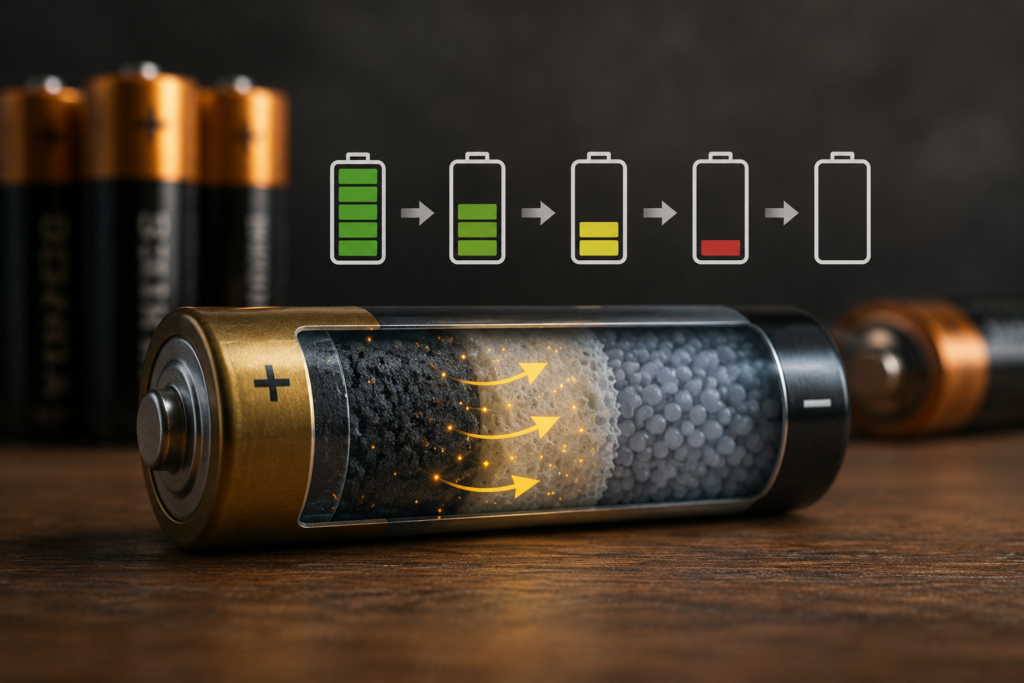
You put fresh batteries in a drawer, forget about them for a year, and later discover they are weaker than expected.
Nobody used them. Nothing was connected. No flashlight was left switched on.
So where did the energy go?
The answer is less dramatic than it sounds, but surprisingly interesting. Batteries are not perfectly sealed boxes of stored electricity. They are chemical systems, and chemistry does not completely stop just because the battery is sitting quietly on a shelf.
Small reactions continue inside. Charges slowly move. Materials age. Electronic protection circuits may draw a little power. Heat can speed everything up.
Bit by bit, the battery loses charge.
This process is called self-discharge, and every battery does it to some degree.
What Is Battery Self-Discharge?
Self-discharge is the gradual loss of stored energy while a battery is not connected to a device.
Inside a battery, chemical reactions separate charge and create a voltage between the positive and negative terminals. When you connect the battery to a load, electrons travel through the external circuit and power the device.
Simple enough.
The trouble is that some unwanted reactions also happen inside the battery. These reactions allow a small amount of stored energy to disappear without doing any useful work.
You can think of it like a water tank with a tiny internal leak. The leak may be so small that you do not notice it for weeks or months, but eventually the water level drops.
Some batteries lose charge slowly. Others lose it much faster.
The rate depends on:
- Battery chemistry
- Battery age
- Storage temperature
- Manufacturing quality
- State of charge
- Internal damage
- Attached electronics
- Storage time
A good-quality alkaline battery may remain usable for years in storage. A rechargeable battery may lose a noticeable amount of charge within a few months, depending on its chemistry.
Internal Chemical Reactions Never Fully Stop
A battery may look completely inactive from the outside, but its internal materials are still chemically alive.
The electrolyte, electrodes and separator continue to interact. Tiny side reactions consume active materials and gradually reduce the amount of energy available.
In lithium-ion batteries, for example, a protective layer forms on the negative electrode. This layer is necessary because it helps stabilize the battery, but its formation and slow growth consume a small amount of lithium.
Other unwanted reactions may also occur between the electrolyte and electrode materials.
The battery is not “leaking electricity” in the same way that a wire leaks current. Instead, stored chemical energy is being lost through reactions that do not contribute to useful electrical output.
Some of these losses are reversible through charging.
Others are permanent.
That is one reason an old rechargeable battery may show 100% on the screen yet still run down much faster than it did when new.
Temperature Makes a Big Difference
Heat is one of the biggest enemies of battery storage.
Higher temperatures speed up chemical reactions. That includes both the useful reactions and the unwanted side reactions responsible for self-discharge and battery ageing.
A battery stored in a hot car, sunny window or warm utility room will usually lose charge faster than the same battery stored in a cool, dry cupboard.
This does not mean you should freeze every battery you own.
Very low temperatures can reduce performance temporarily, create condensation problems and damage some battery types if stored or charged incorrectly. Lithium-ion batteries, in particular, should not be charged when they are extremely cold because metallic lithium plating can occur.
For normal household storage, a cool and dry location is usually best.
Avoid:
- Direct sunlight
- Radiators
- Hot vehicles
- Damp garages
- Metal boxes where terminals may short
- Areas with large temperature swings
People often store spare batteries in kitchen drawers beside ovens or boilers. Convenient, yes. Ideal, not really.
Battery-Management Systems Also Use Power
Many modern battery packs contain more than cells.
Laptop batteries, power-tool batteries, electric-bike packs, power banks and phone batteries often include a battery-management system, commonly called a BMS.
The BMS monitors things such as:
- Cell voltage
- Pack voltage
- Temperature
- Charging current
- Discharging current
- Cell balancing
- Overcharge protection
- Deep-discharge protection
- Short-circuit protection
This electronics package needs power to operate.
Usually, the amount is tiny. But tiny current multiplied by several months can become meaningful.
A lithium-ion pack may therefore lose charge even when it is completely disconnected from the device. The cells self-discharge, and the BMS quietly draws its own standby current at the same time.
Some battery packs also include:
- Bluetooth modules
- Fuel-gauge circuits
- LED indicators
- Memory chips
- Wake-up circuits
- Communication controllers
Each circuit may consume only a little energy, but none of it is truly free.
This is why a power-tool battery stored for a year may be nearly empty even though it was fully charged when you put it away.
Lithium-Ion Batteries Versus Alkaline Batteries
Not all batteries behave the same way in storage.
Battery chemistry matters enormously.
Lithium-Ion Batteries
Lithium-ion batteries are rechargeable and widely used in:
- Phones
- Laptops
- Power tools
- Electric vehicles
- Cameras
- Power banks
- Drones
- E-bikes
They generally have relatively low self-discharge compared with older rechargeable chemistries such as nickel-cadmium.
However, lithium-ion batteries still lose charge through internal chemical reactions and electronic standby consumption.
They also age with time, even when they are not being used.
That part catches people out.
A lithium-ion battery does not need to complete hundreds of charge cycles to deteriorate. Calendar ageing happens simply because time passes. High temperature and spending long periods at 100% charge can accelerate this ageing.
For long-term storage, lithium-ion batteries are usually happier when they are:
- Partially charged
- Stored somewhere cool
- Checked occasionally
- Prevented from falling into deep discharge
Leaving a lithium-ion battery completely empty for a long time can be risky. The cell voltage may fall below the safe limit, and the battery-management system may refuse to charge it again.
The battery may appear dead, even though the device was never used.
Alkaline Batteries
Alkaline batteries are primary batteries, meaning they are normally used once and then discarded.
They are common in:
- Remote controls
- Clocks
- Toys
- Flashlights
- Smoke detectors
- Wireless keyboards
Alkaline batteries usually have a long shelf life because their self-discharge rate is fairly low.
A good alkaline battery can retain much of its energy for several years when stored correctly.
Still, it does not remain perfect forever.
Chemical reactions continue slowly inside, and the metal casing, seals and internal materials gradually age. As the battery gets older, internal pressure may rise and corrosion may weaken the seal.
Eventually, the battery may lose capacity or begin to leak.
Which Type Holds Charge Better?
For long storage, alkaline batteries often perform well because they are designed to sit unused for years.
Lithium-ion batteries also have relatively low self-discharge, but the attached protection electronics and gradual calendar ageing can reduce their stored charge and long-term capacity.
The comparison is not quite apples to apples, though.
An alkaline AA battery is a simple disposable cell. A laptop battery is a rechargeable multi-cell pack with sensors, protection circuits and communication electronics. One is a chemical container. The other is practically a tiny electronic system with paperwork.
Why Old Batteries Sometimes Leak
Battery leakage is not just old liquid escaping from a cracked container.
It usually begins with chemical changes inside the cell.
In an alkaline battery, the internal electrolyte is commonly potassium hydroxide. As the battery ages or becomes deeply discharged, unwanted reactions can produce gas and increase pressure inside the casing.
The seal may eventually fail.
When that happens, corrosive electrolyte can escape and form a white, crusty deposit around the terminals.
That crust is not harmless dust. It can damage:
- Battery contacts
- Circuit boards
- Springs
- Metal holders
- Plastic housings
- Wiring
A leaking battery left inside a remote control for a few years can turn a cheap repair into a small archaeological excavation.
Leakage becomes more likely when batteries are:
- Very old
- Fully discharged
- Left inside devices for years
- Exposed to heat
- Mixed with batteries of different ages
- Mixed with different chemistries
- Charged when they are not rechargeable
- Installed backwards
- Physically damaged
Mixing one new battery with several weak batteries is especially unhelpful. The weaker cell may be forced into reverse polarity during use, increasing the chance of leakage.
Why Batteries Leak Inside Devices
A battery may have a long shelf life in its package but leak after being left inside a device.
Why?
Because some devices continue drawing tiny amounts of current even when they appear switched off.
Remote controls, clocks, thermostats and electronic toys may contain circuits that remain active in standby mode. Over several years, the batteries become deeply discharged.
Deeply discharged alkaline batteries are more likely to experience chemical instability and leakage.
There is also another problem: people forget them.
A set of batteries sitting in a package may be replaced when it reaches its expiry date. The batteries inside an old flashlight in the basement might remain there until 2034, quietly corroding the terminals.
Do Rechargeable Batteries Leak Too?
They can, although leakage is less common with sealed modern lithium-ion cells than with old alkaline or nickel-based batteries.
Lithium-ion batteries are more likely to:
- Swell
- Lose capacity
- Trip their protection circuit
- Develop high internal resistance
- Overheat if damaged
- Vent gases in severe failures
A swollen lithium-ion battery should not be squeezed, punctured or continued in service.
Swelling usually means gas has formed inside the cell due to electrolyte decomposition or internal degradation. The battery may still appear to work, but it should be treated as damaged.
Nickel-metal hydride and nickel-cadmium rechargeable batteries can also vent or leak under abusive conditions, overcharging or advanced ageing.
Does a Battery Lose Voltage or Capacity?
Both can happen, but they are not exactly the same thing.
A resting battery may show a reasonable voltage on a multimeter while no longer being able to supply useful current.
This happens because the battery’s internal resistance increases with age.
The voltage may look fine with no load connected. The moment the battery powers a motor, lamp or radio, the voltage collapses.
This is why checking a battery only with an unloaded multimeter reading can be misleading.
A proper battery tester applies a small load and measures how well the battery maintains its voltage.
In other words, the battery may look awake until you ask it to do something.
Relatable, perhaps.
Why Some Rechargeable Batteries Go Flat Quickly
Older rechargeable battery chemistries can have much higher self-discharge than alkaline or lithium-ion cells.
Traditional nickel-metal hydride batteries, for example, may lose a noticeable percentage of their charge each month.
Low-self-discharge nickel-metal hydride cells are designed to hold charge longer and are often better for devices that are used occasionally.
Battery quality matters too.
Cheap cells may contain more impurities, weaker separators or less consistent manufacturing. These imperfections can create additional internal leakage paths and speed up self-discharge.
A high-capacity label does not automatically mean the battery will store well.
Sometimes the battery with the biggest number printed on the wrapper is the one that disappoints first. Marketing has hobbies too.
Can You Stop Self-Discharge Completely?
No.
You can slow it down, but you cannot eliminate it.
All real batteries experience some internal chemical change over time. Even if a battery is never connected to anything, its materials continue ageing.
What you can do is reduce the conditions that make the process worse.
How to Store Batteries Properly
For ordinary household batteries:
- Store them in a cool, dry place.
- Keep them away from direct sunlight.
- Leave them in their original packaging where possible.
- Keep loose batteries from touching metal objects.
- Do not mix old and new batteries.
- Do not mix different brands or chemistries in one device.
- Remove batteries from equipment that will not be used for months.
- Check stored rechargeable batteries occasionally.
For lithium-ion packs:
- Avoid leaving them fully empty.
- Avoid prolonged storage at very high temperature.
- Store them partly charged for long periods.
- Check their charge every few months.
- Stop using packs that are swollen, cracked or unusually hot.
For alkaline batteries:
- Remove them from rarely used devices.
- Replace all cells in a set at the same time.
- Watch for white crust, corrosion or swelling.
- Do not attempt to recharge standard alkaline cells.
Should Batteries Be Stored in a Refrigerator?
This advice comes from a time when certain battery chemistries and storage conditions made cooling more useful.
Modern alkaline and lithium batteries normally do not need refrigeration.
A refrigerator introduces moisture and condensation risks. If cold batteries are immediately placed into equipment, water may form on the terminals or surrounding components.
A cool cupboard is generally enough.
The fridge is better used for food. Batteries are rarely improved by being stored beside cheese and half an onion.
What Should You Do With Leaking Batteries?
Do not handle leaking material with bare hands.
The electrolyte may be corrosive.
Use gloves and avoid touching your eyes or face. Remove the battery carefully without crushing it. Follow local battery-recycling rules rather than throwing it into general waste.
For alkaline battery corrosion inside a device, small amounts of acidic household material such as vinegar or lemon juice are sometimes used to neutralize alkaline residue. However, the device should be disconnected, the liquid should be applied sparingly, and the area must be completely dry before reuse.
Do not use this approach on damaged lithium-ion batteries.
A leaking, swollen, hot or punctured lithium-ion battery should be isolated from flammable materials and handled through an appropriate battery-recycling or hazardous-waste service.
Why a “Dead” Battery May Recover Slightly
Sometimes a battery appears dead, then works again after sitting for a while.
This is not free energy.
Under heavy load, the battery voltage drops because of internal resistance and chemical limitations. Once the load is removed, the internal chemistry partially equalizes and the terminal voltage rises again.
The battery may power the device briefly, but its real capacity has not magically returned.
It is similar to resting halfway up a staircase. You feel better for a moment, but the staircase is still there.
The Simple Explanation
Batteries lose charge while unused because their internal chemistry never becomes perfectly inactive.
Slow side reactions consume stored energy. Heat speeds those reactions up. Battery-management electronics draw small amounts of power. Age increases internal resistance and damages seals.
Lithium-ion batteries usually have fairly low self-discharge, but they still age over time and may be drained by protection electronics.
Alkaline batteries can remain usable for years, yet old or deeply discharged cells may build internal pressure and leak corrosive electrolyte.
So the missing charge did not vanish into thin air.
It was gradually consumed inside the battery itself, one tiny chemical reaction at a time.