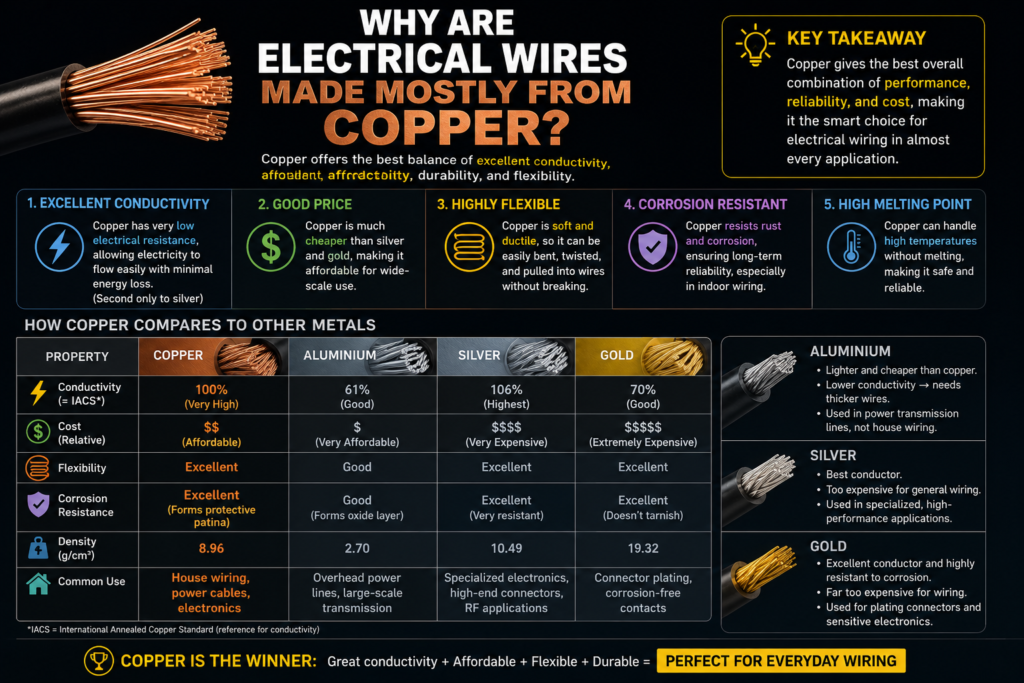
Silver conducts electricity better than copper. Gold barely corrodes. Aluminium is lighter and often cheaper.
Yet open a household cable, an extension lead, a motor winding, or an electrical panel, and the conductor inside will usually be copper.
Why?
Because electrical wiring is not a contest to find the metal with the highest conductivity. A useful conductor must also be affordable, mechanically strong, flexible enough to install, resistant to corrosion, and easy to terminate safely.
Copper happens to offer an unusually good balance of all those properties.
It is not the absolute winner in every category. It is simply very good at nearly everything that matters.
What Makes a Good Electrical Conductor?
An electrical wire has a fairly straightforward job: carry current from one point to another without wasting too much energy or becoming dangerously hot.
The resistance of a conductor depends on three main factors:
Resistance = resistivity × length ÷ cross-sectional area
Or:
R = ρL ÷ A
Where:
- R is resistance
- ρ is the material’s resistivity
- L is conductor length
- A is its cross-sectional area
A material with low resistivity allows current to pass more easily.
Longer wires have more resistance, while thicker wires have less resistance. That is why a large cable can carry more current than a small cable made from the same material.
Conductivity is important, then. Very important.
But it is only the opening round.
An electrical conductor must also survive bending, pulling, vibration, temperature changes, moisture, oxidation, screw terminals, crimp connections, and several decades of sitting behind plasterboard where nobody wants to see it again.
Copper handles that rather well.
Copper Has Excellent Electrical Conductivity
Copper is one of the best electrical conductors available.
At room temperature, pure copper has a conductivity of roughly 58 million siemens per metre. Exact values vary slightly with purity, temperature, and manufacturing condition.
Only a few common metals conduct better.
Silver is the most electrically conductive pure metal, but copper comes remarkably close. Depending on the reference values used, silver may conduct only several percent better than high-quality electrical copper.
That small improvement is not enough to justify using silver for kilometres of ordinary wiring.
Copper’s low resistance means a practical cable can carry substantial current without requiring an absurdly large conductor.
Lower resistance also means:
- Less voltage drop
- Lower heat generation
- Reduced energy loss
- Better efficiency
- More compact cable sizes
This matters in everything from a phone charger to a factory distribution board.
A poor conductor could still carry electricity, of course. It would simply need to be thicker, shorter, cooler, or operated at a lower current.
Not ideal when wiring an entire building.
Copper Is Ductile
Conductivity would not be particularly useful if the metal shattered every time someone tried to bend it.
Copper is highly ductile, meaning it can be drawn into long, thin wires without breaking.
Manufacturers can pull copper through progressively smaller dies until it reaches the required diameter. The resulting wire can be used as one solid conductor or combined into many fine strands.
Stranded copper is especially useful where flexibility is required, such as:
- Appliance leads
- Extension cables
- Control panels
- Robotics
- Vehicles
- Portable tools
- Industrial machinery
- Motor connections
The strands move slightly against one another as the cable bends, allowing it to flex more easily than a solid conductor of the same cross-sectional area.
Copper is not indestructible. Repeated bending at one sharp point can cause work hardening and eventually break the strands.
Still, compared with many other conductive metals, it provides a practical combination of flexibility and fatigue resistance.
Copper Is Mechanically Strong
Wires experience more mechanical stress than they appear to.
During installation, cables may be:
- Pulled through conduits
- Bent around corners
- Clamped under terminals
- Crimped into lugs
- Subjected to vibration
- Supported over long distances
- Exposed to expansion and contraction
Copper can withstand these conditions while maintaining a reliable electrical connection.
It is stronger than aluminium for a conductor of the same size and is less prone to permanent deformation under terminal pressure.
This matters at screw connections.
A terminal must remain tight for years. If the conductor gradually changes shape beneath the screw, contact pressure may decrease. Resistance then increases, which produces heat, which can make the connection deteriorate even faster.
A loose electrical connection has a nasty habit of becoming its own heating element.
Copper is not immune to poor workmanship, but it is generally forgiving and mechanically stable.
Copper Connections Are Relatively Easy to Make
A conductor is only as useful as its connections.
Copper works well with common termination methods, including:
- Screw terminals
- Spring terminals
- Crimp lugs
- Compression connectors
- Soldered joints
- Busbar connections
- Welded connections
Its surface is comparatively straightforward to prepare, and compatible connectors are widely available.
Copper conductors can also be soldered easily because solder wets a clean copper surface well. Soldering is not appropriate for every power connection, but it remains valuable in electronics and control equipment.
Electricians, panel builders, manufacturers, and maintenance technicians already have a vast ecosystem of tools and products built around copper.
That practical infrastructure matters.
A slightly better material on paper may not be better in the field if it requires unusual connectors, specialised handling, or expensive installation methods.
Copper Handles Corrosion Reasonably Well
Copper does oxidise.
Fresh copper has a bright reddish surface, but exposure to air gradually creates darker copper oxides. In outdoor environments, additional reactions can eventually form the familiar green patina seen on old roofs and statues.
Still, copper’s corrosion behaviour is usually manageable.
Its surface products tend to form relatively stable layers, and properly designed copper connections can remain reliable for decades.
Copper also performs well in many indoor and enclosed electrical applications where moisture and aggressive chemicals are limited.
This does not mean bare copper is suitable for every environment. Salt, acids, ammonia, sulphur compounds, moisture, and incompatible metals can all cause problems.
For harsher conditions, copper conductors and contacts may be:
- Tinned
- Silver-plated
- Nickel-plated
- Sealed
- Insulated
- Protected with suitable compounds
Compared with aluminium, copper is often easier to connect reliably because its surface oxidation creates fewer termination difficulties.
Why Not Use Silver?
Silver has the highest electrical conductivity of any pure metal.
So why not make every wire from silver?
The obvious answer is cost.
Silver is far more expensive than copper. Replacing the copper in buildings, cables, transformers, motors, and power equipment with silver would increase material costs enormously while providing only a modest reduction in resistance.
That is a terrible bargain for most applications.
Silver is also denser than copper, so it offers no meaningful weight advantage. It can tarnish when exposed to sulphur-containing compounds, forming silver sulphide on its surface.
Despite those disadvantages, silver is used where its properties justify the expense.
Typical applications include:
- High-current switch contacts
- Relay contacts
- Circuit-breaker contacts
- Contact alloys
- Conductive pastes
- Solar-cell conductors
- Certain high-frequency components
- Silver-plated conductors
Silver-plated copper combines the mechanical structure and lower cost of copper with silver’s excellent surface conductivity.
It is especially useful in high-frequency and high-temperature applications where current tends to concentrate near the conductor’s surface.
For ordinary building wire, though, solid silver would be rather like using a sports car to deliver one envelope down the street. It works. It just makes very little economic sense.
Why Not Use Gold?
Gold is famous for being used in electronics, which sometimes creates the impression that it must be a better conductor than copper.
It is not.
Gold conducts electricity well, but its electrical conductivity is lower than both silver and copper.
Gold’s real advantage is its exceptional resistance to corrosion.
It does not readily oxidise or tarnish under ordinary conditions. A thin gold surface can therefore maintain a clean, reliable electrical contact even after long periods of storage or exposure.
This makes gold useful for:
- Connector contacts
- Edge connectors
- Test equipment
- Communication hardware
- Aerospace electronics
- Medical equipment
- High-reliability signal connections
- Semiconductor bonding
Usually, only a thin layer of gold is applied over another metal. The bulk conductor may still be copper.
Using solid gold for ordinary wiring would be unnecessarily expensive, mechanically soft, heavy, and electrically worse than copper.
Gold is valuable where the surface contact must remain dependable—not because engineers enjoy hiding treasure inside connectors.
Why Aluminium Is a Serious Competitor
Aluminium is the main practical alternative to copper in power wiring.
It is widely used in:
- Overhead power lines
- Large feeder cables
- Utility distribution
- Substations
- Service entrance conductors
- Busbars
- Large industrial installations
Aluminium has several major advantages.
It is lighter than copper and often less expensive. Its density is only about one-third that of copper, which makes an enormous difference in long overhead spans.
A lighter conductor places less mechanical load on towers, poles, insulators, and supporting hardware.
This is why overhead transmission lines are commonly made from aluminium rather than copper.
Many use aluminium strands wrapped around a steel core. The aluminium carries most of the current, while the steel provides mechanical strength.
Aluminium Conducts Less Than Copper
Aluminium’s electrical conductivity is only around 60% that of copper, depending on the alloy and condition.
This means an aluminium conductor must have a larger cross-sectional area to achieve resistance similar to a copper conductor.
As a rough comparison, aluminium may need around 1.6 times the cross-sectional area of copper for comparable conductivity.
That sounds like a disadvantage—and it is, in confined spaces.
However, aluminium is so much lighter that even a physically larger aluminium conductor may still weigh considerably less than the equivalent copper conductor.
This creates a trade-off:
- Copper is smaller for the same resistance.
- Aluminium is lighter and often cheaper.
For a cable squeezed into a compact control cabinet, copper is usually attractive.
For a conductor hanging between pylons, aluminium often wins.
Aluminium Forms a Tough Oxide Layer
Aluminium reacts quickly with oxygen.
The resulting aluminium oxide layer protects the underlying metal from further corrosion, which is useful in many mechanical applications.
Electrically, however, aluminium oxide is a problem because it is a strong insulator.
A poorly prepared aluminium connection may therefore have high contact resistance even though the metal underneath is highly conductive.
Reliable aluminium terminations require proper procedures and suitable hardware.
Depending on the system, this may include:
- Aluminium-rated terminals
- Correct conductor preparation
- Oxide-inhibiting compound
- Controlled tightening torque
- Compatible lugs
- Appropriate crimping tools
- Protection against moisture
- Periodic inspection where required
Using a connector intended only for copper can lead to overheating and failure.
The conductor itself may be perfectly capable of carrying the current. The connection is where the trouble begins.
Aluminium Expands More With Heat
All metals expand when heated and contract when cooled.
Aluminium’s thermal expansion is greater than copper’s.
In a heavily loaded circuit, the conductor warms. When the load decreases, it cools. Repeated thermal cycling can alter connection pressure, particularly in poorly designed or incorrectly tightened terminals.
Aluminium is also more susceptible to creep, which is slow permanent deformation under sustained mechanical pressure.
Over time, a conductor clamped beneath a screw may flatten slightly. The connection becomes looser, contact resistance rises, and additional heat is produced.
Modern aluminium cables and compatible termination systems are designed with these issues in mind. Properly installed aluminium wiring can be safe and reliable.
Problems arise when aluminium is treated as though it were simply lightweight copper.
It isn’t.
Why Older Aluminium House Wiring Developed a Bad Reputation
In some countries, aluminium branch-circuit wiring was installed in homes when copper prices were high.
Certain older installations developed connection problems, particularly at receptacles, switches, and junctions that were not well suited to aluminium conductors.
Contributing factors included:
- Incompatible terminals
- Aluminium alloys with poor mechanical properties
- Oxidation
- Thermal expansion
- Creep
- Incorrect installation methods
- Copper-to-aluminium connections without suitable connectors
These problems sometimes led to overheating and fires.
Modern aluminium conductor alloys, connectors, and installation rules are much improved. Aluminium remains widely used in larger cables where its economic and weight advantages are substantial.
Still, copper remains the preferred choice for many small branch circuits because it is easier to terminate reliably in compact devices.
Copper Is More Compact
Space is valuable inside electrical equipment.
A copper conductor can carry the same current as a physically larger aluminium conductor, assuming comparable conditions and design requirements.
Smaller conductors are easier to route through:
- Conduits
- Cable trays
- Junction boxes
- Distribution boards
- Control panels
- Motors
- Transformers
- Machinery
This becomes particularly important in windings.
Motor and transformer manufacturers want to fit as much conductor as practical into a limited slot or window area. Copper’s high conductivity allows more effective electrical performance in a compact space.
Aluminium windings do exist, especially where cost and weight matter. They simply require different dimensions and manufacturing considerations.
Copper Works Well in Motor and Transformer Windings
Copper is a natural choice for electromagnetic windings.
It can be drawn into fine wire, coated with thin electrical insulation, bent into tight shapes, and packed efficiently into slots or coils.
Its low resistance helps reduce winding losses.
Those losses are commonly described by:
P = I²R
Where:
- P is power converted into heat
- I is current
- R is resistance
Reducing winding resistance lowers heat production for a given current.
Less heat can mean:
- Better efficiency
- Longer insulation life
- Higher power density
- Easier cooling
- More compact equipment
Copper windings are used in motors, transformers, relays, solenoids, inductors, generators, and countless other electromagnetic devices.
The material has been doing this job for a long time, and it is rather good at it.
Copper Is Easy to Recycle
Copper has considerable recycling value.
Old cables, busbars, motors, transformers, and electrical equipment can be processed to recover the metal.
Recycled copper can retain excellent electrical properties when properly refined. This reduces the need for new mining and keeps valuable material in circulation.
Its high scrap value is economically useful, though it has an unfortunate side effect: copper cables and grounding systems attract thieves.
Still, recyclability strengthens copper’s overall case as an industrial material.
It is expensive enough to recover, but not so expensive that it becomes impractical for everyday wiring.
Why Not Use Iron or Steel?
Iron and steel are strong, cheap, and widely available.
They are also much worse electrical conductors than copper.
A steel wire would require a much larger cross-sectional area to achieve similar resistance. It would produce greater losses and more heating.
Steel is also less flexible and more vulnerable to certain forms of corrosion.
That does not mean steel has no place in electrical systems.
It is commonly used for:
- Conduit
- Cable armour
- Enclosures
- Structural support
- Transformer cores
- Motor laminations
- Reinforcing components
- Steel-cored aluminium conductors
Steel is useful where strength or magnetic properties matter.
For carrying current efficiently, copper and aluminium are better choices.
What About Copper-Clad Aluminium?
Copper-clad aluminium, often abbreviated as CCA, consists of an aluminium core covered by a layer of copper.
It is lighter and cheaper than solid copper.
CCA appears in some communication cables, loudspeaker wires, low-cost extension products, and unfortunately in products marketed in ways that make the conductor material easy to overlook.
Its conductivity is lower than solid copper, so a CCA conductor cannot safely be treated as though it were an equal-sized copper conductor.
Potential concerns include:
- Greater voltage drop
- More heating
- Lower mechanical strength
- More difficult terminations
- Oxidation where aluminium becomes exposed
- Misleading conductor-size claims
CCA can be appropriate when the entire product is designed, rated, and tested for it.
Problems arise when it is substituted for copper without changing conductor size, protection, connectors, or current ratings.
A shiny copper-coloured surface does not always mean the wire is copper all the way through.
Is Oxygen-Free Copper Better for Wiring?
Oxygen-free copper is marketed heavily in premium audio cables.
It contains very low levels of oxygen and can offer benefits in specialised manufacturing, vacuum systems, high-temperature applications, and certain electronic uses.
For ordinary household power wiring, the practical electrical difference between standard high-quality electrical copper and expensive oxygen-free copper is extremely small.
Normal electrical-grade copper is already highly pure and highly conductive.
A larger conductor, shorter cable run, sound termination, and correct installation will usually matter far more than an exotic purity label.
A cable cannot hear the marketing brochure.
Copper Is Not Perfect
Copper has disadvantages.
It is:
- Heavier than aluminium
- More expensive than many common metals
- Vulnerable to theft
- Capable of corroding in aggressive environments
- Subject to work hardening under repeated movement
- Dependent on mining and energy-intensive processing
Its price can also fluctuate significantly.
For very large power systems, copper’s weight and cost may become difficult to justify. That is where aluminium often takes over.
For miniature or corrosion-sensitive contacts, gold may be better.
For specialised contact surfaces and high-frequency conductors, silver may offer advantages.
No single metal is best everywhere.
The Practical Comparison
Copper
Copper combines excellent conductivity, mechanical strength, flexibility, corrosion resistance, compact size, and easy termination.
It is the usual all-round choice for building wiring, flexible cables, panels, motors, transformers, and electronics.
Aluminium
Aluminium is lighter and often cheaper, but it conducts less efficiently and requires larger conductors and carefully designed connections.
It is especially useful for overhead lines and large power cables.
Silver
Silver offers the best conductivity, but its high cost makes it impractical for general wiring.
It is more commonly used in contacts, coatings, pastes, and specialised equipment.
Gold
Gold resists corrosion exceptionally well, but it costs far more and conducts less effectively than copper.
Its main role is in reliable connector and contact surfaces.
Why Copper Usually Wins
Copper is used for most electrical wires because it achieves the best overall compromise.
It conducts almost as well as silver without silver’s extraordinary cost.
It is more conductive and compact than aluminium, while being easier to terminate reliably.
It lacks gold’s near-perfect corrosion resistance, but it is vastly more affordable and actually conducts electricity better.
Copper can be drawn into fine strands, bent around corners, crimped, soldered, clamped, insulated, and expected to remain in service for decades.
That combination is difficult to beat.
The best conductor is not always the metal with the lowest resistance.
It is the metal that carries current efficiently, survives the installation, keeps its connections tight, resists the environment, and does all of that without turning every cable project into a luxury purchase.
Most of the time, that metal is copper.