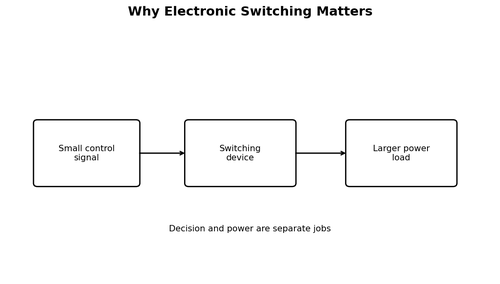
This chapter establishes a switching concept that applies to relays, BJTs, and MOSFETs alike. A small control signal can manage a larger load.
The main ideas are: A small control signal can manage a larger load. Switching separates decision from power delivery. Every switch has voltage current and power limits. Good designs consider the load before the switch.
Think in current paths. Identify the power source, load, switching element, return path, and control input. If you cannot trace the intended load current with the switch on and off, the circuit is not yet understood well enough to troubleshoot efficiently.
A useful troubleshooting habit is to divide the circuit into control, switch, and load. Prove each block separately before blaming the component in the middle.
Worked thinking: A 3.3 V microcontroller pin can command a 12 V fan through a suitable driver without powering the fan from the pin itself. The example is meant to demonstrate the method, not to replace the ratings and test conditions of the actual part you use.
Design view – a small control signal can manage a larger load. Ask which component or connection establishes this behavior and which rating could be exceeded if the load changes. This turns a descriptive fact into a selection rule.
Troubleshooting view – switching separates decision from power delivery. Imagine the reading if this condition were missing, too weak, too high, reversed, or intermittent. A useful test is one that separates those possibilities instead of merely producing another number.
Design view – every switch has voltage current and power limits. Ask which component or connection establishes this behavior and which rating could be exceeded if the load changes. This turns a descriptive fact into a selection rule.
Troubleshooting view – good designs consider the load before the switch. Imagine the reading if this condition were missing, too weak, too high, reversed, or intermittent. A useful test is one that separates those possibilities instead of merely producing another number.
A switch should be evaluated in both steady state and transition state. ON-state voltage drop creates heat, OFF-state voltage stress can damage the device, and the brief transition between states can be the most stressful period during fast or repetitive switching.
Finish by verifying the real load. A driver that works with an LED may still fail with a relay, motor, solenoid, heater, or long cable because startup current, inductance, wiring resistance, and electrical noise change the conditions dramatically.
Worked Example
A 3.3 V microcontroller pin can command a 12 V fan through a suitable driver without powering the fan from the pin itself.
Hands-On Mini-Lab
- Draw the intended current path with the switch ON.
- Draw the intended current path with the switch OFF.
- Mark every supply and reference ground.
- Write the maximum expected load current.
- Identify the safest default state if the controller resets.
Common Beginner Mistakes
- Ignoring startup and reset behavior.
- Forgetting that every voltage measurement needs a reference.
- Selecting a switch before measuring the load.
- Treating a control pin as if it were a power output.
Fault-Finding Lens
- Verify the actual supply voltage at the load and switching device while the load is commanded ON.
- Measure the control quantity at the device itself: base current for a BJT, VGS for a MOSFET, or coil voltage for a relay.
- Check the load independently when possible so a failed load is not mistaken for a failed driver.
- Inspect protection parts, grounds, connectors, and wiring for open circuits, shorts, reversed polarity, or excessive voltage drop.
- After the repair, repeat the original operating condition and verify current, voltage drop, temperature, and turn-off behavior.
Check Your Understanding
- Explain why electronic switching matters in your own words.
- Which voltage or current would you measure first to verify this stage?
- What is one failure mode that could make the switch run hot?
- What protection component or design margin is most relevant here?
- How would the circuit behave during controller startup or reset?
Key Points
- A small control signal can manage a larger load.
- Switching separates decision from power delivery.
- Every switch has voltage current and power limits.
- Good designs consider the load before the switch.