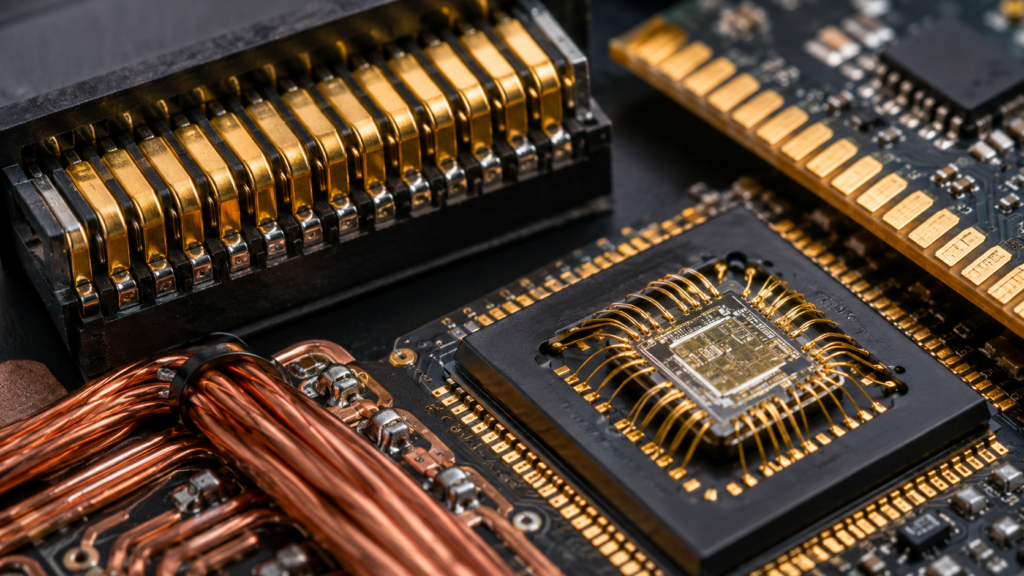
Crack open an old computer, smartphone or industrial control board and you may notice tiny flashes of gold around connector pins, chip packages and circuit-board contacts.
It looks expensive because, well, it is.
Gold costs far more than copper, yet manufacturers continue putting it inside devices that are otherwise built from inexpensive plastics, silicon and ordinary metals. That seems wasteful at first. If copper conducts electricity well and costs much less, why not use copper everywhere?
Because conductivity is only part of the job.
Copper is an excellent conductor, but its exposed surface reacts with air and moisture. Over time, it can develop oxides and other corrosion products that interfere with reliable electrical contact. Gold, on the other hand, is remarkably resistant to corrosion. It can sit exposed for years and still provide a clean, dependable surface.
Electronics manufacturers are not usually making entire components from solid gold. That would be financial madness. Instead, they use an extremely thin layer only where its special properties matter most.
A whisper of gold, rather than a brick of it.
Copper Is Actually a Better Bulk Conductor
Gold is often described as an excellent conductor, which is true. However, it is not the best common metal for carrying electrical current.
Silver has the highest electrical conductivity of any pure metal. Copper comes next, while gold conducts slightly less effectively than copper.
So gold is not used because electricity somehow “likes” it more.
For wires, circuit-board tracks, busbars, motor windings and power cables, copper is usually the practical winner because it combines:
- high electrical conductivity;
- reasonable mechanical strength;
- good availability;
- relatively low cost;
- easy manufacturing;
- good solderability.
If a company made ordinary household wiring from solid gold, the wire would cost a fortune and perform slightly worse than copper of the same dimensions.
There is no technical prize for that.
Gold becomes valuable in electronics when the contact surface must remain stable, clean and reliable over a long period. Its resistance to oxidation often matters more than its basic conductivity.
The Real Problem Is the Surface
When two pieces of metal touch, electricity does not flow evenly through their entire visible contact area.
Under a microscope, metal surfaces are rough. They meet at many tiny high points known as contact spots. The actual conductive area is much smaller than it appears.
If those spots are clean metal, current can pass with relatively low contact resistance. If they are covered by oxide, dirt, moisture or corrosion, the resistance rises.
That can cause:
- intermittent signals;
- voltage drop;
- heating;
- communication errors;
- distorted audio;
- complete connection failure.
This is especially troublesome in low-voltage digital and signal circuits. A small change in contact resistance may not matter much to a heavy-duty power connection, but it can cause unreliable behaviour in sensitive electronics.
One moment the connector works. The next, a tiny vibration or temperature change makes it fail.
Anyone who has ever wiggled an old charging cable until it worked has already met the problem.
Why Copper Corrodes
Copper reacts with oxygen and other substances in its environment.
A freshly exposed copper surface is bright and reddish. Over time, it can darken as copper oxides form. In damp, polluted or salty environments, additional corrosion compounds may develop.
The green layer seen on old copper roofs and statues is a more advanced example of copper corrosion. Electronic connectors generally do not grow dramatic green coats under normal indoor conditions, but even a much thinner layer can affect small signal contacts.
Copper oxide is far less conductive than clean copper.
This means that an exposed copper connector may perform well when new but become less dependable as its surface changes.
The underlying copper may still be perfectly capable of carrying current. The trouble sits right on top of it—a film only micrometres thick.
Gold Barely Reacts With Its Environment
Gold is known as a noble metal because it resists chemical reactions that readily affect many other metals.
Under ordinary conditions, gold does not rust, tarnish or form a stubborn insulating oxide layer. Moisture and oxygen have very little effect on it.
That stability makes gold extremely useful for electrical contact surfaces.
A gold-plated connector can remain electrically reliable after years of exposure to air, repeated connection cycles and moderate environmental contamination. The surface stays conductive instead of slowly turning into a less predictable chemical layer.
That is the main answer.
Gold is used inside electronics not because it is the cheapest way to carry electricity, but because it is one of the best ways to preserve a reliable electrical connection.
Electronics Use Thin Gold Plating, Not Solid Gold Parts
Most visible gold in electronics is plating.
A base component may be made from:
- copper;
- brass;
- phosphor bronze;
- nickel;
- another copper alloy.
The manufacturer then applies one or more extremely thin metallic layers to the surface.
A common structure might be:
- copper alloy base material;
- nickel barrier layer;
- thin gold surface coating.
The copper or copper alloy provides conductivity and mechanical strength. Nickel acts as a barrier, helping prevent the copper from migrating into the gold and improving wear performance. Gold provides the corrosion-resistant contact surface.
This layered approach uses each metal for what it does best.
The gold coating can be astonishingly thin. Depending on the application, it may range from a very light decorative or protective flash to a thicker engineered layer designed to survive repeated mating cycles.
You are seeing real gold, but not very much of it.
Why Connectors Often Have Gold-Plated Contacts
Connectors are one of the most obvious places where gold earns its keep.
Examples include:
- computer expansion-card contacts;
- memory-module contacts;
- HDMI connectors;
- USB connectors;
- audio connectors;
- high-quality test leads;
- industrial control connectors;
- telecommunications equipment;
- aerospace electronics;
- medical equipment.
These contacts may be repeatedly inserted and removed. They experience friction, vibration, humidity, dust and changing temperatures.
A reliable connector needs more than low resistance on the first day. It must keep working after hundreds or thousands of mating cycles.
Gold helps because its surface remains conductive and corrosion-resistant.
In low-level signal applications, this is especially important. A communications connector may carry tiny currents and voltages. There may not be enough electrical energy to break through an oxide layer automatically.
Heavy power contacts sometimes benefit from a slight wiping or arcing action that disrupts surface films. Delicate data connections do not have that luxury.
They need the surface to behave properly from the start.
Why Not Use Bare Copper Contacts?
Bare copper contacts would initially work.
They might even perform very well for a while. The difficulty is maintaining consistent performance over years of use.
Oxidation increases contact resistance, and repeated insertion can scratch or contaminate the surface. In humid environments, the decline may happen faster.
Copper is also relatively soft. A contact must survive mechanical pressure without permanently deforming or wearing away too quickly.
Manufacturers therefore often use copper alloys for strength and coat them with more suitable surface materials.
Gold does not replace the entire connector. It protects the tiny part where electrical contact actually happens.
That distinction saves a great deal of money.
Why Is Nickel Usually Placed Under the Gold?
Applying gold directly onto copper can cause problems.
Copper atoms can gradually diffuse into the gold layer. Once copper reaches the surface, it may oxidise and reduce the corrosion resistance that the gold coating was supposed to provide.
A nickel underlayer acts as a diffusion barrier.
It also:
- improves coating durability;
- provides a harder supporting surface;
- reduces porosity problems;
- helps the gold layer adhere properly;
- protects the underlying copper.
However, the nickel layer must remain covered at the actual contact surface. If the gold wears through, exposed nickel may oxidise and contact performance can deteriorate.
This is why gold thickness matters in frequently used connectors.
Very thin plating may be perfectly adequate for a contact that is connected once and left alone. A test connector that is plugged and unplugged every day needs something more durable.
Hard Gold and Soft Gold Are Not the Same
Electronics manufacturers use different types of gold finishes depending on the application.
Soft gold is high-purity gold. It is useful where excellent bondability and chemical stability are required. It is commonly associated with semiconductor bonding and certain circuit-board finishes.
However, pure gold is relatively soft and can wear quickly under repeated mechanical contact.
Hard gold contains small amounts of other metals that improve hardness and wear resistance. It is often used on connector fingers, switch contacts and other surfaces that experience repeated rubbing.
The added alloying material makes the coating more durable, though it may not be ideal for every bonding or soldering process.
So when a specification says “gold plated,” that does not tell the whole story.
Thickness, purity, underlayers and hardness all matter.
Gold Fingers on Circuit Boards
The gold-coloured strips along the edge of a graphics card, memory module or other plug-in circuit board are often called gold fingers.
These contacts slide into a matching connector. During insertion, the two surfaces rub against each other slightly. This wiping action helps remove minor contamination, but it also creates mechanical wear.
Gold fingers commonly use hard gold over nickel because they must survive repeated insertion and removal.
The underlying circuit-board conductor is still copper. The gold covers only the contact area at the edge.
This is a neat example of cost-efficient material selection:
- copper carries the signal across the board;
- nickel forms a durable barrier;
- gold protects the exposed connection.
Using gold for the entire circuit-board track would provide little benefit and increase cost enormously.
Engineering tends to be less glamorous than it looks. Most of the gold is only where somebody calculated that failure would cost more.
Gold Finishes on Printed Circuit Boards
Printed circuit boards contain copper pads where components are soldered or where electrical contact must be made.
Bare copper oxidises quickly, so manufacturers usually apply a protective surface finish. Gold is involved in several common finishes.
One widely used finish is electroless nickel immersion gold, commonly abbreviated as ENIG.
In this process:
- nickel is deposited over the copper;
- a very thin gold layer is applied over the nickel.
The gold protects the nickel from oxidation before soldering. During soldering, the thin gold layer dissolves into the solder, allowing the joint to form with the nickel surface underneath.
ENIG produces flat, smooth pads, which is useful for fine-pitch components and compact surface-mount assemblies.
However, it is important not to confuse ENIG with thick hard-gold connector plating. ENIG gold is generally much thinner and is not intended to survive heavy repeated mechanical wear.
It may look equally shiny in a product photo, but functionally it is a different finish.
Why Circuit Boards Cannot Simply Leave Copper Exposed
A newly manufactured copper pad can be soldered easily while the surface is clean.
Leave it exposed to air for long enough, however, and oxide formation makes soldering less reliable. Solder may fail to wet the surface properly, creating weak or inconsistent joints.
A protective finish preserves solderability between board manufacturing and final assembly.
Gold-based finishes offer several benefits:
- good corrosion resistance;
- excellent surface flatness;
- long storage life;
- reliable solderability;
- compatibility with fine-pitch components;
- suitability for certain wire-bonding processes.
They also cost more than some alternatives.
Other circuit-board finishes include hot-air solder levelling, immersion silver, immersion tin and organic protective coatings. Each has advantages, limitations and preferred applications.
Gold is not automatically the best choice for every board. It is chosen when its performance justifies the price.
Gold Bonding Wires Inside Semiconductor Packages
Inside many integrated-circuit packages, microscopic wires connect the silicon chip to the external metal leads.
These are called bonding wires.
For decades, gold was one of the most widely used bonding-wire materials because it offered a very convenient combination of properties:
- resistance to corrosion;
- high ductility;
- easy formation of tiny wire bonds;
- stable electrical performance;
- reliable manufacturing processes;
- good compatibility with traditional packaging methods.
The wire may be thinner than a human hair.
A bonding machine positions it at high speed, forms a connection to the semiconductor die and then creates another bond on the package lead or substrate. This process is repeated for every required electrical connection.
Gold’s softness and workability made it highly dependable for this delicate task.
Are All Bonding Wires Still Made From Gold?
No.
Because gold is expensive, many manufacturers have shifted toward copper, palladium-coated copper and other bonding-wire materials.
Copper bonding wire offers:
- lower material cost;
- good electrical conductivity;
- better thermal conductivity;
- potentially strong current-carrying performance.
But copper is harder than gold and more chemically reactive. The bonding process can require tighter control, specialised equipment and carefully managed protective atmospheres.
Copper bonding may also place greater mechanical stress on delicate semiconductor structures.
Gold remains useful where manufacturing reliability, corrosion resistance or specialised performance outweighs the cost. Copper dominates many cost-sensitive, high-volume applications.
So even in one of gold’s traditional strongholds, the cheaper metal has been steadily pushing back.
That is what happens when manufacturers produce millions of chips. Saving a fraction of a cent per unit starts to look rather serious.
Why Gold Is Useful for Very Small Signals
Some electrical contacts carry substantial current. Others carry signals so small that even a modest increase in contact resistance becomes troublesome.
Gold is particularly valuable in low-current, low-voltage connections such as:
- sensors;
- measurement instruments;
- communication systems;
- medical equipment;
- audio connections;
- test equipment;
- precision control circuits.
At these low signal levels, oxide layers may not be electrically punctured or cleaned by the current.
A dirty or oxidised contact can therefore behave like an unwanted resistor, a rectifying junction or an intermittent switch.
Gold provides a stable metal-to-metal interface.
This is why expensive laboratory instruments may use gold-plated connectors even though the actual amount of current is tiny. In fact, the tiny current is part of the reason.
Gold Helps Maintain Low Contact Resistance
Every connector introduces some contact resistance.
Ideally, that resistance is extremely small and remains stable over time. In real equipment, contact resistance may change because of corrosion, wear, contamination and mechanical relaxation.
Gold’s oxide-free surface helps keep the resistance low and predictable.
This is valuable in high-speed digital electronics as well as simple DC circuits. Modern data signals can change billions of times per second. Connectors must preserve signal quality, impedance and timing while avoiding random resistance changes.
At those speeds, a connector is not merely “a piece of metal touching another piece of metal.” It becomes part of the electrical transmission path.
Tiny imperfections matter.
Gold cannot fix a poorly designed connector, but it removes one major source of uncertainty: surface corrosion.
Does Gold Improve Audio Quality?
Gold-plated audio connectors can resist corrosion and maintain reliable contact. That is genuinely useful.
However, gold plating does not magically improve sound quality beyond what a clean, properly designed connection can transmit.
A gold-plated connector may remain reliable for longer, especially in humid conditions or on equipment that is connected and disconnected frequently. It may reduce crackling caused by oxidised contacts.
But an extravagant gold-plated cable does not automatically produce richer bass, wider soundstage or spiritually awakened treble.
The engineering benefit is durability and stable contact resistance.
Marketing departments occasionally add poetry.
Why Not Use Silver Instead?
Silver conducts electricity better than both copper and gold.
The problem is that silver tarnishes. It reacts with sulfur compounds in the air and forms a dark surface layer.
Silver oxide remains relatively conductive compared with many other metal oxides, and silver contacts are widely used in switches, relays and power devices. In higher-current applications, silver can perform extremely well.
Still, tarnish and environmental sensitivity make it less suitable for some low-level signal contacts.
Gold is often preferred when long-term surface stability is more important than achieving the absolute lowest bulk resistance.
Again, the winning material depends on the job.
Silver for one application. Copper for another. Gold for the fussy little contact that must still work ten years from now.
Why Not Use Stainless Steel?
Stainless steel resists corrosion and is mechanically strong.
Unfortunately, its electrical conductivity is much lower than that of copper or gold. This makes it a poor choice for many current-carrying paths.
It can still appear in connector structures, springs, enclosures and mechanical hardware, but designers usually prefer a more conductive material at the actual electrical interface.
A connector may therefore combine several materials:
- steel for mechanical strength;
- copper alloy for conductivity and spring action;
- nickel for a barrier layer;
- gold for the final contact surface.
No single material does everything perfectly.
Gold Also Handles Harsh Environments Well
Electronics used in offices and homes live fairly comfortable lives.
Other equipment operates in:
- aircraft;
- spacecraft;
- factories;
- offshore installations;
- medical devices;
- military systems;
- telecommunications cabinets;
- vehicles;
- humid outdoor locations.
In these environments, connector failure may be expensive, dangerous or impossible to repair quickly.
Temperature cycling, vibration, moisture and contamination all increase the demands placed on contact surfaces.
Gold plating costs more initially, but it may reduce maintenance, downtime and failure risk.
Spending a little extra on a connector is easy to justify when the alternative is sending a technician up a remote telecommunications tower—or launching another satellite, which is generally not cheap.
Can Gold Wear Off?
Yes.
Gold is corrosion-resistant, but it is not immune to mechanical wear.
Every time a connector is inserted or removed, the contact surfaces rub. Thin plating may gradually wear through, exposing the nickel or copper beneath it.
Wear depends on:
- gold thickness;
- gold hardness;
- contact force;
- surface roughness;
- number of mating cycles;
- contamination;
- connector alignment.
Cheap connectors may use extremely thin gold flash that provides some initial corrosion protection but is not intended for heavy use.
High-cycle industrial connectors use thicker and more carefully specified plating.
This is one reason two connectors can look nearly identical while having very different prices and service lives.
The gold colour is easy to copy. The engineering specification is not.
Why Mixing Contact Metals Can Cause Problems
Electrical contacts should be designed with compatible materials.
Mating a gold-plated contact with a tin-plated contact, for example, can sometimes create reliability problems in applications involving vibration or repeated motion. The different metals may wear, transfer material or develop fretting corrosion.
Fretting occurs when tiny repeated movements damage the contact surfaces and create debris or oxide films.
For reliable connector systems, both mating halves are usually designed as a matched pair with compatible plating.
Replacing one half with a connector that merely fits physically may not produce the same long-term performance.
It clicks into place. That does not necessarily mean it belongs there.
Is There Enough Gold in Electronics to Recover?
Electronic devices contain only small amounts of gold individually, but large quantities of discarded equipment can add up.
Gold may be found in:
- connector contacts;
- circuit-board edge fingers;
- semiconductor packages;
- older bonding wires;
- processor pins;
- telecommunications boards;
- certain high-reliability components.
Professional recyclers process large volumes of electronic waste using specialised mechanical, chemical and metallurgical methods.
Trying to recover gold from a handful of old circuit boards at home is usually neither profitable nor safe. Many extraction methods involve corrosive acids, toxic fumes and hazardous waste.
The gold is real.
The internet videos making it look like free money are often less real about the cost, risk and disappointing final quantity.
Why Cheap Electronics Still Contain Gold
Even low-cost electronics may contain gold-plated contacts.
The amount is simply tiny.
A microscopic coating can provide the required corrosion resistance without adding much to the total product cost. Manufacturers may also limit gold only to the precise contact zone rather than coating the entire pin.
Modern plating processes are tightly controlled. Material is deposited in measured thicknesses, and manufacturers work hard to avoid using even slightly more gold than necessary.
There is a reason connector specifications discuss micrometres rather than millimetres.
Gold is expensive, but unreliability can be more expensive.
Copper and Gold Work Together
The question is not really gold or copper.
Most electronics use both.
Copper handles the bulk work:
- carrying current through wires;
- forming circuit-board tracks;
- creating power planes;
- winding transformers;
- connecting components;
- removing heat.
Gold handles selected surface jobs:
- resisting corrosion;
- protecting connector contacts;
- preserving solderable finishes;
- supporting wire bonding;
- maintaining stable low-level signals.
Copper provides the highway. Gold protects the tollbooth.
One material moves electricity efficiently and economically across distance. The other keeps critical connection points clean and trustworthy.
That combination makes far more sense than building everything from either metal alone.
Gold Is Used Where Failure Begins at the Surface
Gold is not inside electronics because engineers enjoy making products unnecessarily expensive.
It is there because exposed metal surfaces are often the weakest part of an electrical connection.
Copper carries current extremely well and costs far less, but it oxidises. Gold remains chemically stable, resists corrosion and maintains dependable contact resistance over long periods.
That makes a thin gold layer useful on connectors, circuit-board contacts, certain finishes and microscopic bonding wires.
The clever part is not using gold everywhere.
It is using almost none of it—then placing that tiny amount exactly where it prevents the most trouble.