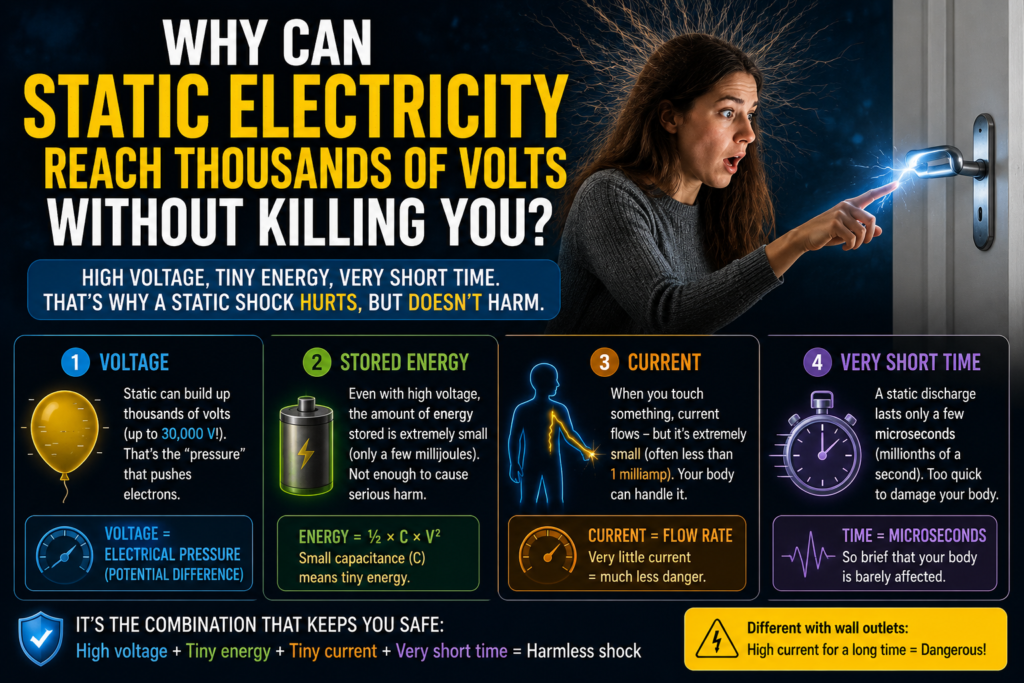
You walk across a carpet, reach for a metal door handle, and—snap.
A tiny spark jumps from your finger. It stings, you pull your hand back, perhaps say something unprintable, and then carry on with your day.
That little shock may have involved several thousand volts.
Now compare that with a household electrical outlet. Depending on where you live, it may supply only 120 or 230 volts, yet contact with it can cause severe injury or death.
How can a 10,000-volt static shock be little more than an unpleasant surprise while a much lower-voltage power source is genuinely dangerous?
Because voltage is only part of the story.
To understand electrical danger, we also need to consider:
- How much electric charge is available
- How much energy has been stored
- How much current flows through the body
- How long that current continues
- What path the current takes
Static electricity can produce an impressive voltage, but it usually has very little charge behind it. Once that tiny amount of stored charge escapes, the event is over.
What Is Static Electricity?
Static electricity is an imbalance of electric charge on the surface of an object.
The word static does not mean the electrons are perfectly motionless. It means the charge has accumulated in one location rather than flowing continuously through a circuit.
This charge can build when two different materials touch and then separate.
Walking across a synthetic carpet is the classic example. As your shoes repeatedly contact and leave the carpet, electrons may transfer between the materials. Depending on the materials involved, your body may gain extra electrons or lose some.
Your entire body then sits at a different electrical potential from nearby objects.
Touch a grounded metal door handle and the accumulated charge suddenly has a route to equalise. Electrons move through the tiny air gap, creating the spark and sharp sensation we recognise as a static shock.
The spark may look dramatic in a dark room. Electrically, though, there is not much fuel in the tank.
Static Voltage Can Be Surprisingly High
A person walking across a dry carpet can develop a static potential of several thousand volts. Under favourable conditions, the voltage may rise above 10,000 volts.
The exact value depends on factors such as:
- Humidity
- Clothing materials
- Shoe soles
- Floor covering
- Movement
- How well the person is insulated from ground
Dry air encourages static buildup because charge leaks away more slowly.
Humid air provides a slightly more conductive path along surfaces, allowing charge to dissipate before an extremely high potential develops. This is why static shocks are often more common during winter, when indoor heating makes the air dry.
Still, the voltage figure sounds alarming.
Ten thousand volts?
That is far above the voltage in a wall socket. Yet comparing voltage numbers alone is like comparing water pressure without asking how much water is available or how long the pressure can be maintained.
A pressure washer and a pressurised perfume bottle may both produce a narrow jet. Only one can keep delivering it.
Voltage Is Electrical Pressure
Voltage is often compared with pressure in a water system.
It represents the electrical potential difference between two points—the “push” capable of moving electric charge.
A high voltage means there is a strong tendency for charge to move if a conductive path becomes available.
That is why a static spark can jump through air. The voltage becomes high enough to break down the small air gap between your finger and a metal object.
However, voltage does not tell us how much charge will move.
Nor does it tell us how long the source can maintain the voltage.
A static-charged person may be at 10,000 volts relative to ground, but the amount of separated charge is tiny. As soon as that charge transfers, the voltage collapses.
A power supply behaves differently. It continually moves charge and works to maintain its output voltage, even while current is flowing.
That difference is crucial.
Current Is What Flows Through You
Electric current is the rate at which electric charge moves.
It can be expressed as:
Current = charge ÷ time
Or:
I = Q ÷ t
A shock becomes dangerous when enough current flows through the body, especially if it passes through the chest, heart, or respiratory muscles.
Voltage creates the push, but current is the actual movement of charge through tissue.
The current produced by a static discharge may briefly become quite high at the instant the spark forms. However, the discharge lasts for an extremely short time—often only nanoseconds or microseconds.
The total amount of charge transferred remains small.
This is an important distinction. Saying that static electricity “has no current” is not quite correct. There is definitely current during the spark. That is what creates the sensation.
It simply does not continue for long.
Why Static Shocks End So Quickly
Your body and the surrounding environment can behave somewhat like a small capacitor.
A capacitor stores separated electric charge between conductive regions. Your body can hold a small charge relative to the ground, especially when insulating shoes separate you from it.
As static charge accumulates, your body’s voltage rises.
When you touch a conductive object, the stored charge rushes out. The voltage falls almost immediately because there is no substantial power source continuing to replace the lost charge.
The sequence looks roughly like this:
- Charge accumulates on your body.
- Your voltage relative to ground increases.
- Your finger approaches a grounded conductor.
- The electric field breaks down the remaining air gap.
- A short spark transfers the stored charge.
- Your body and the object reach nearly the same potential.
- The current stops.
The entire event is over before you have time to consciously react.
That is why static shocks feel sharp rather than continuous. A quick sting, then nothing.
Stored Energy Matters More Than the Voltage Number
The energy stored in a capacitive system can be estimated using:
Energy = ½ × capacitance × voltage²
Or:
E = ½CV²
This formula reveals something interesting.
Voltage has a large effect because it is squared. However, the capacitance of a human body relative to its surroundings is very small—often roughly tens to a few hundred picofarads, depending on body position and the environment.
A picofarad is one trillionth of a farad. Tiny.
Suppose a person has an effective capacitance of 100 picofarads and becomes charged to 10,000 volts.
The stored energy would be approximately:
E = ½ × 100 × 10⁻¹² × 10,000²
That works out to about:
0.005 joules, or 5 millijoules
The voltage is enormous compared with a household outlet, yet the total energy is only a few thousandths of a joule.
That is enough to create a visible spark and a painful little jab. It is usually not enough to sustain dangerous current through the body.
Usually. There are exceptions, which we will get to.
A Water-Tank Analogy
Imagine two water systems.
The first is a tiny spray bottle pressurised to an extremely high level. When you press the nozzle, it produces a sharp burst—but only for a moment. The bottle contains very little water, and the pressure disappears quickly.
The second system is connected to a large pump and an unlimited water supply. Its pressure may be lower, but it can continue delivering water for as long as the pump remains energised.
Static electricity resembles the tiny pressurised bottle.
A mains electrical supply resembles the continuously operating pump.
The static source may have a much higher initial voltage, but it cannot sustain significant current. A wall outlet has lower voltage, yet it can keep pushing charge through a conductive path.
That sustained delivery is what makes ordinary power circuits so dangerous.
Why a Wall Outlet Is More Dangerous
A household electrical system is connected to transformers, generators, and a large power network.
If you touch an energised conductor while also providing a path to neutral or ground, the supply does not simply discharge once and become empty.
It continues maintaining the voltage.
Current can keep flowing through your body until:
- You break contact
- A fuse or circuit breaker operates
- A residual-current device trips
- The power source is disconnected
- The circuit changes in some other way
Even a fraction of a second can be dangerous.
Alternating current can interfere with nerve signals, cause muscles to contract, prevent a person from releasing the conductor, disrupt breathing, and affect the heart’s rhythm.
The danger is not merely that 230 volts exists. It is that the electrical system can drive harmful current through the body and continue supplying energy.
A static charge cannot normally do that. It empties almost at once.
Resistance Still Plays a Role
The current through a conductive path is influenced by voltage and resistance.
In simplified form, Ohm’s law states:
Current = voltage ÷ resistance
Or:
I = V ÷ R
At first glance, applying 10,000 volts to this equation seems as though it should produce an enormous current through the body.
For one very brief moment, it may produce a sharp current pulse.
But a static source is not an ideal voltage supply. Its voltage collapses rapidly as charge leaves it.
Ohm’s law still applies at each instant, but the available voltage is constantly falling during the discharge. There is not enough stored charge to maintain the initial current.
By contrast, an electrical outlet works hard to maintain approximately the same voltage while current flows.
That is why treating a static-charged body as though it were a stiff 10,000-volt power supply gives the wrong picture.
The number is real. The source capacity is not comparable.
Why Does the Shock Hurt?
Even though the total energy is small, a static discharge can still hurt.
The current is concentrated through a tiny contact area, usually near the fingertip. The spark may also heat a microscopic channel through the air and irritate nerve endings near the skin.
The discharge happens extremely quickly, creating a sudden and intense sensation.
It is rather like being flicked with a rubber band. The event does not contain enormous energy, but that energy arrives abruptly and in one small spot.
A stronger static buildup may create:
- A louder snap
- A longer spark
- A brighter flash
- A sharper sensation
- A small visible mark in rare cases
Still, under normal everyday conditions, the current falls away too quickly to produce the sustained internal effects associated with a mains electric shock.
Peak Current Can Be Misleading
Static discharges may produce high peak currents.
This sometimes causes confusion. If the peak current is high, how can the event be harmless?
Because peak current is only one part of the waveform.
Imagine two vehicles:
- One briefly reaches high speed and immediately stops.
- The other travels at a slightly lower speed for several hours.
The first has the higher peak speed, but the second covers far more distance.
Similarly, a static discharge may produce a relatively large current for an incredibly short duration. The total charge and energy transferred remain small.
Electrical injury depends on the complete exposure:
- Current magnitude
- Duration
- Current path
- Frequency
- Contact area
- Skin condition
- Total delivered energy
A single peak value does not tell the whole story.
Why Static Electricity Can Damage Electronics
Static shocks are usually harmless to people, but electronic components are far less forgiving.
Modern integrated circuits contain microscopic structures separated by extremely thin insulating layers. A static discharge that feels like almost nothing to a person can puncture those layers or damage semiconductor junctions.
The component may fail immediately.
Worse, it may suffer partial damage and fail later, making the problem difficult to diagnose.
This is why technicians working with sensitive electronics use:
- Antistatic wrist straps
- Conductive work mats
- Grounded tools
- ESD-safe clothing
- Antistatic packaging
- Humidity control
- Proper handling procedures
A person might not even feel the discharge. The voltage can still be high enough to damage a circuit board.
Human skin is thick compared with the insulating structures inside a microchip. The chip loses that contest rather badly.
Static Sparks Can Ignite Flammable Materials
Everyday static shocks are usually not dangerous to the person receiving them, but the spark can become an ignition source.
Flammable gases, vapours, dust clouds, and certain chemical mixtures may require only a tiny spark to ignite.
This is why static control is taken seriously in:
- Fuel-handling facilities
- Chemical plants
- Grain-processing sites
- Paint-spraying areas
- Gas installations
- Pharmaceutical production
- Powder-handling systems
A few millijoules may sound insignificant, yet some flammable mixtures can be ignited by considerably less energy.
Workers bond and ground conductive equipment so charge cannot accumulate between containers, pipes, vehicles, or processing machinery.
In those environments, a static spark is not merely an annoying finger sting. It can be the match nobody saw.
Can Static Electricity Ever Injure a Person?
Normal household static shocks rarely cause serious direct injury.
However, static electricity is not completely harmless.
Problems can occur when:
- The spark ignites a flammable atmosphere.
- The surprise causes someone to fall from a ladder.
- The person jerks into moving machinery or a sharp object.
- Sensitive medical or electronic equipment is affected.
- The “static” source is actually a high-energy charged capacitor.
- Charge has accumulated on large industrial equipment.
The last two points are especially important.
Not every high-voltage discharge is ordinary static electricity from clothing or carpet.
A high-voltage capacitor can store substantial energy. Even after equipment is switched off, a charged capacitor may retain a dangerous voltage and deliver a powerful current pulse.
Large conductive objects can also store more charge than a human body because they may have much greater capacitance.
So the phrase “high voltage but low current” should never be used as a blanket excuse to treat unknown electrical sources as safe.
Static Electricity Versus a Charged Capacitor
Both static-charged objects and capacitors store electric charge, but their energy capacities can be wildly different.
A person might have an effective capacitance around 100 picofarads.
An industrial capacitor may have a capacitance measured in microfarads or even farads—millions or billions of times larger.
Because stored energy depends on both capacitance and voltage, a capacitor at a lower voltage can contain vastly more energy than a person charged to 10,000 volts.
This is why capacitors inside power supplies, variable-frequency drives, amplifiers, microwave ovens, and other equipment can remain dangerous after power has been disconnected.
The voltage rating alone does not reveal the complete hazard.
Always ask: how much energy can the source deliver?
What About Tasers and Electric Fences?
Devices such as electric fences and conducted-energy weapons may also use high voltage, but they are intentionally designed electrical sources rather than accidental static buildup.
Their high voltage helps overcome skin resistance or jump small air gaps.
However, their output current, pulse duration, repetition rate, and delivered energy are controlled.
An electric fence may produce short pulses separated by relatively long pauses. This makes the shock painful and memorable while reducing the likelihood of prolonged muscle contraction under normal conditions.
Still, such devices can be dangerous in certain circumstances, particularly for vulnerable individuals, animals, or anyone who becomes trapped against the conductor.
Again, “high voltage” does not automatically mean deadly, but neither does it automatically mean safe.
The waveform and energy matter.
Why Lightning Is Not Just a Large Static Shock
Lightning begins with an enormous separation of static charge, but comparing it to a carpet shock is like comparing a dripping tap with a collapsing dam.
The voltage can reach millions of volts, but more importantly, a lightning discharge moves a vast amount of charge and releases tremendous energy.
It can produce extremely high current, intense heat, explosive pressure, fires, burns, nervous-system injury, and cardiac arrest.
Lightning proves that static charge can certainly be deadly when enough charge and energy have accumulated.
The harmlessness of ordinary static electricity does not come from some special rule that static voltage cannot injure people. It comes from the tiny scale of the everyday source.
Voltage, Current, and Energy Are Not Interchangeable
These electrical terms are related, but they do not mean the same thing.
Voltage
Voltage is the electrical potential difference that can push charge through a path.
Current
Current is the rate at which charge flows.
Charge
Charge is the quantity of electricity available to move.
Energy
Energy is the source’s capacity to perform work, produce heat, create a spark, or damage tissue and equipment.
A high voltage with very little stored charge may produce a brief spark.
A moderate voltage connected to a powerful source may produce sustained and dangerous current.
A high voltage combined with large capacitance can store lethal energy.
Looking at voltage alone is therefore a poor way to judge electrical risk.
The Main Reason Static Shocks Are Brief
An everyday static shock ends quickly because the stored charge is limited.
Once the voltage becomes high enough to create a conductive path—through direct contact or an air spark—the charge rapidly equalises.
There is no generator continuously rebuilding the potential difference.
The current rises, the charge transfers, the voltage collapses, and the current stops.
All of this may happen in a tiny fraction of a second.
That brief duration, combined with the small amount of stored energy, is why a static shock can involve thousands of volts without normally causing serious injury.
The Main Point
Static electricity can reach extremely high voltages because only a small amount of charge is needed to raise the potential of a low-capacitance object, such as a human body.
But high voltage does not automatically mean high energy.
An ordinary static shock usually contains:
- Very little stored charge
- Only a few millijoules of energy
- A short current pulse
- A voltage that collapses almost immediately
A household power supply may operate at a much lower voltage, yet it can maintain current and continue delivering energy through the body.
That is the key difference.
Static electricity is like a tiny cup of water at enormous pressure. A power circuit is a pipe connected to a pump.
The cup may surprise you.
The pump can keep going.