A transformer can be doing absolutely nothing dramatic—no sparks, no smoke, no overloaded cables—and still sit there humming like it has forgotten the words to a song.
Small transformers may produce a faint buzz that disappears beneath ordinary room noise. Larger distribution transformers can be heard from several metres away, especially late at night when everything else is quiet.
That familiar sound is not electricity itself.
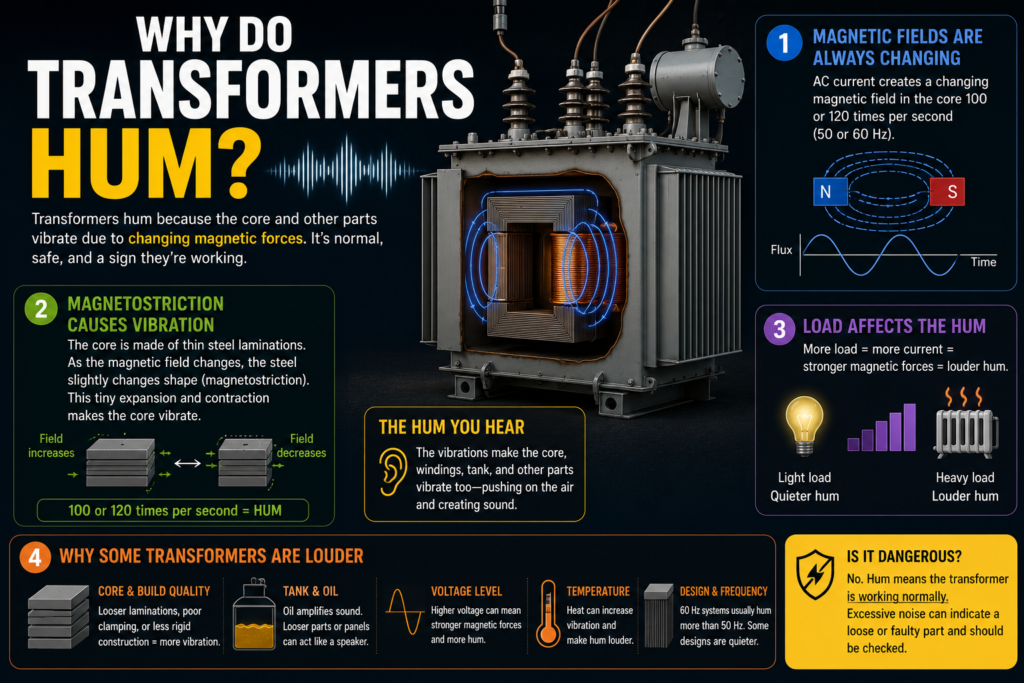
It comes from tiny mechanical movements inside the transformer. Alternating magnetic fields cause the steel core and windings to vibrate, and those vibrations travel through the enclosure, mounting surface, and surrounding air as sound.
The main causes are:
- Magnetostriction in the transformer core
- Electromagnetic forces in the windings
- Loose or vibrating mechanical parts
- Resonance in the enclosure or mounting structure
- Cooling fans and pumps on larger transformers
Some humming is completely normal. A new or unusually loud noise, though, may point to overvoltage, loose components, excessive load, damaged insulation, or another developing problem.
A Transformer Is an Electromagnetic Device
A transformer transfers electrical energy between circuits through a changing magnetic field.
Alternating current flows through the primary winding and produces alternating magnetic flux in the core. That flux passes through the secondary winding and induces a voltage across it.
There is usually no direct electrical connection between the primary and secondary windings. Energy crosses through the magnetic field.
The magnetic flux changes continuously:
- It increases in one direction.
- It reaches a peak.
- It falls back toward zero.
- It increases in the opposite direction.
- It reaches another peak.
- It returns to zero again.
This process repeats according to the supply frequency.
On a 50 Hz electrical system, the current completes 50 cycles every second. On a 60 Hz system, it completes 60 cycles every second.
The magnetic field is therefore changing very quickly, and the transformer’s physical structure responds to those changes.
Not by much. We are talking about microscopic movement.
Microscopic does not necessarily mean silent.
Magnetostriction: The Main Source of Transformer Hum
The most common explanation for transformer hum is magnetostriction.
Magnetostriction is the tendency of a magnetic material to change its dimensions slightly when exposed to a magnetic field.
Transformer cores are commonly made from thin sheets of electrical steel. When the alternating magnetic field magnetises the steel, its internal magnetic regions shift and realign.
As this happens, the steel expands and contracts by a tiny amount.
The dimensional change may be only a few millionths of the material’s original size. You would not see the core visibly breathing in and out. Still, the movement happens across many laminations and repeats dozens or hundreds of times each second.
Those repeated movements create vibration.
The vibrating core pushes against:
- Adjacent laminations
- Core clamps
- The transformer frame
- Insulating materials
- The enclosure
- The mounting surface
The movement eventually reaches the surrounding air, where we hear it as a hum or buzz.
Why the Hum Is Often 100 Hz or 120 Hz
A transformer connected to a 50 Hz supply often produces a strong sound component around 100 Hz.
On a 60 Hz supply, the dominant component is commonly around 120 Hz.
Why twice the electrical frequency?
Because magnetostriction occurs during both halves of the AC cycle.
The core changes dimension when magnetised in one direction, and it changes again when magnetised in the opposite direction. The physical movement does not simply reverse with magnetic polarity in the same way the current does.
As a result, the core experiences two main dimensional changes during each electrical cycle.
That gives:
- 50 Hz supply → approximately 100 Hz fundamental hum
- 60 Hz supply → approximately 120 Hz fundamental hum
The sound is rarely one perfectly clean tone. Transformers also generate harmonics at higher multiples of the base frequency.
This mixture of frequencies is why transformer noise often sounds more like a rich mechanical buzz than a pure musical note.
The Core Is Built From Laminations
A transformer core is usually not made from one solid block of steel.
Instead, it consists of many thin insulated sheets called laminations.
The laminations reduce eddy-current losses by restricting circulating currents within the steel. Less unwanted current means lower heating and improved efficiency.
However, a laminated core contains many individual pieces that can potentially vibrate.
The laminations are stacked and clamped tightly together. If the clamping pressure is uneven, if varnish deteriorates, or if parts become loose with age, the laminations may move against one another.
Even extremely small movement can create noticeable noise.
A properly assembled transformer may still hum because magnetostriction cannot be eliminated completely. Good construction simply keeps the vibration controlled.
The Windings Can Vibrate Too
The core is not the only moving part.
Current flowing through the primary and secondary windings creates magnetic fields. Those fields interact with each other and with leakage flux around the windings.
This interaction produces electromagnetic forces on the conductors.
In a well-designed transformer, the windings are mechanically secured using insulation, spacers, bracing, resin, varnish, or other support materials.
Even so, alternating current produces alternating forces.
When load current rises, the forces acting on the windings generally become stronger. The conductors may flex slightly, press against supporting materials, or transmit vibration into the transformer frame.
Under normal conditions, the movement is small and controlled.
During a short circuit, however, winding forces can become enormous. That is why transformer windings require strong mechanical support. A severe fault may deform windings, damage insulation, or loosen internal structures.
So, yes, the humble buzz has a more aggressive cousin.
Does a Transformer Hum With No Load?
Yes.
A transformer can hum even when nothing is connected to its secondary winding.
As long as the primary winding is energised, magnetising current flows and alternating magnetic flux develops in the core. Magnetostriction therefore continues whether the transformer is supplying a load or not.
This is known as no-load noise or core noise.
A transformer sitting energised with an open secondary may still produce its familiar hum because the core remains magnetised and demagnetised every cycle.
That surprises some people. They assume the noise must mean the transformer is working hard.
Not necessarily.
A lightly loaded transformer may still hum clearly, especially if it is mounted on a wall, steel panel, or hollow structure that amplifies the vibration.
Why Load Can Make the Transformer Louder
Although core noise exists at no load, transformer noise may increase as electrical load rises.
There are several reasons.
First, higher load means more current in the windings. More current creates stronger electromagnetic forces between conductors and windings.
These forces can increase winding vibration.
Second, load produces more heat. As the transformer warms up, metal parts expand, insulation materials soften slightly, and mechanical stresses change.
A transformer may therefore sound different after operating under load for several hours.
Third, larger power transformers may start additional cooling equipment when load or temperature rises. Fans and oil pumps can add their own mechanical noise.
The transformer’s overall sound may then include:
- Core hum
- Winding vibration
- Cooling-fan noise
- Pump noise
- Airflow noise
- Enclosure resonance
It becomes less of a single hum and more of a small industrial orchestra.
Load Is Not Always the Main Cause
A louder transformer does not automatically mean it is overloaded.
Core flux is determined mainly by applied voltage, frequency, and the number of winding turns. For a fixed transformer design, increasing the supply voltage or reducing the frequency can push the core toward magnetic saturation.
A transformer may therefore become much louder even with little secondary load if:
- The supply voltage is too high
- The supply frequency is too low
- The voltage waveform is distorted
- DC is present in the winding current
- The core has a mechanical problem
This matters because people sometimes hear a loud hum and immediately blame the connected equipment.
The load might be responsible. Or the core may simply be unhappy with the voltage being applied to it.
Overvoltage and Core Saturation
Every transformer core is designed to operate within a certain magnetic flux range.
If the applied voltage rises too high, the magnetic flux also increases. At some point, the core begins approaching magnetic saturation.
In saturation, a large increase in magnetising current produces relatively little additional magnetic flux.
The magnetising current becomes distorted and may rise sharply. The transformer can run hotter, draw excessive current, and produce stronger vibration and noise.
A transformer designed for 50 Hz should not casually be operated at a lower frequency while receiving its full rated voltage. Reducing frequency without reducing voltage increases the magnetic flux per cycle.
This is why the voltage-to-frequency ratio matters.
A loud, harsh hum combined with overheating or unusually high no-load current can be a warning sign of overexcitation or saturation.
That is not a “tap it with a screwdriver and see what happens” situation.
Harmonics Can Change the Sound
Modern electrical systems often contain nonlinear loads such as:
- Variable-frequency drives
- LED drivers
- Computer power supplies
- Battery chargers
- Rectifiers
- Uninterruptible power supplies
- Electronic lighting ballasts
These loads can distort the current waveform and introduce harmonics.
Harmonic currents create magnetic forces at additional frequencies. They may increase heating and change the audible character of the transformer.
Instead of a smooth low-frequency hum, the transformer may produce:
- A sharper buzz
- Higher-frequency tones
- Pulsing noise
- A rough or uneven sound
The voltage waveform can also contain distortion, which affects core flux and magnetostriction.
This is one reason two transformers of the same rated power may sound different when installed in different electrical environments.
One may be feeding ordinary resistive loads. The other may be surrounded by drives, switching power supplies, and equipment chopping the waveform into something that barely resembles a sine wave.
DC Offset Can Make a Transformer Noisy
Transformers are designed for alternating magnetic flux that remains reasonably balanced around zero.
A small DC component in the supply can shift this magnetic operating point.
This is sometimes called DC offset or DC bias.
Even a modest DC component can push one half of the magnetic cycle closer to saturation. The transformer may then draw asymmetrical magnetising current and produce more mechanical noise.
DC offset may come from certain electronic loads, poorly designed dimmers, rectifiers, or asymmetrical switching devices.
In audio equipment, this effect is sometimes blamed when a toroidal transformer suddenly begins buzzing even though its connected load has not changed much.
The transformer may be perfectly capable of handling the power. It simply dislikes the shape of the supply waveform.
Reasonable complaint, honestly.
Why Some Transformers Are Louder Than Others
Transformer noise depends on much more than power rating.
Core material
Higher-quality electrical steel can reduce core losses and magnetostriction. Grain-oriented steel is commonly used in power transformers because its magnetic properties are carefully controlled.
Different alloys and manufacturing methods produce different noise characteristics.
Magnetic flux density
A transformer designed to operate at a higher flux density may be smaller and cheaper, but it can also run louder.
Conservative designs use more core material and operate farther from saturation, often reducing noise.
Core shape
EI cores, toroidal cores, C-cores, and other constructions behave differently.
Toroidal transformers are often quiet because their continuous ring-shaped core provides an efficient magnetic path with small air gaps. Still, they can become surprisingly noisy when affected by DC offset, overvoltage, or poor mounting.
Lamination quality
Uneven, damaged, or loosely clamped laminations can vibrate more than a tightly assembled core.
The quality of varnish, bonding, stacking, and mechanical pressure all matter.
Winding construction
Windings that are properly braced, impregnated, and secured usually create less noise.
Loose winding turns or deteriorated insulation can allow greater movement.
Enclosure design
A transformer core may produce only modest vibration, but a large sheet-metal cover can act like a loudspeaker.
Flat panels are especially good at turning small vibrations into audible noise.
Mounting method
Bolting a transformer rigidly to a hollow wall or steel cabinet can transmit vibration into a much larger surface.
That surface may resonate and amplify the sound considerably.
Rubber isolation pads, flexible mounts, and proper structural design can reduce transmitted vibration.
Transformer size
Large transformers generally produce more total sound energy because they contain more magnetic material and larger structural parts.
However, a small poorly mounted transformer can sound far more annoying than a large well-designed one.
Size alone does not settle the argument.
Resonance Can Amplify a Small Vibration
Every mechanical structure has natural frequencies at which it vibrates more easily.
This is called resonance.
If the transformer’s vibration frequency matches the natural frequency of its enclosure, support frame, cabinet door, wall, or floor, the sound can become much louder.
The transformer itself may be operating normally. The surrounding structure is simply acting as an amplifier.
This is why pressing a hand against a buzzing electrical-panel door may temporarily reduce the noise. Your hand adds damping and changes the panel’s vibration.
Naturally, nobody should open or touch energised electrical equipment unless they are qualified and the task can be performed safely.
But as a diagnostic principle, it shows how much of the audible sound may come from the structure rather than from the core alone.
Why Old Transformers May Hum More
Transformer noise can change with age.
Over years of heating, cooling, vibration, and electrical stress:
- Core clamps may loosen
- Insulating varnish may become brittle
- Winding supports may shrink or deteriorate
- Bolts may lose tension
- Mounting pads may harden
- Enclosure panels may loosen
- Cooling fans may wear out
A gradual increase in noise does not automatically mean failure is imminent.
Still, a noticeable change deserves attention, especially if accompanied by:
- Rising temperature
- A burning smell
- Discolouration
- Oil leakage
- Crackling or arcing sounds
- Frequent protective-device trips
- Reduced output voltage
- Unusual vibration
A normal hum is steady and predictable.
Crackling, popping, sizzling, or sudden harsh buzzing belongs in a different category.
Dry-Type and Oil-Filled Transformers
Dry-type and oil-filled transformers can sound different because their construction and cooling systems differ their construction and cooling systems differ.
Dry-type transformers
Dry-type units use air and solid insulation rather than insulating oil.
The core and coils may be relatively close to the enclosure, so vibration can transfer easily to panels and mounting structures.
Some dry-type transformers are vacuum-pressure impregnated with varnish or cast in resin to secure the windings and improve insulation.
Oil-filled transformers
In an oil-filled transformer, the core and windings are submerged in insulating oil.
The oil provides electrical insulation and carries heat toward the tank walls and cooling system.
The tank can still transmit core vibration. Large flat tank surfaces may radiate noise, while pumps and fans add further sound on forced-cooled units.
The oil does not magically silence the transformer, unfortunately. It changes how vibration and heat move through the unit.
What About Small Plug-In Transformers?
Older plug-in adapters often contain a small iron-core transformer operating directly from the 50 or 60 Hz mains supply.
These adapters may produce an audible low-frequency hum, especially as their laminations or casing age.
Many modern chargers instead use switch-mode power supplies.
A switch-mode supply operates at a much higher frequency—often tens or hundreds of kilohertz. This allows it to use a much smaller transformer.
The switching frequency is usually above normal human hearing. However, components may still produce audible noise through:
- Subharmonic operation
- Burst-mode control
- Ceramic-capacitor vibration
- Loose transformer windings
- Coil whine
- Mechanical resonance
That high-pitched squeal from a phone charger is not the classic 100 or 120 Hz transformer hum, but it comes from a related theme: electromagnetic forces making real components move.
Can Transformer Hum Be Reduced?
Transformer noise can often be reduced, though not always eliminated.
Common methods include:
- Tightening approved external fasteners
- Securing loose enclosure panels
- Using vibration-isolation pads
- Installing flexible cable connections
- Moving the transformer away from resonant walls
- Adding structural damping
- Improving core clamping during manufacture
- Impregnating windings with varnish or resin
- Reducing overvoltage
- Correcting harmonic or DC-offset problems
- Replacing worn fans or pumps
- Selecting a lower-noise transformer design
Care is required.
Overtightening core hardware or changing clamping arrangements can damage insulation, alter internal stresses, or make noise worse. Internal transformer repairs should be handled by qualified personnel following the manufacturer’s instructions.
Spraying random adhesive into an energised transformer is, for the record, not a recognised engineering solution.
Is Transformer Hum Dangerous?
A steady hum is normal for many transformers.
The sound alone does not prove that the transformer is overloaded or defective.
However, investigation may be justified when the noise:
- Becomes suddenly louder
- Changes from humming to rattling
- Includes crackling or popping
- Is accompanied by overheating
- Appears after a wiring change
- Begins after new nonlinear loads are connected
- Varies dramatically with supply voltage
- Is accompanied by a burning smell
- Causes excessive vibration in the enclosure
Large power transformers are often monitored using sound, vibration, temperature, dissolved-gas analysis, and other diagnostic methods.
Changes in noise can provide useful clues, but they should be interpreted alongside electrical measurements and physical inspection.
A transformer may be loud and healthy.
It may also be quiet while developing an internal problem.
Engineering rarely offers the convenient answer first.
The Main Point
Transformers hum because alternating magnetic fields create tiny mechanical movements inside them.
The steel core expands and contracts through magnetostriction. Electromagnetic forces make the windings vibrate. Those vibrations pass into clamps, frames, enclosures, walls, and the surrounding air.
The dominant hum is commonly around:
- 100 Hz on a 50 Hz electrical system
- 120 Hz on a 60 Hz electrical system
Load can increase noise by creating stronger winding forces and activating cooling equipment. Overvoltage, saturation, harmonics, DC offset, loose laminations, poor mounting, and resonance can make the sound considerably louder.
So the hum is not electricity making a noise directly.
It is the transformer’s physical structure responding to an alternating magnetic field—expanding, contracting, and vibrating so slightly that you cannot see it, yet clearly enough that you can hear it.