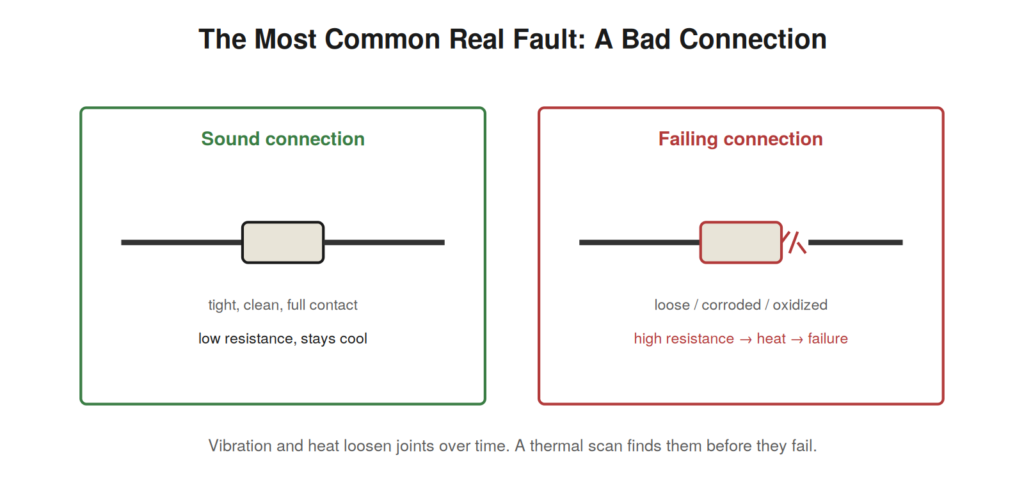
If this book could impress one practical fact on every troubleshooter, it would be this: the single most common real cause of industrial electrical faults is a bad connection. Not a failed component, not a design flaw — a loose, corroded, or degraded connection at a terminal, a splice, or a lug. Understanding why connections fail, and how to find them, resolves an enormous share of faults.
Why connections fail
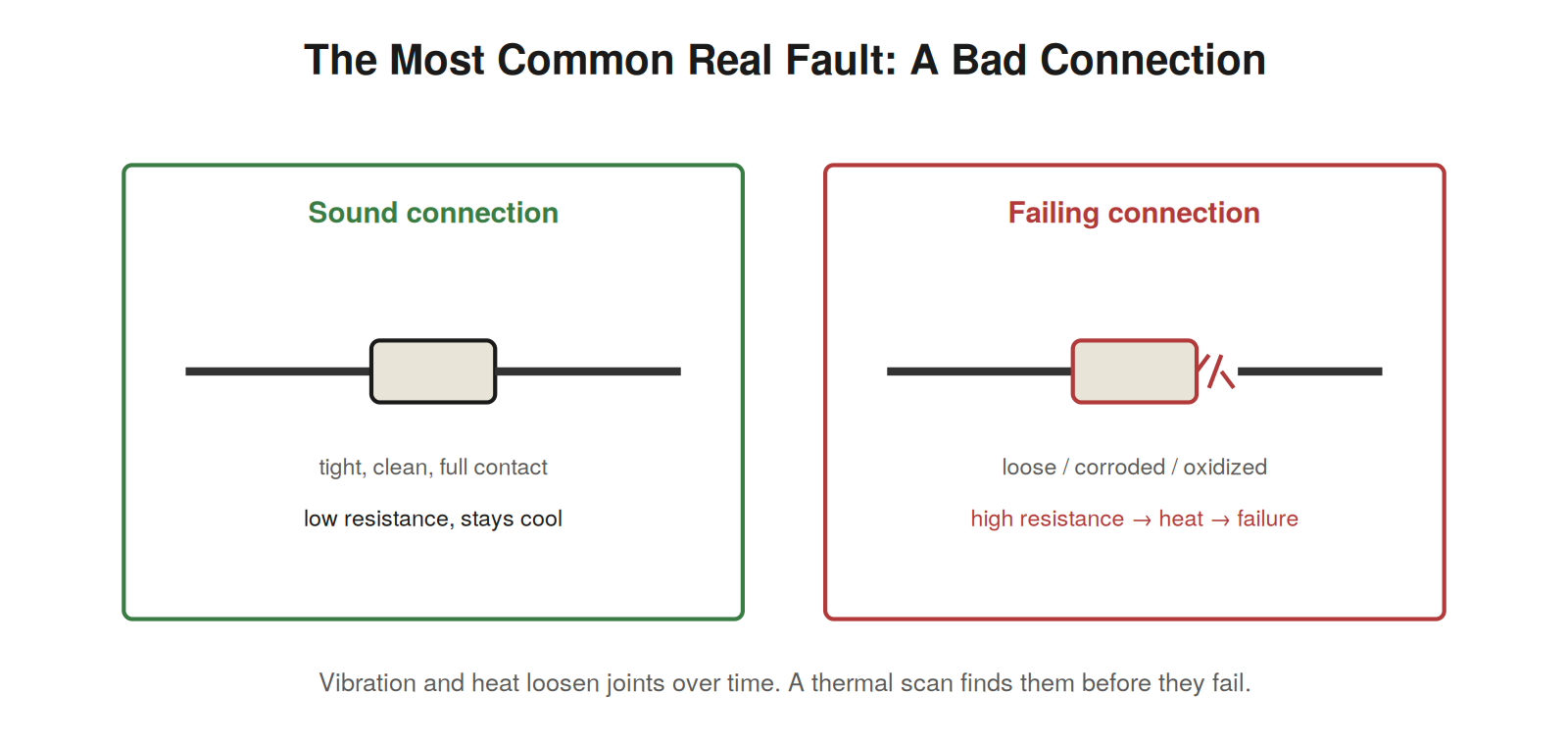
A connection fails through a predictable progression. Vibration, thermal cycling, and time gradually loosen a terminal that was once tight. As it loosens, the contact area shrinks and its resistance rises. Under load current, that resistance produces heat, and heat accelerates the degradation — oxidizing the metal, further loosening the joint, sometimes discoloring or charring the surrounding insulation. The connection may work intermittently for a time, making and breaking as conditions shift, before it fails completely. This progression explains why bad connections so often present first as maddening intermittent faults and why they are frequently found by the heat they produce.
Finding the bad connection
Several techniques find failing connections. A thermal imaging camera scanning an energized panel under load reveals hot spots where resistance is producing heat, often catching a connection well before it fails — one of the highest-value uses of thermal imaging in the plant. A careful visual and physical inspection, with the circuit safely de-energized, finds terminals that are loose to the touch, discolored, or corroded; gently tugging conductors reveals ones that are not properly secured. A voltage drop measurement across a connection carrying current — a small voltage where there should be almost none — quantifies a high-resistance joint directly. And for intermittent faults, deliberately disturbing suspect wiring while monitoring the circuit can provoke a loose connection into revealing itself.
Doing terminations right
Because connections are the most common fault, making them well is preventive troubleshooting. A sound termination is tight to the correct specification — neither loose nor overtightened to the point of damaging the conductor — clean and free of corrosion, with the right lug or ferrule for the conductor, and with good full contact area. Stranded conductors benefit from proper ferrules; aluminum conductors demand specific practices to prevent oxidation and loosening. When you repair a bad connection, repairing it properly — rather than merely retightening a compromised terminal — is what keeps it from returning. A connection remade correctly can last decades; one merely nudged tight again may fail within weeks.
THE VIBRATION FACTORConnections on or near equipment that vibrates — motors, pumps, presses, anything with rotating or reciprocating parts — loosen fastest and deserve the most scrutiny. When troubleshooting equipment that vibrates, suspect the connections before the components. |
A case file: the intermittent fault found by hand
An intermittent fault resists every attempt to correlate it with time or conditions, appearing at random with no discernible pattern. Suspecting a loose connection, the technician turns to provocation, methodically disturbing the wiring in the implicated circuit while monitoring the signal, with the circuit in a safe state for such testing. Working along the terminals, gently tugging and wiggling each in turn, he reaches one where a light touch makes the signal flicker — the loose connection, revealed by provocation where pattern analysis had failed. The terminal looked sound to the eye but had enough looseness to make and break contact under the slightest disturbance, and in normal operation the ordinary vibration of the equipment was intermittently opening it, producing the random-seeming fault. Remaking the connection properly eliminates it. The case demonstrates that for an intermittent fault suspected to be a loose connection, deliberately and safely disturbing the wiring while watching the circuit can provoke the fault into revealing itself and pinpoint the exact terminal, succeeding where waiting for a pattern cannot, because the trigger — ordinary vibration — leaves no distinctive pattern in time to analyze.
Voltage drop: measuring a bad connection directly
A powerful and underused technique quantifies a bad connection directly: measuring the voltage drop across it while it carries current. A sound connection has almost no resistance, so almost no voltage develops across it even under load; a failing connection has elevated resistance, so a measurable voltage appears across it when current flows. By metering across a terminal, a splice, or a lug while the circuit is loaded, a high-resistance connection reveals itself as a voltage drop that should not be there. This is especially valuable because it works on connections that look fine and measure fine at rest — the resistance only matters under load, and the voltage-drop measurement tests exactly that condition. Where a thermal camera finds a bad connection by the heat it produces, the voltage-drop measurement finds it by the voltage the resistance develops, and the two techniques together make failing connections, the most common of all faults, findable before they progress to complete failure.
Why connections are the most common fault
It is worth dwelling on why connections, above all components, are the most common real cause of industrial electrical faults, because understanding the reason sharpens the instinct to suspect them. A connection is a mechanical junction carrying electrical current, and it is subject to forces that components sealed in their housings largely escape: the vibration of nearby equipment working it loose, the thermal cycling of heating and cooling with load expanding and contracting the joint, the corrosion of the environment attacking the contact surfaces, and simple time relaxing what was once tight. Every one of these acts on connections continuously throughout their service life, and there are vastly more connections in a plant than there are components, so the sheer number of junctions multiplied by the constant forces acting on them makes connections the statistically dominant fault. This is why the experienced troubleshooter, presented with almost any electrical fault, holds the bad connection near the top of the suspect list from the start, and why thermal scanning and connection inspection are among the highest-value preventive practices — they target the fault that the physics of the plant makes most likely.
The thermal signature of a failing joint
A failing connection announces itself through heat, and understanding this signature makes the thermal camera and even the back of a hand into diagnostic tools. As a connection loosens or corrodes, its contact resistance rises, and current flowing through that resistance produces heat in proportion to the resistance and the square of the current. A connection that should be nearly at ambient temperature runs warm, then hot, as it degrades, and this heat is both a symptom and an accelerant, because the heat further degrades the joint in a worsening cycle. A thermal scan of a panel under load makes this heat visible, revealing a hot terminal among its cooler neighbors long before the connection fails outright, and even without a camera, a connection noticeably warmer than its surroundings — sensed with appropriate caution — is suspect. Because the heat appears well before the final failure, and because it pinpoints the exact joint, the thermal signature of a failing connection is one of the most useful diagnostic phenomena in the plant, turning the most common fault into one that can be caught while it still works and repaired on a planned basis rather than during a breakdown.
Doing a termination that lasts
Because connections are the most common fault, the quality of a termination is preventive troubleshooting, and the difference between a connection remade properly and one merely nudged tight is the difference between a repair that lasts decades and one that fails within weeks. A lasting termination has several qualities. It is tightened to the correct specification — firm enough for solid low-resistance contact but not so tight as to damage or cold-flow the conductor, which torque specifications exist to define. Its contact surfaces are clean and free of corrosion, because corrosion is resistance. It uses the appropriate lug, ferrule, or terminal for the conductor type and size, with stranded conductors properly terminated and aluminum conductors given the specific treatment they require to resist oxidation and loosening. And it has good full contact area rather than a partial or marginal engagement. When repairing a bad connection, the crucial point is to remake it properly to these standards rather than simply retightening a joint whose surfaces are already corroded or whose terminal is already compromised, because a compromised connection merely retightened will soon fail again, while one properly remade — cleaned, correctly terminated, torqued to specification — restores the decades of reliable service a good connection should provide. The extra care of a proper termination is repaid many times over in the repeat failures it prevents.
If you remember one thing
If a troubleshooter took only one practical lesson from this entire book, it should be this: the single most common real cause of industrial electrical faults is a bad connection. Not a failed component, not a design error, not an exotic fault — a loose, corroded, or degraded connection at a terminal, a splice, or a lug. This one fact, properly internalized, sharpens the instinct that solves a large fraction of faults, because it means that presented with almost any electrical fault, the experienced troubleshooter holds the bad connection near the top of the suspect list from the start, and checks connections early rather than late. The reasons connections dominate — the vibration, thermal cycling, corrosion, and time that work continuously on the vast number of junctions in a plant — make them statistically the most likely fault, and the techniques for finding them — thermal scanning for the heat they produce, voltage-drop measurement for the resistance they develop, visual and physical inspection, provocation for the intermittent ones they cause — are among the most valuable in the trade. A troubleshooter who suspects connections early, knows how to find them, and makes them well when repairing has a decisive advantage on the majority of industrial electrical faults, because they are targeting the fault that the physics of the plant makes most likely, while a troubleshooter who overlooks connections in favor of suspecting components will repeatedly chase the wrong thing. Of all the specific knowledge in this book, the primacy of the bad connection is the one most worth carrying into every job.
A structured summary of connection faults
The connection material, being about the most common fault in the book, deserves consolidation into a structure a troubleshooter can carry. Connections fail through a predictable progression: vibration, thermal cycling, corrosion, and time loosen a joint, its contact area shrinks, its resistance rises, current through that resistance produces heat, the heat accelerates the degradation, and the connection works intermittently before failing completely. This progression explains the two ways connections are found. They are found by heat — a thermal scan of a panel under load revealing a hot joint among cooler neighbors, catching the connection before it fails — and by the voltage their resistance develops, a voltage-drop measurement across a loaded connection revealing resistance that should not be there. They are also found by inspection, with the circuit de-energized, feeling for loose terminals and seeing discoloration or corrosion, and by provocation for the intermittent faults they cause, disturbing wiring while monitoring to reveal a joint that makes and breaks. And they are prevented and repaired by proper termination — correct torque, clean surfaces, the right lug or ferrule, full contact area — remaking a bad connection properly rather than merely retightening a compromised one. The master facts to carry are that the bad connection is the most likely fault to suspect, that heat and voltage-drop are the two measurements that find it, and that vibrating equipment loosens connections fastest and deserves the most scrutiny. This structure, applied to the most common of all faults, resolves an enormous share of what a troubleshooter meets.