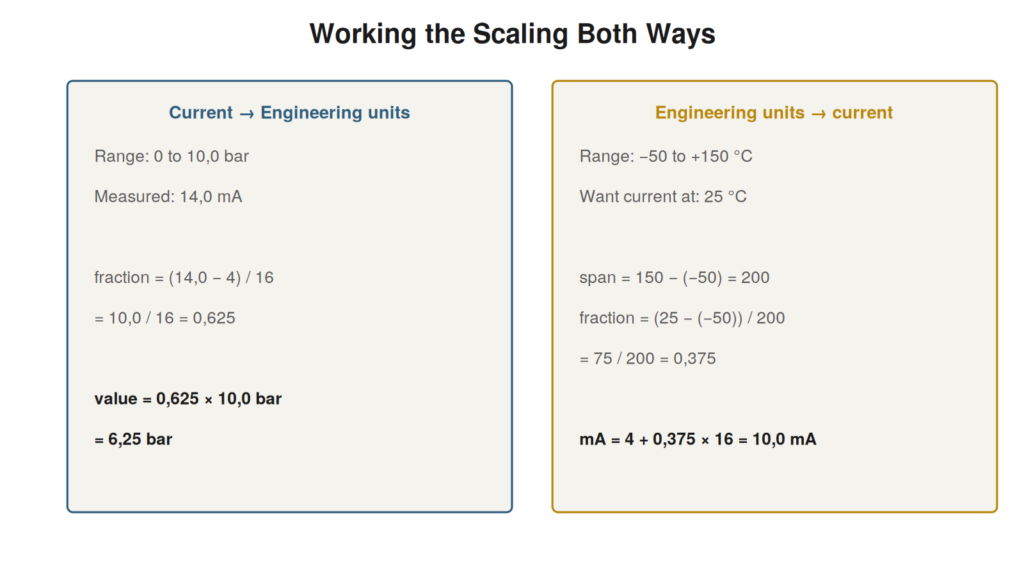
Being able to work the scaling calculation in both directions — from current to value, and from value to current — is a practical skill that lets you predict what a loop should read and verify whether it is correct. The calculation is simple arithmetic once the linear relationship is understood, and doing it confidently is central to interpreting and checking loops.
From current to engineering units
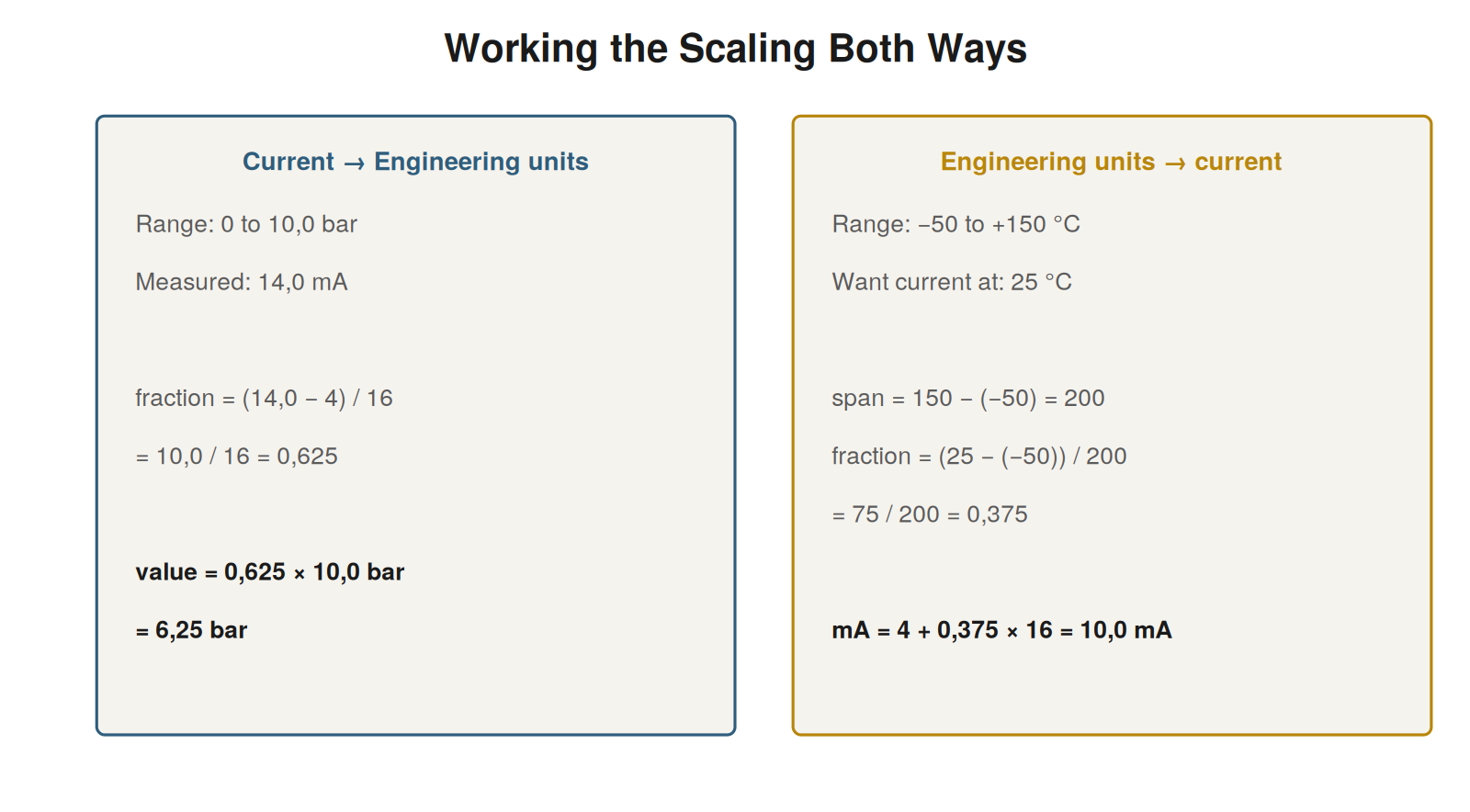
To convert a measured current to an engineering value, first find how far the current is along the 4–20 mA signal range as a fraction, then apply that fraction to the measured range. The fraction is the current minus 4, divided by 16 (the signal span). Multiplying this fraction by the measured span and adding the range minimum gives the value. For example, on a 0 to 10 bar range, a current of 14 mA gives a fraction of (14 minus 4) divided by 16, which is 10 divided by 16, or 0,625; multiplying by the 10 bar span gives 6,25 bar. So 14 mA on this loop is 6,25 bar. This calculation — fraction of signal range, times span, plus minimum — converts any current to its engineering value, and doing it lets you interpret a loop’s current precisely and check whether the displayed value matches what the current should produce, which is a direct test of the scaling.
From engineering units to current
To find what current corresponds to a given engineering value — useful for predicting what a loop should read at a known process condition — the calculation runs in reverse. Find how far the value is along the measured range as a fraction: the value minus the range minimum, divided by the span. Then map that fraction onto the signal range: 4 plus the fraction times 16 gives the current. For example, on a range of minus 50 to plus 150 degrees (a span of 200), the value 25 degrees gives a fraction of (25 minus minus 50) divided by 200, which is 75 divided by 200, or 0,375; then 4 plus 0,375 times 16 gives 10 mA. So at 25 degrees, this loop should carry 10 mA. This reverse calculation lets you predict the expected current for a known process condition, which is invaluable in troubleshooting: knowing the process is at a certain value, you can compute what current the loop should carry and compare it to the actual current, immediately revealing whether the loop is reading correctly.
Using scaling to check a loop
The real power of working the scaling is in checking a loop against reality. If you know the actual process condition — from another instrument, a known state, or a calibration input — you can compute the current the loop should carry and compare it to the current it actually carries. Agreement confirms the loop is reading correctly; disagreement localizes the problem. Furthermore, comparing three things — the actual process value, the loop current, and the displayed value — pinpoints where a discrepancy lies. If the current is correct for the process but the displayed value is wrong, the scaling in the control system is at fault. If the current itself is wrong for the process, the transmitter or loop is at fault. Working the scaling thus gives you a quantitative check that not only detects a problem but helps localize it to the transmitter, the loop, or the scaling configuration, by comparing what should be against what is at each stage from process to current to displayed value.
Common scaling mistakes
A few scaling mistakes are common enough to warn against. The most frequent is forgetting the live zero — treating 4 mA as if it were the zero of the calculation, or dividing by 20 instead of by the 16 mA span. The current fraction is (mA minus 4) divided by 16, not mA divided by 20; forgetting the minus 4 or using 20 gives wrong values, especially at the low end. Another mistake is mishandling a range with a negative minimum, like minus 50 to plus 150 degrees: the span is the maximum minus the minimum, which is 150 minus minus 50, or 200, not 100, and forgetting to subtract a negative minimum correctly throws off the whole calculation. A third is confusing the range (the two endpoint values) with the span (their difference). Being careful with these — always subtract 4 and divide by 16 for the current fraction, always compute span as maximum minus minimum including signs, and keep range and span distinct — avoids the errors that make scaling calculations go wrong, which is important because a scaling error in troubleshooting can send you chasing a loop fault that does not exist.
Scenario: predicting the current to check a loop
A scenario shows the reverse scaling calculation used to check a loop. A pressure loop, ranged 0 to 16 bar, was suspected of reading wrong. A reference gauge showed the actual pressure was 8 bar. Working the scaling from value to current, 8 bar is halfway up the 0-to-16 range (fraction 0,5), so the loop should carry 4 plus 0,5 times 16, which is 12 mA. Measuring the loop current, it read only 10 mA — not the 12 mA that 8 bar should produce. This disagreement, revealed by the calculation, confirmed the loop was reading low and quantified the error, directing the investigation to why the current was 2 mA short of correct. Had the loop read the predicted 12 mA, it would have been confirmed accurate. This scenario shows the power of working the scaling in reverse: knowing the true process value, you compute the current the loop should carry, and comparing it to the actual current immediately tells you whether the loop is right and by how much it is wrong. This quantitative check, from the scaling calculation, turns a vague suspicion into a definite, measured discrepancy that focuses the diagnosis.
Keeping the arithmetic simple
The scaling arithmetic is simple if approached in clear steps, and a consistent procedure prevents errors. For current to value: subtract 4 from the current, divide by 16 to get the fraction (or percent), multiply by the span, add the range minimum. For value to current: subtract the range minimum from the value, divide by the span to get the fraction, multiply by 16, add 4. Following these steps in order, one operation at a time, keeps the calculation straightforward and avoids the mistakes that come from trying to do it all at once. Writing down the intermediate fraction (or percent) is helpful, as it is a meaningful quantity — the position along the range — and a sanity check: a fraction should be between 0 and 1 for an in-range value, so a fraction outside that signals an out-of-range value or an error. Keeping the arithmetic simple and stepwise, with the fraction as a checkpoint, makes scaling calculations reliable, which matters because these calculations are used to check loops and a mistake could mislead the diagnosis. The math is easy; doing it carefully and stepwise is what keeps it correct.
Mental scaling for quick checks
With practice, you can do rough scaling in your head for quick checks, which is a handy field skill. The key anchors are easy: 4 mA is 0%, 12 mA is 50%, 20 mA is 100%, and each 4 mA step is 25%. From these, you can quickly estimate: a current near 8 mA is around 25% of range, near 16 mA around 75%, and interpolate between. Applying the range, you get a rough value without formal calculation — on a 0-to-100 range, 8 mA is about 25, or 25 units. This mental estimation lets you quickly sanity-check a loop: does the current roughly match the expected process value? A gross mismatch is obvious even from the rough mental estimate, flagging a problem worth investigating precisely. Mental scaling does not replace the exact calculation when precision is needed, but for a quick field check — is this loop roughly right? — it is fast and useful. Developing the mental anchors (0, 25, 50, 75, 100% at 4, 8, 12, 16, 20 mA) and interpolating between them lets you estimate a loop’s value at a glance from its current, which is a practical skill for quickly assessing loops in the field without stopping to calculate, reserving the exact arithmetic for when precision matters.
Scaling with offset ranges
Ranges that do not start at zero — like minus 50 to plus 150 degrees, or 20 to 80 percent — require careful handling in scaling, and a clear method prevents errors. The key is to always work from the range minimum, whatever it is. For current to value, after finding the fraction from the current, multiply by the span (maximum minus minimum) and add the minimum — so a fraction of 0,5 on a minus 50 to plus 150 range gives 0,5 times 200 plus minus 50, which is 100 minus 50, or 50 degrees. For value to current, subtract the minimum from the value first — so 50 degrees on that range gives 50 minus minus 50, which is 100, over the span 200, a fraction of 0,5, giving 12 mA. The care is in handling the minimum correctly, especially when it is negative (subtracting a negative adds) or non-zero. Working methodically from the range minimum, computing the span as maximum minus minimum with correct signs, handles offset ranges correctly. These ranges are common — temperatures below zero, suppressed-zero levels — and handling them right, by always working from the actual minimum and computing the span correctly, ensures the scaling is right even when the range does not start at a convenient zero. The method is the same; only the care with the minimum and span differs.
Scaling fluency as a professional skill
Fluency with scaling calculations — doing them quickly and correctly in both directions — is a professional skill worth developing, because it is used constantly in loop work. Interpreting a loop’s current as a value, predicting the current for a known process condition, checking a loop against reality, verifying a calibration point — all use the scaling calculation, and doing it fluently makes these routine rather than laborious. The calculation is simple arithmetic, but doing it confidently and correctly, especially with offset or negative ranges, takes practice until it is second nature. Developing this fluency — through working examples until the calculation is quick and reliable in both directions — makes the constant scaling tasks of loop work effortless, so you can interpret, predict, and check loop values readily. A technician fluent in scaling handles these tasks smoothly, while one who struggles with the arithmetic is slowed at every scaling step. Given how often scaling arises in loop work, fluency with it is a genuinely useful professional skill, repaying the practice needed to develop it with ease at every scaling task thereafter. Working the scaling until it is fluent — fast, correct, both directions, any range — is worth the effort, making a constant part of loop work quick and reliable rather than a recurring point of hesitation or error.