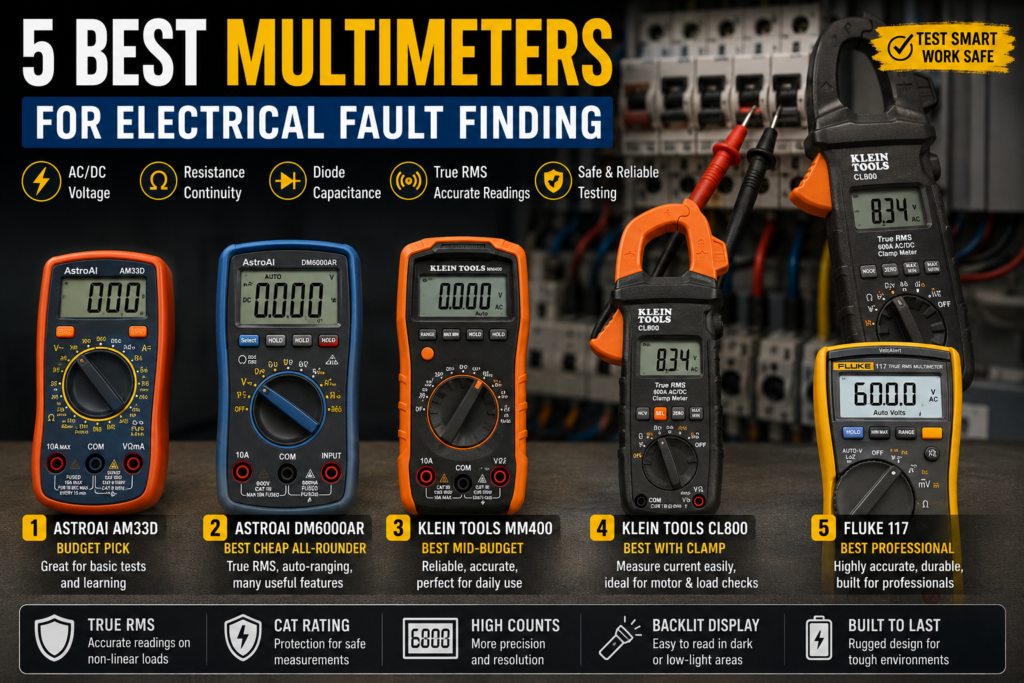
Affiliate disclosure: This post contains affiliate links. If you buy through my links, I may earn a small commission at no extra cost to you.
A good multimeter is one of the most useful tools for electrical fault finding.
You can use it to check voltage, continuity, resistance, fuses, relay coils, contactor coils, power supplies, sensors, switches, and many other electrical problems.
But not every multimeter is good for every job.
For basic hobby electronics, a cheap meter may be enough. For industrial panels, motors, VFDs, contactors, and live electrical troubleshooting, I would choose something safer, more reliable, and preferably with True RMS, auto-ranging, and a proper CAT safety rating.
Below are 5 multimeters I would consider, sorted from cheapest to more expensive.
1. AstroAI AM33D — Cheapest Beginner Option
Best for: basic checks, beginners, simple home/electronics troubleshooting
Affiliate link: [AstroAI Digital Multimeter]
The AstroAI AM33D is one of the cheapest options I would consider for a beginner.
I would not buy this as my main industrial multimeter. But for someone who is just starting and wants to learn simple measurements, it can be useful.
You can use it for basic checks like:
Battery voltage
Continuity
Resistance
Simple DC circuits
Basic fuse checking
Learning how to use a multimeter
The Spruce lists the AstroAI AM33D as a budget pick and notes that it is useful for basic testing like batteries, fuses, outlets, and household appliances. It also mentions that it is manual-range and more limited than better meters.
Why I recommend it
I recommend it only as a very cheap learning meter.
It is good if you want to learn how multimeters work without spending much money. But if you plan to work with industrial electrical panels, 230 V AC, 400 V three-phase circuits, VFDs, or motor control circuits, I would move to a better meter.
Main weakness
It is basic.
For serious electrical fault finding, I would not stop here.
2. AstroAI DM6000AR — Best Cheap All-Rounder
Best for: beginners who want more features without spending too much
Affiliate link: [AstroAI Digital Multimeter ]
The AstroAI DM6000AR is probably the cheapest meter I would seriously consider for general learning and fault finding.
It gives you more useful features than the very basic budget meters.
The Amazon listing I found shows it as a True RMS 6000-count auto-ranging multimeter that measures voltage, current, resistance, diode, continuity, duty cycle, capacitance, and temperature.
That makes it much more useful for electrical troubleshooting than a simple low-cost meter.
You can use it for:
Relay coil voltage
Contactor coil voltage
Continuity testing
Resistance checks
Sensor checks
Power supply checks
Capacitor checks
Temperature checks
Basic electronics and automation learning
Why I recommend it
I recommend this one because it gives a lot of features for the money.
For a beginner, student, or someone learning PLC and automation basics, this is a practical first meter. It is not a premium professional tool, but it is much more useful than the cheapest basic meters.
Main weakness
For industrial daily work, I would still prefer a stronger brand like Klein or Fluke.
But for the price, it is a good starting point.
3. Klein Tools MM400 — Best Mid-Budget Electrician Meter
Best for: electricians, maintenance beginners, better general troubleshooting
Affiliate link: [Klein Tools MM420 ]
The Klein Tools MM400 is a good step up from the cheaper meters.
This is where I think a multimeter starts to feel more like a proper electrical troubleshooting tool.
Pro Tool Reviews highlights the Klein MM400 as a strong home-use multimeter with auto-ranging, the ability to measure AC/DC voltage up to 600 V, 10 A, capacitance, temperature, and frequency. It also lists it as CAT III 600 V.
For fault finding, this is useful because you can check more than just voltage and continuity.
You can use it for:
Control voltage checks
Relay and contactor coils
Motor control circuits
Continuity and resistance
Capacitors
Temperature
Frequency
General electrical troubleshooting
Why I recommend it
I recommend the Klein MM400 because it is a good balance between price and capability.
It is not as expensive as a Fluke, but it is more trustworthy than many random cheap meters. For someone doing electrical maintenance, panel checks, or learning industrial automation, this is a good middle option.
Main weakness
It is still not my top choice for heavy industrial use every day.
But for the price, it is a solid meter.
4. Klein Tools CL900 — Best If You Also Need Current Measurement
Best for: motor current, load current, maintenance troubleshooting
Affiliate link: [Klein Tools CL900]
The Klein Tools CL900 is a clamp multimeter, and this makes it very useful for electrical fault finding.
A normal multimeter usually measures current by putting the meter in series with the circuit. That is not always practical or safe.
A clamp meter lets you measure current by clamping around a conductor.
That is very useful when checking:
Motor current
Heater current
Load current
Phase imbalance
Overload problems
Single-phasing problems
Current draw during operation
The Spruce lists the Klein CL900 as its clamp meter pick and notes that clamp meters can measure by clamping around a conductor instead of breaking into the circuit. It also notes the CL800 has True RMS, auto-ranging, AC/DC voltage, current, resistance, continuity, capacitance, frequency, temperature, and diode testing.
Why I recommend it
I recommend this one if you work with motors, contactors, overloads, heaters, pumps, fans, or industrial equipment.
For motor fault finding, current measurement is extremely useful.
For example, if a three-phase motor has:
L1 = 8.1 A
L2 = 8.3 A
L3 = 0 A
You immediately know you may have a missing phase, bad contactor pole, blown fuse, or wiring issue.
That is why a clamp meter is very useful for maintenance work.
Main weakness
A clamp meter is larger than a normal multimeter.
For small electronics work, it may be less convenient. But for industrial fault finding, I like having a clamp meter.
5. Fluke 117 — Best Professional Choice
Best for: electricians, serious maintenance technicians, professional troubleshooting
Affiliate link: [Fluke 117]
The Fluke 117 is the most expensive option on this list, but it is also the one I would trust most for professional electrical troubleshooting.
Fluke meters are popular for a reason. They are known for reliability, accuracy, and durability.
The Spruce lists the Fluke 117 as its best overall multimeter and highlights True RMS, auto-ranging, a backlit display, and VoltAlert non-contact voltage detection. It also says the Fluke 117 is highly accurate, reliable, durable, and suitable for AC/DC electrical systems up to 600 V.
For industrial and maintenance work, this is a very strong meter.
You can use it for:
Electrical panel troubleshooting
Control voltage testing
Power supply checks
Relay and contactor diagnosis
VFD input checks
Sensor wiring checks
Continuity and resistance
Capacitance
Frequency
General fault finding
Why I recommend it
I recommend the Fluke 117 if you want a serious tool that should last a long time.
If you are working as an electrician, maintenance technician, automation technician, or industrial engineer, this is the kind of meter that makes sense.
It is more expensive, but when you are diagnosing real faults, wrong readings can waste time or lead you in the wrong direction.
Main weakness
The price.
For a beginner, it may feel expensive. But if you use a multimeter often, I think it is worth considering.
My Final Recommendation
If I had to choose based on budget, I would decide like this:
Cheapest learning option: AstroAI AM33D
Best cheap useful option: AstroAI DM6000AR
Best mid-budget choice: Klein Tools MM400
Best for motor and load current: Klein Tools C900
Best professional choice: Fluke 117
For someone learning electrical fault finding, PLCs, relays, contactors, and motor control, I would personally start with either the AstroAI DM6000AR or the Klein MM400.
If you work with motors often, I would strongly consider the Klein CL800 because current measurement is very useful.
If you want a professional meter and do not want to upgrade later, I would go for the Fluke 117.
Important Safety Note
A multimeter is only safe if it is used correctly.
Before testing live circuits, always check:
Voltage rating
CAT safety rating
Lead condition
Fuse condition
Correct meter setting
Correct input socket
Your own training and safety procedures
Never use a cheap unknown meter on live industrial panels if you are not sure about its safety rating.
For 230 V / 400 V industrial troubleshooting, I would rather spend more on a trusted meter than risk using a poor-quality one.
[…] Check the recommended testers here:[5 Best Multimeters for Finding Electrical Faults] […]