Affiliate disclosure: This post contains affiliate links. If you buy through my links, I may earn a small commission at no extra cost to you.
A non-contact voltage tester is one of those small tools that almost every electrician, maintenance technician, automation technician, or DIY electrical learner should have.
It is not a replacement for a multimeter. It does not prove a circuit is safe to touch. But it is a very useful first safety check before working around wires, outlets, terminals, control panels, contactors, light circuits, or junction boxes.
In simple words, a non-contact voltage tester helps you quickly check if AC voltage may be present without touching the conductor directly.
Below are 5 good Amazon options, listed from cheaper/basic options to more professional choices.
Important Safety Note
A non-contact voltage tester is only a quick warning tool.
Always confirm with a proper multimeter or approved voltage tester before touching conductors. Also remember that many non-contact voltage testers are mainly designed for AC voltage, so they may not detect 24V DC PLC circuits, DC sensors, or some low-voltage control wiring.
Use it as a first check, not as your only safety test.
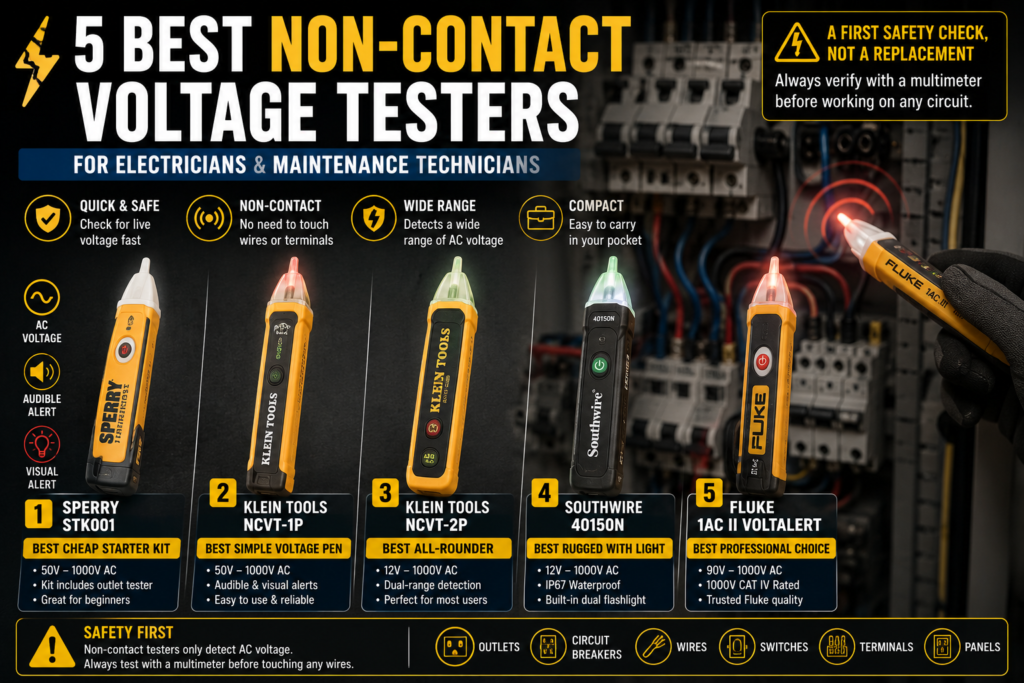
1. Sperry Instruments STK001 — Best Cheap Starter Kit
Best for: beginners, home electrical checks, outlet testing
Affiliate link: [Sperry Instruments STK001]
The Sperry Instruments STK001 is a nice budget-friendly option because it usually comes as a kit with a non-contact voltage tester and a receptacle / GFCI outlet tester.
That makes it useful if you want something simple for checking outlets, basic AC voltage presence, and common household electrical problems.
The Amazon listing shows the Sperry STK001 as a battery-powered non-contact voltage tester and receptacle tester kit, with a voltage range from 50V to 1000V AC.
Why I recommend it
I recommend this one for beginners because it gives you two useful tools in one package.
You can use the non-contact voltage tester to check if AC voltage may be present, and the outlet tester can help check basic outlet wiring problems.
It is good for:
Basic electrical learning
Home outlet checks
Beginner electrician tool bags
Quick AC voltage presence checks
Simple maintenance work
Main weakness
It is not my first choice for industrial panel work.
For PLC panels, contactors, motors, and automation maintenance, I would prefer a more rugged tester with better features.
2. Klein Tools NCVT-1P — Best Simple Voltage Pen
Best for: electricians who want a simple, reliable pen tester
Affiliate link: [Klein Tools NCVT1P ]
The Klein Tools NCVT-1P is a simple non-contact voltage tester pen.
It is made for standard AC voltage detection and is very easy to use. The Amazon listing says it detects 50V to 1000V AC and uses LED and audible alarms when voltage is detected.
Why I recommend it
I like this one because it is simple.
Not every tool needs to be complicated. For many electricians and maintenance workers, a basic voltage pen is enough for quick checks.
It is good for:
Checking live wires
Checking outlets
Checking light switches
Checking circuit breakers
Fast first safety checks
The green LED is useful because it shows the tester is powered on, and the red light / audible alert makes voltage detection easy to notice.
Main weakness
It is not dual-range.
If you want to detect lower AC voltages, such as some doorbell, thermostat, or low-voltage AC circuits, a dual-range model is better.
3. Klein Tools NCVT-2P — Best All-Rounder for Most People
Best for: electricians, maintenance technicians, automation beginners
Affiliate link: [Klein Tools NCVT2P ]
The Klein Tools NCVT-2P is one of my favorite choices for general use because it is dual-range.
The Amazon listing says it detects 12V to 1000V AC and gives both visual and audible signals. It can detect standard AC voltage in cables, circuit breakers, switches, outlets, and wires, and it can also detect lower AC voltage in systems like doorbells, thermostats, low-voltage lighting, and irrigation systems.
Why I recommend it
This is the one I would recommend to many beginners who want one useful voltage tester.
The dual-range feature makes it more flexible than a basic 50V–1000V tester.
It is good for:
Electrical fault finding
Panel checks
Basic automation work
Building maintenance
Outlet and lighting circuits
Low-voltage AC checks
General tool bag use
For most people, this is probably the best balance between price, usefulness, and features.
Main weakness
It is still a non-contact tester.
Do not use it as the only proof that a circuit is de-energized. Always verify with a proper meter before working.
4. Southwire 40150N — Best Rugged Option with Flashlight
Best for: maintenance technicians, industrial work, rough environments
Affiliate link: [Southwire Tester NCVD]
The Southwire 40150N is a good option if you want something more rugged.
The Amazon listing shows it as a dual-range non-contact voltage tester with 12V to 1000V AC detection, IP67 waterproof housing, and dual flashlights.
Why I recommend it
I like this one for maintenance work because tools get dropped, thrown in bags, used in dark panels, and sometimes exposed to dust or moisture.
The built-in flashlight is useful when checking panels, junction boxes, outlets, machine frames, or dark corners around equipment.
It is good for:
Maintenance technicians
Industrial troubleshooting
Panel checks
Machine wiring checks
Work in dark areas
People who want a tougher tester
Main weakness
It may cost more than a basic voltage pen.
If you only need a simple tester for occasional use, the cheaper models may be enough.
5. Fluke 2AC — Best Professional Choice
Best for: professional electricians and serious maintenance technicians
Affiliate link: [Fluke 2AC]
The Fluke 2AC is the professional pick on this list.
Fluke is well known in electrical testing tools, and this tester is simple, compact, and trusted by many technicians.
The Amazon listing describes the Fluke 1AC II as a pocket-sized non-contact voltage tester for 90V to 1000V AC, with audible alert and a CAT IV rating. Another Amazon listing for the Fluke 1AC II mentions detection from 90V to 1000V AC and a 1000V CAT IV safety rating.
Why I recommend it
I recommend this one if you want a serious tool from a trusted test-equipment brand.
It is good for:
Professional electricians
Electrical maintenance technicians
Industrial troubleshooting
Daily tool bag use
People who prefer Fluke tools
For professional work, reliability matters. A cheap tester may be okay for learning, but if I used one every day, I would rather have a tool I trust.
Main weakness
It is usually more expensive than budget testers.
Also, its detection range starts at 90V AC, so if you need low-voltage AC detection, a dual-range tester like the Klein NCVT-2P or Southwire 40150N may be more suitable.
My Final Recommendation
If you want the cheapest useful option, I would look at the Sperry STK001.
If you want a simple voltage pen, the Klein NCVT-1P is a good basic choice.
If you want the best all-rounder, I would choose the Klein NCVT-2P.
If you want a rugged tester with flashlight features, I would consider the Southwire 40150N.
If you want the professional option, I would choose the Fluke 2AC.
My personal pick for most electricians, beginners, and maintenance technicians would be the Klein NCVT-2P, because the dual-range detection makes it more useful than a basic voltage pen.
For professional daily use, I would choose the Fluke 2AC or keep it together with a proper multimeter.
Quick Buying Tips
When choosing a non-contact voltage tester, look for:
AC voltage detection range
Audible and visual alarm
Dual-range detection if needed
Built-in flashlight
Pocket clip
Auto power-off
CAT safety rating
Good brand reputation
Durable body
And again, never rely only on a non-contact voltage tester before touching electrical conductors.
Use it as a quick warning tool, then verify properly with a multimeter or approved voltage tester.
Check the recommended testers here:
[5 Best Multimeters for Finding Electrical Faults]